



Claude Code’s Felix Rieseberg: Set Unreasonable Goals, Then Tell the Model They’re Reasonable
Felix Rieseberg, who leads Claude Code’s desktop app, argues that “be more ambitious with AI” is a method, not a slogan. If you want a page to drop from 10 seconds to 5, ask for 0.2 seconds and tell the model that target is reasonable. Turn task nouns into verbs, and grade the work with an external result rather than the model’s self-score. He says the advice is not Claude-specific, but the model does need a computer, installable software, and the raw data.
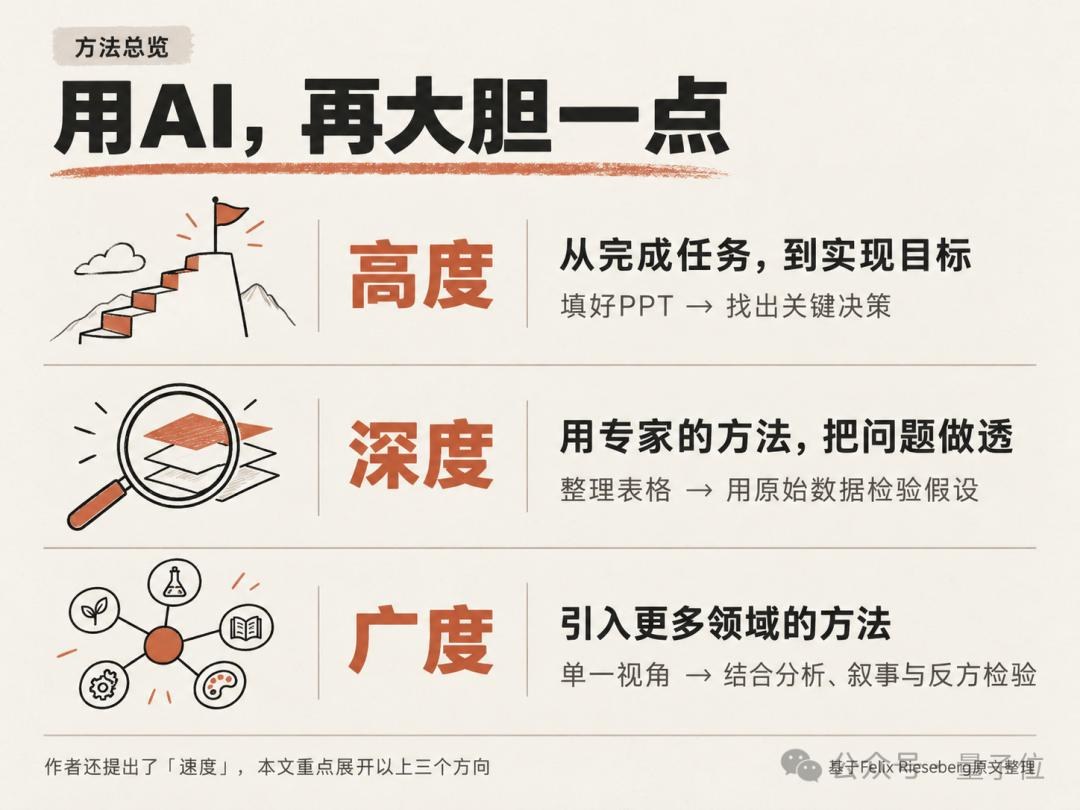
Height: ask for the outcome, not the chore
His own step up was from “fix this crash” to “keep the app crash-free.” That only works after the model can read crash reports, map a build to a Git commit, and reach Windows, macOS, and Linux machines so it can reproduce and verify the fix.
A quarterly review can climb the same way. First, hand over as much data as you can and ask what changed, why, and what to do. Next, ask for the three most urgent decisions with arguments for and against. Then ask it to design something better than a quarterly slide deck at surfacing problems early, prove that on your own history, and run it beside the old process for a quarter. His test: if the work still needs a meeting, raise the goal one level. He also notes that, as of 2026, telling a model “go make money” still does not run a company.
Depth: expert tools, and no self-grading
“Think like an expert” often only changes the vocabulary. He wants the tools those experts actually use—a database and a statistical model, not a Markdown table—plus four moves: set a goal the model will call impossible and insist it is solvable; reproduce your current belief from raw data (for example, “churn is an onboarding problem”); hunt for early signals you do not already know, then test them on data the model has not seen; and accept only an external check the model can run, not its own score. As of October 2026 in his note, he still treats that last rule as mandatory.
A practical first prompt asks the model, before rewriting the task, what top practitioners would do that you did not ask for, which raw materials they start from, which methods and tools they use, and what besides the two of you can prove the result. For a related “give it the environment” pattern, see our note on Claude acting in the physical world.
Breadth: borrow fields, skip the role-play
“Make a deck” becomes “in 30 minutes, convince busy people of a causal story and get a decision under uncertainty,” a noun-to-verb move he credits to Kelley and Littman’s *The Art of Innovation*. Then ask which functions a real team would hire—analyst, editor, motion, a red team—and have the model use those methods rather than play the characters. He says a colleague’s Blender interior render is what pushed him to have Claude build a 3D environment for his own homepage. Again, that requires a machine that can install software and reach data through MCP or another connector.
Why he frames it as self-efficacy
The second half is about the human limit, not the prompt. Locke and Latham’s review of 35 years of goal research found that specific, hard goals beat “do your best.” He cites George Dantzig treating two unsolved statistics problems as homework in 1939, Roger Bannister’s sub-four-minute mile in May 1954 and a second runner 46 days later, and—as the essay states—Sabastian Sawe’s sub-two-hour marathon in London this April, with the runner-up also under two hours. The point is that seeing a hard thing done resets what people attempt. For the company behind Claude, see Jack Clark’s path from reporter to co-founder.
FAQ
Q: What does an “unreasonable” goal mean here? A: If the real hope is 10 seconds down to 5, ask for 0.2 seconds and, when the model refuses, state that the problem is solvable and tell it to try again. The point is a higher search ceiling, not a promise that 0.2 seconds will land.
Q: How do you stop the model from only sounding expert? A: Require raw data and the field’s real tools, and ban self-scoring. Code has to run; a prediction has to be checked on data the model has not seen.
Q: Is this only for Claude? A: He says no. The requirement is a model that can use a computer, install software, and reach the relevant data through MCP or another interface.
相关文章