



Component makers that once stayed behind the scenes in embodied AI are stepping onto the stage.
For a long time, component suppliers remained almost invisible in the embodied AI race. Financing and media attention mostly focused on robot makers and model companies. People cared about who built faster humanoid robots, or whose embodied foundation models could handle more complex tasks, but rarely asked a more basic question: who actually provides the joints, eyes, hands, and the communication and control systems that connect them?
In an Apple-style industrial system, supply-chain companies often shoulder the heaviest work in manufacturing, R&D, and delivery, yet do not necessarily share brand-side profits. Embodied AI faces a similar issue. Robot makers set the specs; component firms deliver them. When system architectures change, suppliers re-adapt. When products finally gain attention, brand value and valuations largely stay with the robot makers.
Now these behind-the-scenes companies are beginning to appear as a collective force.
On September 2, the China Embodied AI Tier 1 Industry Alliance was formally established. It was jointly initiated by Xingyuan Zhi and Lingxin Qiaoshou, together with more than 20 core industry players including Orbbec, FAIRINO, Folai New Materials, Hesai Technology, Huaweike, Livox, Langyi Robotics, Linghou Robotics, Rokae, Myer Microvision, Neodymium Creation, Quanzhibo, Senyun Intelligent, RoboSense, Tashan, Yuanwen Zhike, iFLYTEK Robot Super Brain Platform, Xinjingcheng, Quectel, Zhixing Embodied, and Zongguanxian.
Alliance members cover embodied brains, dexterous hands, voice interaction, LiDAR, visual and tactile perception, robotic arms, chassis, wireless communications, thermal management, and more. Combined, their products are already enough to assemble a fairly complete robot.
But they are not gathering to build another robot brand. The alliance’s three priorities are cross-hardware adaptation, cross-embodiment deployment, and scenario validation. Through joint adaptation, collaborative tuning, and shared test results, it aims to lower integration costs among components and push the industry from competitive cooperation toward symbiotic collaboration.
In other words, these firms no longer want to quote only against drawings. They want earlier involvement in product definition, turning individual parts into reusable, scenario-validated capability modules—and ultimately gaining greater participation and bargaining power in the embodied AI wave.
What component makers may gain is not just order growth from robot volume. Productization, industrial specialization, and globalization in embodied AI are happening at the same time—and they are also competing for standards, influence, and profits.
Components are no longer fragmented
In the early stage of embodied AI, deep vertical integration by robot makers was almost inevitable.
There was no unified product architecture and no mature supply chain. Robots differed widely in size, payload, degrees of freedom, communication protocols, and control frequency, making off-the-shelf parts hard to find. To ship prototypes and demos quickly, robot makers had to keep as many links as possible in-house.
That approach helped early products appear quickly, but it also locked the supply chain into heavy customization. The same sensor needed recalibration on different robots; the same dexterous hand might require interface changes when paired with another arm; a joint module adapted to one generation could need rework after only modest changes in robot specs.
Component makers appeared to have many customers, but what they actually faced was a set of isolated projects. Large amounts of R&D were burned on repeated adaptation. Engineering know-how struggled to settle into standard products, and economies of scale were slow to form. They took on a lot of hidden R&D for robot makers, yet were still paid by part counts and bill-of-materials prices.
That is also why supply-chain firms easily fall into low-margin traps. Bargaining power does not necessarily depend on whether a company sits at the part, robot, or solution layer. It depends more on how replaceable its product is, and whether it can help define the system. In Apple’s supply chain, pure processing and commodity part suppliers earn limited profits; by contrast, leading memory vendors today can raise prices. The difference comes from irreplaceability.
The formation of the Embodied AI Tier 1 Alliance may be a signal that these companies want to band together and push the industry toward maturity.
Cross-hardware adaptation means parts from different vendors can be combined at lower cost. Cross-embodiment deployment means a capability is no longer locked to one robot maker. Scenario validation lets component firms prove what real problems they solve, not only what specs they offer.
When adaptation methods, test results, and scenario experience can be reused, suppliers are no longer selling just a sensor, an arm, or a hand. They are selling a mature capability that can enter a full robot system. Robot makers no longer need to reinvent every layer and can put more resources into products, models, and scenarios.
That means industrial specialization in embodied AI is shifting from “robot makers set requirements, component makers deliver” toward joint product definition between robot makers and Tier 1 suppliers.
What component makers really want to escape is not being behind the scenes—many global industrial giants also stay out of consumer view. Behind the “Tier 1 alliance” identity is a larger commercial ambition: leaving a role that only reacts to parameters and competes on cost.
Another announcement fits the other side of this awakening. On September 10, RoboSense disclosed an asset deal in which its indirect wholly owned subsidiary Shenzhen Suteng planned to sell interests related to embodied robot complete-machine R&D, manufacturing, and sales to Xiyuan Robot for RMB 59.878 million. As a major supplier of robot LiDAR, RoboSense chose not to keep extending vertically from components into complete robots. Instead, it spun off the robot business and refocused on more reusable perception capabilities.
The divestiture looks more like a reaffirmation of capability boundaries. Early on, borders among complete robots, components, and solutions were blurry, and doing everything helped seize a window. Once commercialization begins in earnest, capital-heavy robot businesses can dilute R&D and management resources and may even put suppliers in competition with downstream customers.
The alliance is horizontal consolidation; the divestiture is vertical contraction. They look opposite, but both show component makers abandoning the urge to do everything and concentrating on reusable strengths that can scale. Knowing how to focus, like daring to ally, is a sign of industry maturity.
Spring arrives a step earlier
In the past, talk of component opportunities often rested on a simple premise: once humanoid robots ship in the millions, each needing dozens of joints, multiple sensors, and a pair of dexterous hands, the supply chain would naturally explode.
But component opportunities may not need to wait for that moment.
Today’s robots are still exploring quadruped, biped, wheeled, humanoid, and arm-based forms. The end-state morphology is unsettled. After years of debate, OpenAI CEO Sam Altman still says: “We will certainly build humanoid robots, and we will also develop other forms of robots.” Fortunately, underlying needs already share common ground: sensing the environment (vision), controlling motion (joints), manipulating objects (dexterous hands), and handling communication, power, and thermal issues.
A robot maker usually bets on a limited set of product forms. A reusable component company can enter a dozen or even dozens of robot makers at once—serving humanoids, collaborative robots, logistics AMRs, cleaning robots, and other intelligent devices.
The more diverse robot bodies become, the earlier reusable cross-form capabilities can reach scale.
Some changes already show up in financial and shipment data. Hesai reported robot LiDAR shipments of 142,371 units in Q2 2026, up 193.4% year over year. RoboSense delivered about 303,000 units in its robot business in 2025 and achieved its first quarterly profit, largely driven by robot demand.
These numbers do not mean humanoid robots have already scaled. The clearer signal is that some foundational capabilities are crossing single robot categories and forming markets first. Component makers do not need to correctly pick which robot form wins; if their products enter enough robots, they can share growth across the physical AI market.
That is the value of the alliance’s push for cross-embodiment deployment. When component firms face dozens of architectures alone, growth brings more custom work. Once interfaces, testing, and adaptation experience can be reused, growth can turn into scale.
Behind this sits a clear chain: lower adaptation costs let products enter more platforms; more customers expand shipments; scale then drives costs down and products to maturity; and when more robot makers actively adopt an interface, suppliers gain stronger product-definition power.
So the spring for component makers is not simply waiting for Elon Musk’s vision of “one for every person” at tens of billions of units. More important is that the same capability can be sold into more robots. In short, component makers need to form standards and gain definition power.
Mass production is also accelerating. With Tesla Optimus ramping—“1,000 units per week in September”—and supply-chain reports of about 5,000 new Tesla orders to suppliers, whether as confidence in the technical path or as real financial and market returns, spring for T-chain component makers is arriving ahead of the grand technical narrative. Just days ago, XPeng’s robot production line officially started, reinforcing the same signal. For component makers, these together form rare certainty while the technology itself is still far from converging.
Still, this spring will not fall evenly on every company.
If products remain highly customized, each new customer adds R&D and service cost in lockstep, and scale can become exhaustion. Firms that rely only on capacity expansion and low prices may enter a harsh price war before humanoids truly scale—and supply-chain price cuts are already visible. Meanwhile, robot makers still strongly prefer in-house development for joints, controllers, and dexterous hands, further blurring boundaries.
Those that capture real industry upside will be companies whose products can be reused across embodiments, upgraded from parts into modules, and backed by interface, testing, certification, and scenario know-how.
That is the real difference between a strong Tier 1 and an ordinary supplier. Ordinary suppliers manufacture to customer specs. Tier 1 suppliers can tell robot makers how combinations deliver better system performance. The former mainly shares manufacturing margin; the latter begins to share technology and system value.
Another “Chinese face”
Another opportunity for component makers comes from changing global circulation in the industry.
New energy vehicles have given Chinese manufacturing a mature overseas path: complete R&D and production at home, then enter foreign markets with own brands and full products. But a complete vehicle concentrates brand, software, hardware, data, and supply chain. Its origin is highly visible and easily becomes a policy focal point.
Embodied AI faces a similar overseas reality—and may therefore take a different route from autos: China may not need to ship complete humanoid robots worldwide. Sensors, joints, dexterous hands, and engineering capability can enter robot bodies of different countries and brands.
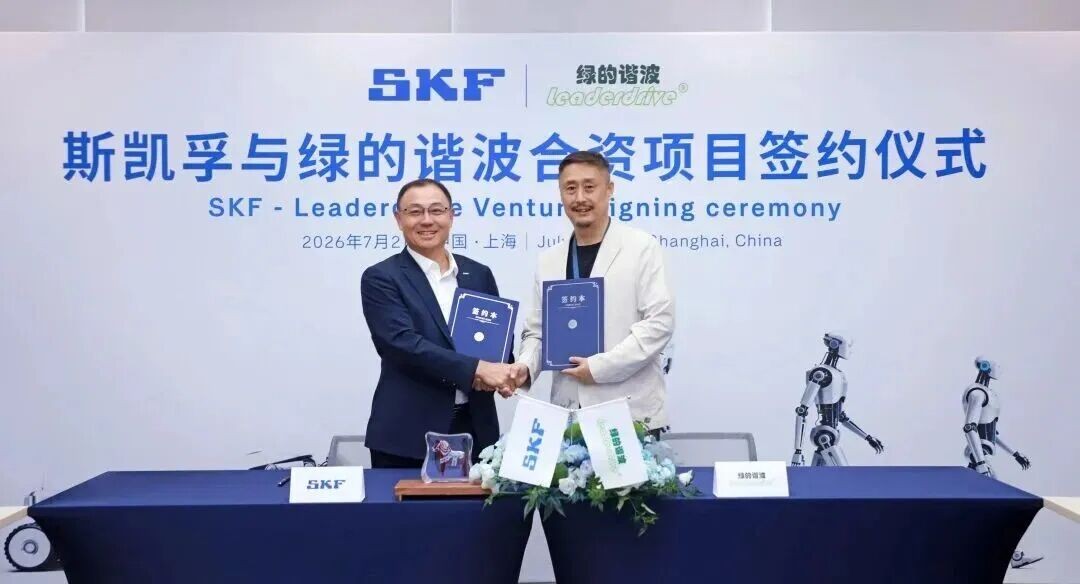
Leaderdrive’s recent moves already show this shift. In July, Leaderdrive signed an agreement with Swedish industrial giant SKF to set up a joint venture in China focused on high-precision transmission components for robot joints. Leaderdrive contributes application know-how in automation and humanoid robots; SKF contributes bearing technology, scaled manufacturing, and global supply-chain capability. The JV plans to use SKF’s sales network to expand in Europe, Japan, and the United States.
Still, “componentization” is no simple shortcut for going overseas. What component makers must do, through multiple paths, is transform from “Chinese suppliers” into “global Tier 1” players.
NEV overseas expansion contests consumer brands. Embodied AI component expansion contests industrial interfaces, technical standards, and positions in global supply chains. The latter goes deeper—and is harder to replace.
That may be another way spring arrives for component makers.
But spring will not belong to every parts manufacturer. Relying only on cost, capacity, and custom processing still leads to price pressure and substitution. Companies with a real shot at industrial position are those completing three upgrades: from parts to modules, from modules to system capabilities, and from domestic suppliers to global Tier 1 players.
In the future, as Chinese embodied AI goes global, it may not always look like a robot with Chinese characters on its chest. It may also be a sensor, a joint module, or a dexterous hand entering robot bodies of different countries and brands.
By then, Chinese companies may not build every robot’s complete body—but they may decide how those robots see, move, and get work done.
相关文章