



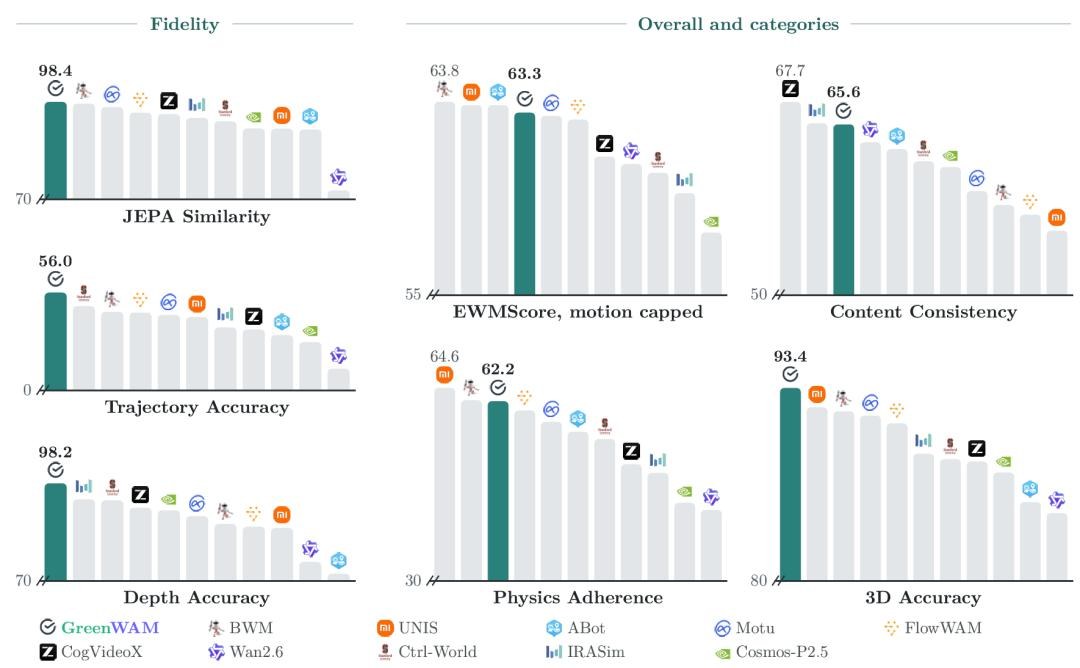
The Brain team at Sber’s robotics center introduces GreenWAM, a world foundation model that uses one set of weights both to forecast what an action will do and to choose the next action. On WorldArena 1.0 it leads the world–action and video models they compare on trajectory, depth, and 3D accuracy (56.0, 98.2, and 93.4). On a real humanoid bagging task, in-distribution and out-of-distribution success are 95.6% and 84.0%, above a Cosmos 3 Edge policy and π0.5. The preprint is GreenWAM: A World Foundation Model for Robotics (arXiv 2610.18774).
One action space for 20 bodies
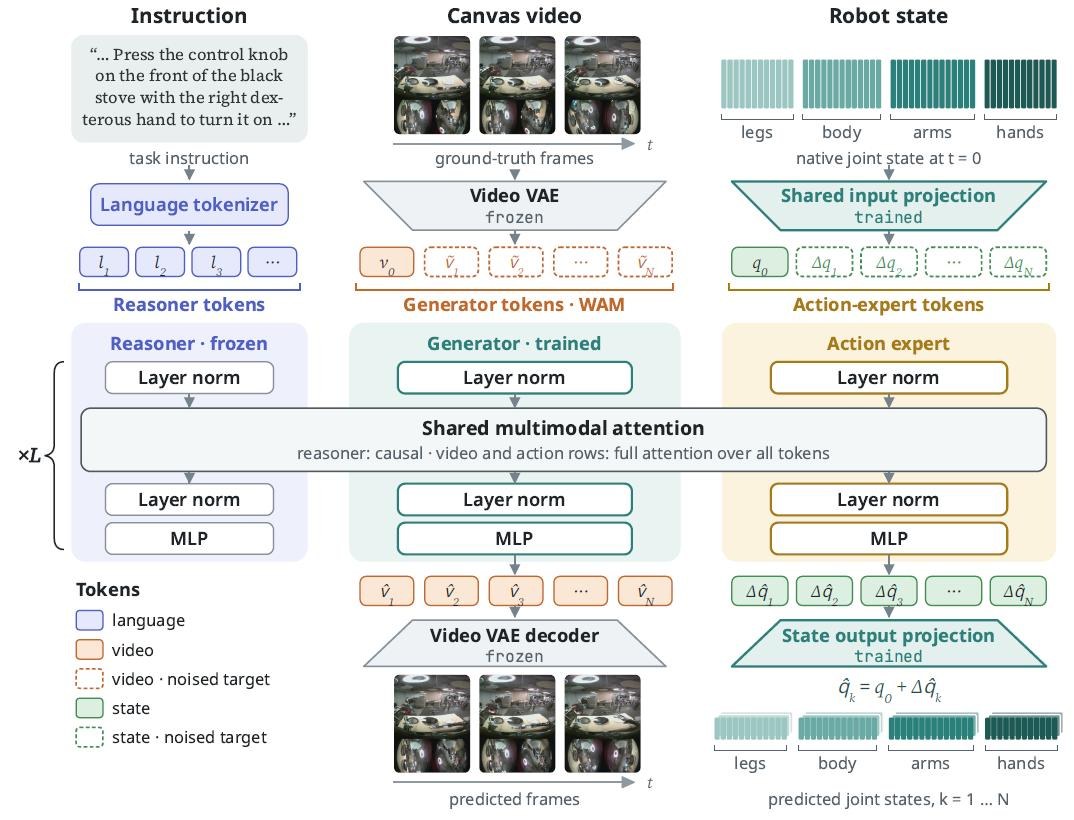
Dual-arm, single-arm, and humanoid datasets do not share a native action vector. GreenWAM pools public data with in-house LeRobot-format logs across 20 embodiments, then maps them onto 79 shared anatomical slots: 12 for legs, 23 for the body (7 base pose, 6 base twist, 7 torso, 3 head), 18 for arms, and 26 for hands (one open–close coordinate per parallel gripper, per-finger coordinates for dexterous hands, plus spare slots).
Preparation is staged so later steps do not rewrite earlier decisions: register camera roles and state layout, then cut atomic subtasks. The corpus starts at 1.44 million complete subtasks and 1,688.5 hours, keeps 1.43 million and 1,674.7 hours after quality filtering, and gets usable instructions for 1.19 million. Head and left/right wrist views are composited onto one canvas, with the head image dominant. For what a world model is predicting in the first place, see what world models actually are.
Seven questions, one generator, then an action expert
GreenWAM starts from the public Cosmos 3 Edge 4B checkpoint, with a mixture-of-transformers, a causal video VAE, and rectified-flow training. The same generator weights cover seven modes: future video, observation given a trajectory, the trajectory that produced a video, and the next action. About three quarters of samples predict video, with or without a trajectory; a quarter runs inverse dynamics and world–action modes. History-conditioned forward dynamics is used twice as often as history-conditioned image-to-video. Three-camera clips are composited offline; at inference the model’s own video becomes history, and history resets at dropped gaps and episode boundaries.
For control, action tokens leave the shared generator. The action expert is initialized as an exact copy of the generator tower, so the split does not change the first prediction; it is then trained for control while keeping the visual and action knowledge. The team’s finding is that splitting the expert at the start of adaptation, and keeping the world model’s modes during that stage, makes the policy more robust. That is a different bet from training a world model and then discarding it; we looked at the “train, then step aside” pattern in a world model that leaves after training.
Benchmarks, then a real bagging task
WorldArena 1.0 track 1 scores 15 metrics. Among all 127 entries, GreenWAM’s JEPA similarity is 98.41, second only to BLM at 98.49. On 1,000 test clips the composite score is 63.31, just above published Motubrain (63.16) and FlowWAM-FiveAges (62.99).
As a policy, RoboTwin 2.0 (50 tasks, 100 trials per setting) shows 86.98% success in the regular setting and 48.10% when randomized, averaging 67.54%. On CALVIN it completes 4.64 instructions per chain (standard error about 0.03), above FLOWER’s 4.53. On RoboDojo the composite is 16.12 and success is 10.49%, both above π0.5, X-VLA, and X-WAM. On LIBERO a single policy is close to specialists trained for that benchmark, and it posts the highest zero-shot LIBERO-plus success among the results they list.
The real task is a Green humanoid placing a bottle and a cap in a bag, then lifting the bag with both hands, split into five instructions. GreenWAM, a distilled student, and the Cosmos 3 Edge policy each predict 16 actions per call; π0.5 predicts 50. GreenWAM’s in- and out-of-distribution success is 95.6% and 84.0%, versus 88.9% and 80.0% for Cosmos 3 Edge and 84.4% and 76.0% for π0.5. The student model lands at 91.1% and 80.0%, so one-step inference cuts compute while keeping most of the control.
The authors also mark the limits: changed task geometry, compounding error over long horizons, and embodiments absent from training still hurt. A shared action interface, real-robot deployment, and more reliable long-horizon prediction are the next steps they name.
FAQ
Q: How is GreenWAM different from a video world model? A: It does not only roll out future frames. The same weights also emit robot state through inverse dynamics and world–action modes, and an action expert is split off later for control.
Q: How do 20 robot types share one model? A: Actions are mapped onto 79 anatomical slots for legs, body, arms, and hands, and head plus wrist cameras are composited onto one canvas, instead of keeping each robot’s native action vector.
Q: Does the real-robot result beat π0.5 across the board? A: On this bagging task, GreenWAM’s 95.6% / 84.0% in- and out-of-distribution success is higher than π0.5’s 84.4% / 76.0%. The paper still flags unseen bodies and long-horizon error, so the gap should not be read as a win on every manipulation task.
相关文章