


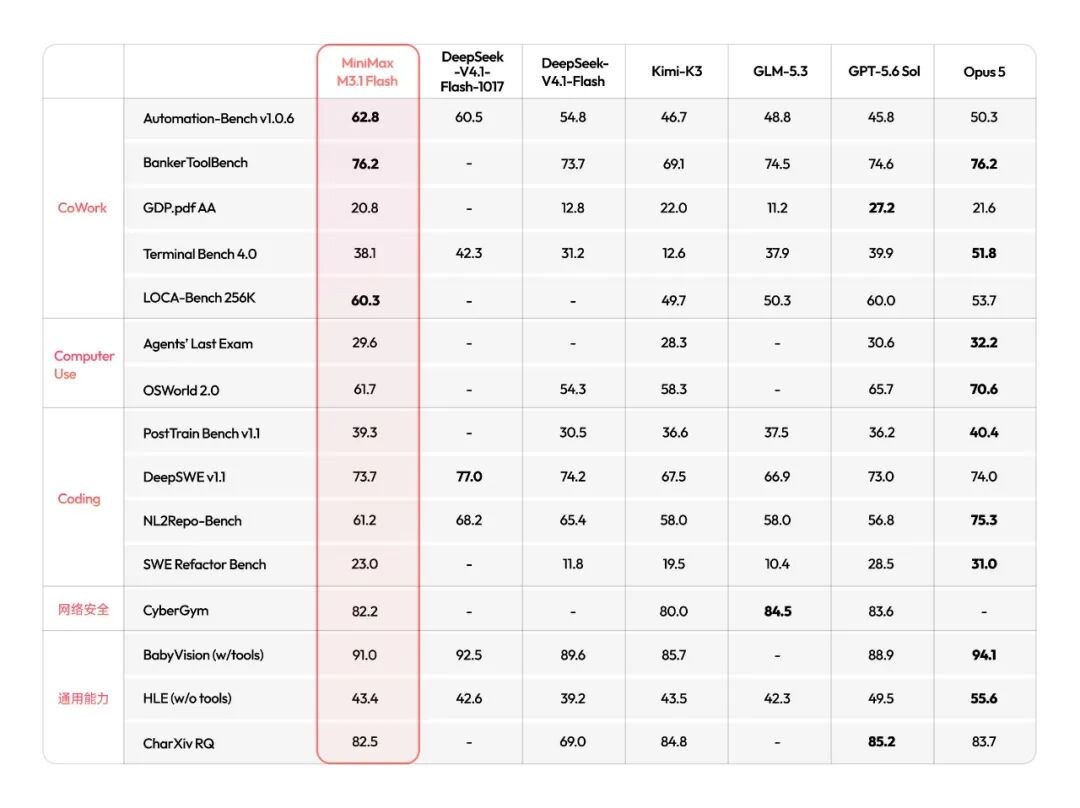
MiniMax has released M3.1 Flash days after DeepSeek V4.1 Flash-1017. On the vendor’s 15-way scorecard it takes three firsts in CoWork-style tasks. DeepSWE v1.1 max lands at 73.7, just above GPT-5.6 Sol’s 73.0, at under ¥2 per task. On Automation-Bench it leads with 62.8, about 12 points over Claude Opus 5 and ahead of DeepSeek V4.1 Flash-1017 at 60.5. API pricing is ¥1 / ¥4 per million input / output tokens, with cache reads at ¥0.1; the company says blended Agent cost is about 70% below prior M3.
Coding hugs the flagship; workflows pull ahead
DeepSWE covers understand–build–fix–test. At roughly 73% scores, the report puts Claude Opus 5 near ¥70+ per task—more than 40× M3.1 Flash—while DeepSeek’s new Flash sits higher in the same price band. On coding value for money, the piece ranks DeepSeek first and M3.1 Flash second.
The clearer gap is cross-SaaS work. On Zapier’s open Automation-Bench (600 real enterprise jobs), medium settings score past Opus 5.5 at max for about ¥0.25 per task versus roughly ¥6; max is about ¥0.3, or ~¥300 for 1,000 jobs. LOCA-Bench 256K leads at 60.3; BankerToolBench ties Opus 5 at 76.2; CyberGym’s 82.2 sits in the top tier next to GLM-5.3 (84.5) and GPT-5.6 Sol (83.6). These are vendor-published compare tables—re-run on your own traffic before locking a stack.
Computer use: ALE estimated at about ¥739 for the full set
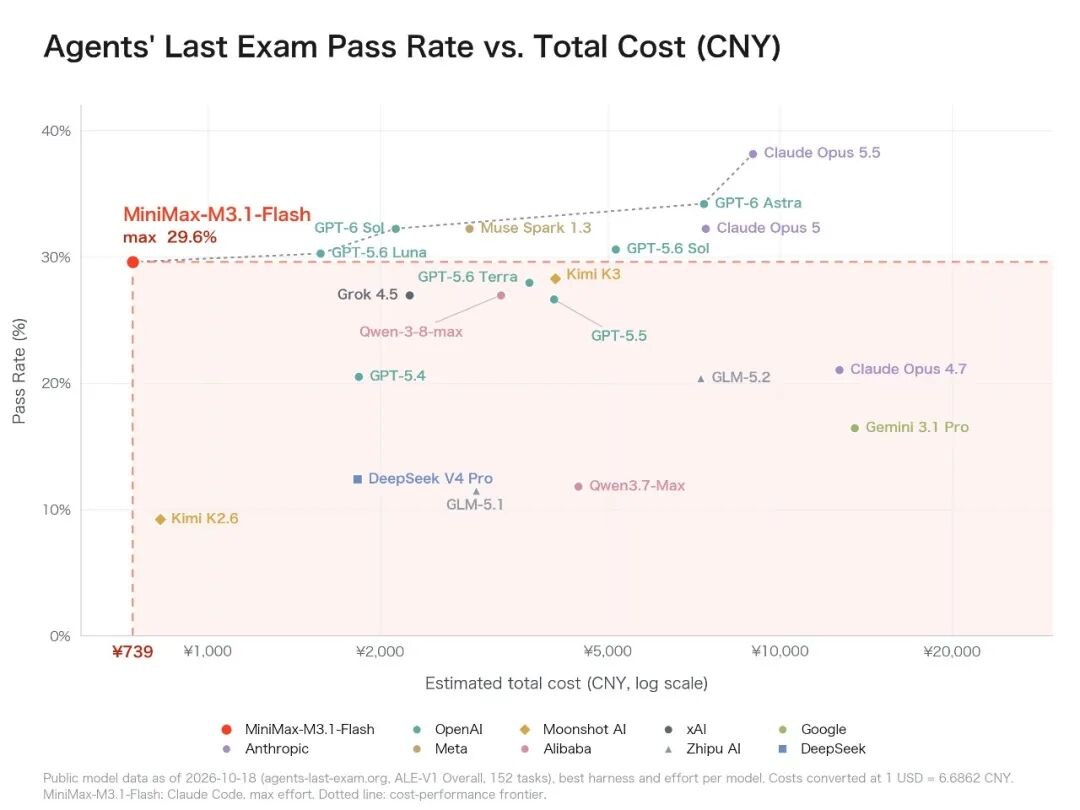
On OSWorld 2.0 (HKU XLANG Lab, 108 long workflows) M3.1 Flash scores 61.7 versus 54.3 for DeepSeek V4.1 Flash. Agents’ Last Exam (Berkeley RDI; 13 industries, 55 niches, 152 tasks) posts 29.6% pass rate, near GPT-5.6 Sol’s 30.6% and Opus 5’s 32.2%, with an estimated full-run cost of about ¥739—the lowest among 20+ models shown. Higher-pass models start near ¥1,600 (GPT-5.6 Luna); Sol is about ¥5,000, Opus 5 / GPT-6 Astra about ¥7,000, Opus 5.5 near ¥9,000; Opus 4.7 and Gemini 3.1 Pro clear ¥10,000 with 21% and 16.5% pass rates.
Price, speed, and the Space Bunny reveal
Unlike DeepSeek’s peak/off-peak tiers, M3.1 Flash is flat all day. Weekday daytime traffic that hits DeepSeek’s peak (¥2 in / ¥8 out) effectively pays MiniMax’s off-peak rate. At 90% cache hit on 1B input tokens, the report estimates ¥190 versus DeepSeek peak ¥236; at 95% it is about ¥145 vs ¥138.
Daily output can exceed 200 TPS with a median above 170 (prior M3 docs cited 100+). MiniMax claimed the anonymous “Space Bunny” that processed over 200T tokens; the formal build uses a more aggressive sparse-attention stack and nearly 3× online inference speed. See our earlier note on the Space Bunny mystery model. Native context is 1M tokens across text, image, and video; thinking is on by default with low–max effort levels. It is live on MiniMax API, M Plan, and MiniMax Code, and the CLI default text model is now M3.1-Flash. For the broader domestic Flash rush, see MiniMax and DeepSeek shipping in the same window.
How to read the “twin star” framing
In this round, DeepSeek looks stronger on DeepSWE-style software engineering; MiniMax looks stronger on enterprise workflows, finance tools, and some computer-use tasks. Where Flash already sits next to flagship scores, the old premium has to be justified by failure rate and retries. MiniMax says a ceiling-focused Pro build is coming next.
FAQ
Q: Does M3.1 Flash clearly beat GPT-5.6 Sol on coding? A: On DeepSWE v1.1 max it is 73.7 vs 73.0—a slim edge with a large cost gap. Other benches diverge; do not treat it as a sweep.
Q: What does Automation-Bench first place mean? A: It measures finishing real SaaS workflows end to end. 62.8 beats Opus 5 and the new DeepSeek Flash, at about ¥0.25 per medium task—useful when you need volume, not a single prestige score.
Q: How should teams choose versus DeepSeek V4.1 Flash? A: On this compare, DeepSeek leads coding value; MiniMax leads Automation-Bench and some finance/computer-use scores, with a flat all-day price. Split traffic and measure on your own jobs.
相关文章