



World models are seriously hot right now.
A few headlines first:
Early this year, Turing Award winner Yann LeCun and Saining Xie co-founded AMI Labs and raised $1.03 billion in a seed round (valuation $3.5 billion)—Europe's largest seed ever. Their main research focus: world models.
Last month, AMD announced it would acquire Fei-Fei Li's World Labs for a headline $8.2 billion, naming Li AMD EVP and Chief Scientist reporting directly to Lisa Su. Her track: also world models.
Days ago, former ByteDance intern Tian Keyu—dismissed for serious violations—started an AI company with no name and no product yet, already raising nearly $30 million (valuation $200 million). His pitch: still world models.
Those deals are only the tip of the iceberg. Across AI, almost every top tech company—Nvidia, Google, OpenAI, Tesla, Amazon, and more—is racing to embrace world models.
If you don't get world models, it's getting embarrassing to say you work in AI.

So what is a world model? How does it differ at the core from the large language models (LLMs) we know? Why are so many top scientists, giant pools of capital, and leading companies betting on it?
In this piece, Xiaozao walks through it in depth.
What Is a World Model, Really?
The first time I saw “World Model,” I thought of digital twins—were the big names planning to clone the physical world with twin tech? If so, that would be a massive project.

I later realized a world model isn't about creating a complete digital copy of the world. More precisely, it should be called a “model of the physical world.”
The core goal isn't to replicate everything, but to let AI build a runnable physical-world simulator in its “brain”—internalizing real-world laws as a base capability.
World models exist so AI can truly grasp how the physical world runs—how objects move, collide, and occlude; how light propagates; and so on.
To understand world models, start with the limits of traditional large models.
Today's traditional large models are essentially LLMs (Large Language Models).
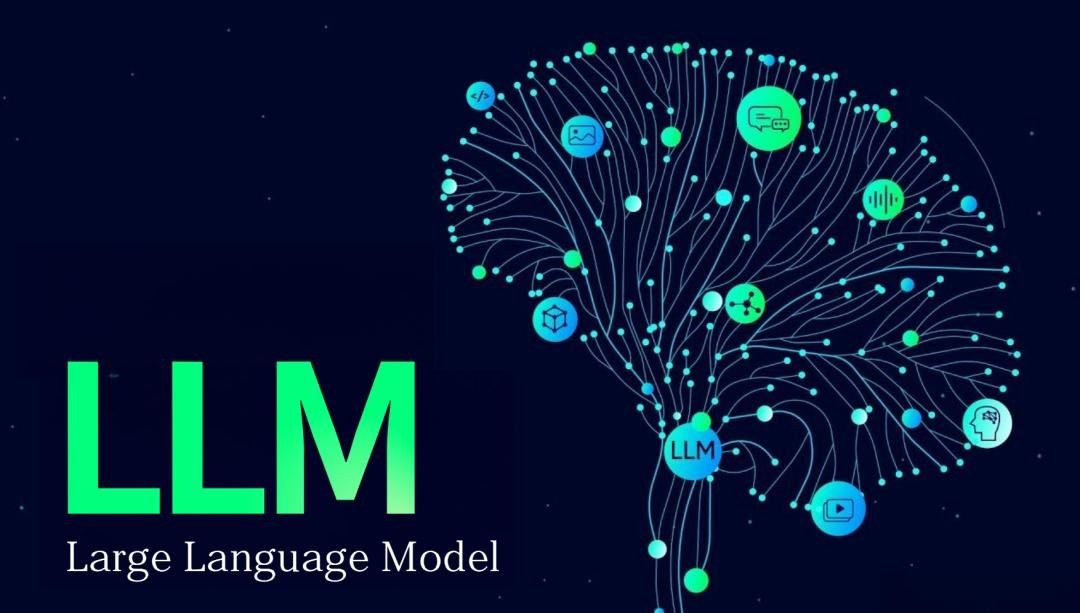
LLMs learn mainly from human-accumulated data—books, articles, web pages, code, conversations. By absorbing oceans of text, images, and video, they master statistical patterns and logical relations inside language, then predict the next most plausible word, phrase, or frame from context.
Video generation models can look realistic, but at heart they “stitch” and “associate” visual fragments from training data, relying on statistical patterns to produce matching clips.
In short: traditional large models know knowledge, not the world.
A simple example.
You ask AI: what happens if a glass cup falls from a one-meter table?
AI can answer perfectly: it falls, hits the floor, shatters, water spills if any.

But here's the point: AI recited the answer—it didn't derive it from understanding the laws.
It doesn't know what gravity is, what hard or soft means, or glass's brittle physics. It only memorized the fixed conclusion “dropped cups break” from billions of training examples.
When the scene drifts even slightly from training data, AI instantly “hallucinates” and makes silly mistakes—in that video, the cup already “breaks continuity” (flips oddly).
The industry broadly agrees traditional large models have three hard flaws:
● No real perception: they only read data; they don't understand the real world.
● No causal logic: they associate and match; they don't reason cause and effect.
● No foresight: they only answer passively; they can't predict how things unfold.
Put bluntly, today's AI is a book-smart student who has read a million volumes—but doesn't know how the world works.
AI that lives only in a computer will never be true AI. Real AI must solve real-world problems and finish real-scene tasks.
So experts proposed world models.
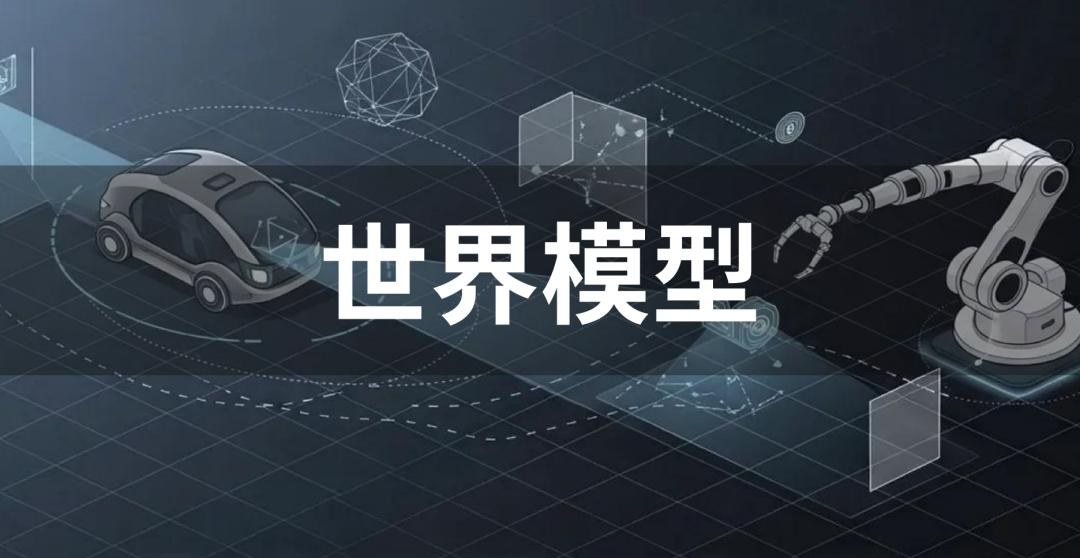
A world model is a foundational technical framework. As above, it lets AI learn the spatial structure and change laws of the real world, then generate, reconstruct, and simulate a 3D world you can keep exploring and interact with in real time.
If traditional large models are “well-read,” world models are "lived experience."
They don't just rote-memorize text and images; with more advanced methods they summarize the underlying operating laws of the physical world and real society—
physics, spatial logic, temporal order, causality, human behavior habits, social common sense, and more.
An AI with a world model carries a “virtual sandbox” in its head.
When it gets a question or a scene instruction, it doesn't only query a database—it simulates, projects, and predicts in real time inside its virtual world, then chooses decisions that match reality.
Back to the cup.
A world-model AI watching a cup fall doesn't recite a fact sheet—it simulates the full chain in its mind:
gravity pull → speed builds → hard floor hits glass → stress fracture → water scatters → wet stain on the floor
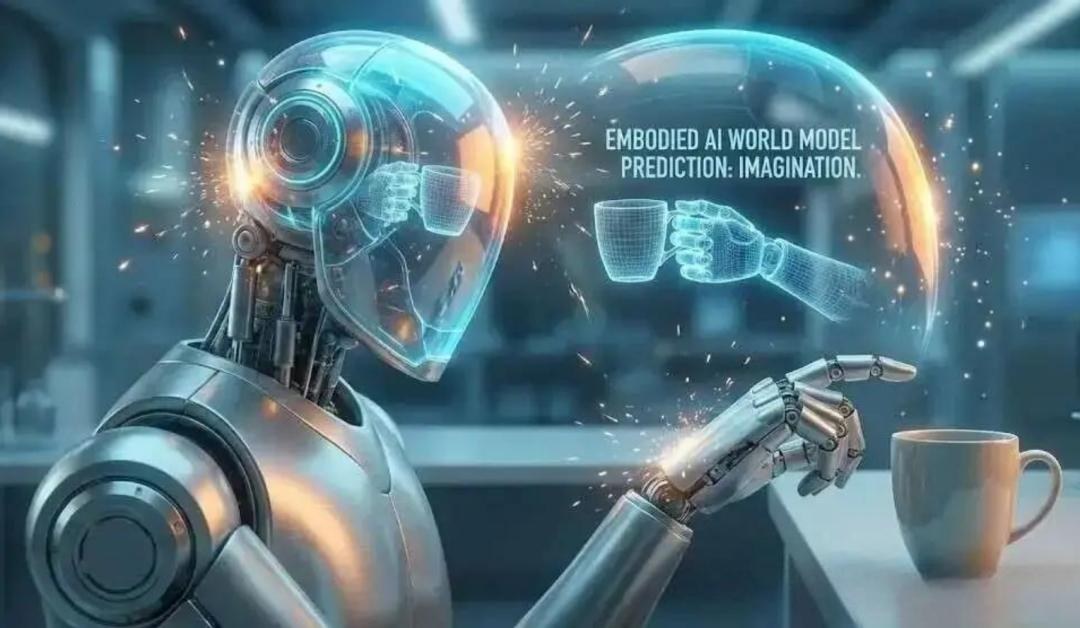
Even if you change the conditions—plastic cup, carpeted floor, ten-centimeter drop—it doesn't need to relearn; it can derive the right outcome from base laws, without AI hallucination.
That's the essential difference: traditional large models learn the surface; world models cultivate the cause.
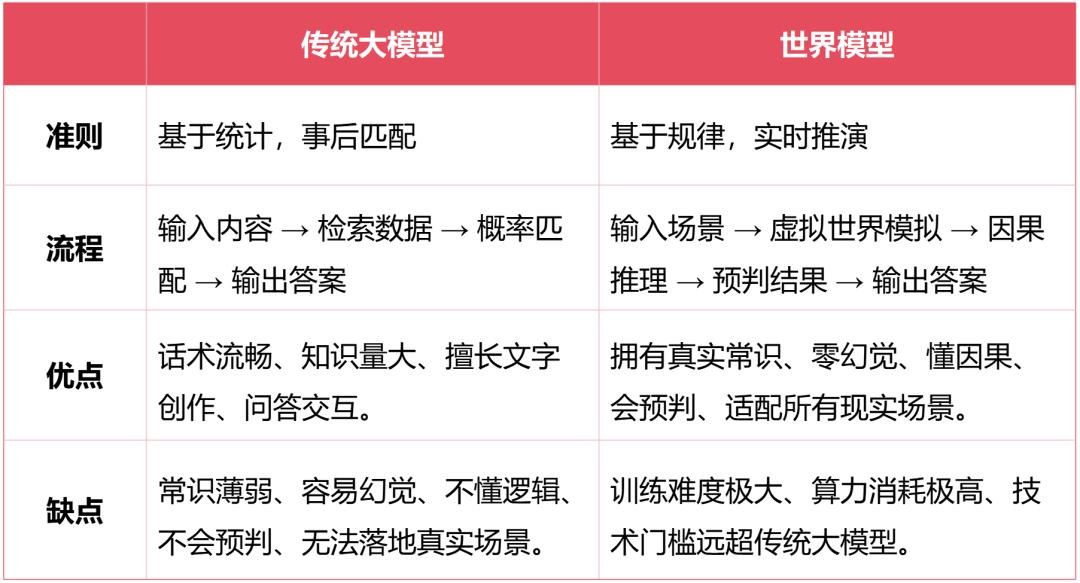
In short: large models know that it is so; world models know why it is so.
What Are World Models Actually Good For?
Many people treat world models as a mere “upgrade” of traditional large models. They aren't. They flip the dimensions of AI capability.
Their core strengths cluster in three places—each hitting a current AI pain point.
First: strong common-sense reasoning
Today's AI often makes basic common-sense errors: people walking backward, cars driving sideways, scenes that violate physics.
World models that have internalized real-world base rules come with a common-sense shield.
Whether drawing, generating video, or projecting scenes, they stick to physical rules, spatial logic, and real-world sense—without absurd mistakes.
Second: powerful future prediction
This is the world model's core killer feature.
Traditional AI only summarizes and answers from known information. A world model can project how the future will change from the present scene.
See weather, traffic, and pedestrian motion, and predict the next seconds or minutes; see equipment state and anticipate failure risk; see one side throw a punch and know the other will dodge.
That foresight is the key step from “passive answering” to “active intelligence.”
Third: cross-scene general adaptation
Most AI today is single-scene: chatbots only chat, image models only draw, autonomous driving only drives.
A world model is a foundation for general AI.
Because it holds world-general laws, text, images, video, robot control, autonomous driving, smart home—all real scenes can transfer without separate fine-tuning for each.
Once you see these capability gaps, it's clear why industry leaders say: world models are AI's next decade.
The traditional large-model dividend is largely hitting a ceiling. Gaps in chat, writing, and Q&A keep shrinking; racing parameters, data, and prompts rarely creates disruptive difference anymore.
AI's future is AGI (artificial general intelligence). AGI absolutely depends on Physical AI—agents that deeply interact with the real world.
About 50% of global GDP still sits in the physical world; most of that future will be shaped by physical AGI. The critical tech breakthrough for that boom is the world model.
Some argue the future AGI stack will likely be: LLM for logical planning (brain) + world model for physical prediction (cerebellum) + embodied intelligence for action (body).
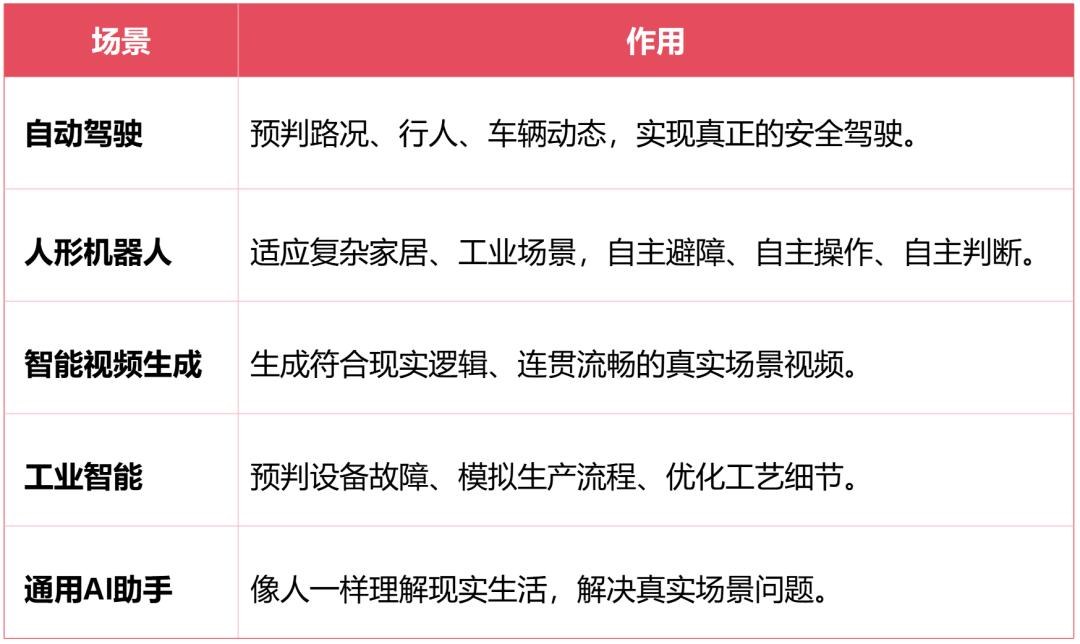
Role of world models
World models are so hot now for two root reasons:
1. Tech conditions are ripe. Years of large-model progress in compute, data, and algorithms have laid the foundation for a world-model surge.
2. Industry need is urgent. Physical-world intelligence is moving from single pilots to broad rollout. Factories need cost and efficiency gains, robots need to enter homes, autonomous driving needs more cities—all require world models as base support.
World models already have scaled validation in embodied intelligence and intelligent driving, easing data scarcity and high trial-and-error cost in high-safety, high-complexity settings.
In intelligent driving, for example, world models build high-fidelity virtual traffic environments and rehearse massive extreme cases—including rare long-tail scenes—to support safer iteration of vehicle decision systems.
In embodied intelligence, the scarcest resource is real manipulation training data. With 3D space construction and physics projection, world models let robots trial actions and plan paths in a “dream,” cutting training cycles and cost.
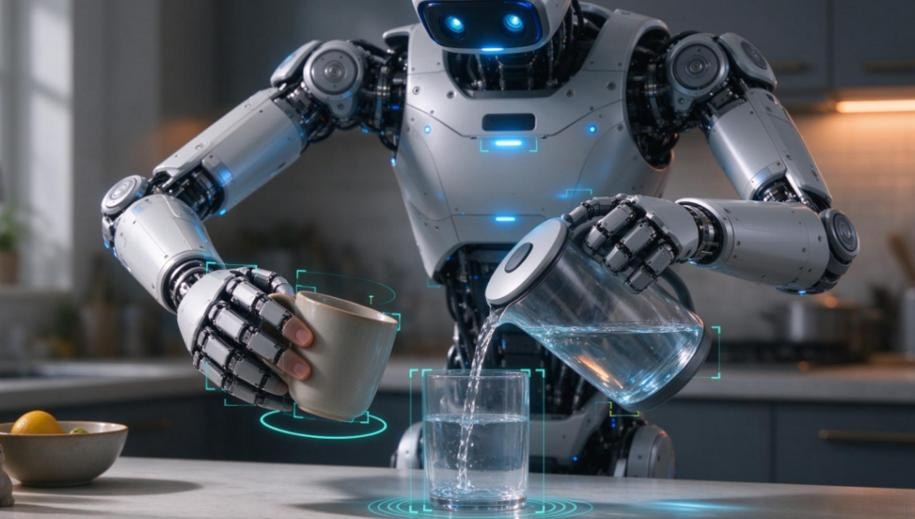
Beyond that, world models are spreading into content creation, climate forecasting, medical simulation, and more—winning users and markets with physical cognition, causal reasoning, and long-horizon simulation.
Challenges Facing World Models
One fair note: the outlook is explosive, but world models are far from mature and still have clear gaps.
First, training cost is extremely high.
Traditional large models train on text at controllable cost. World models need oceans of video, 3D scenes, and dynamic-process data—compute, data cost, and training difficulty are several to tens of times higher.
Second, complex-scene projection is still weak.
Today's world models are precise on simple physics, but still struggle with complex social behavior, multi-person interaction, and long causal chains.
Third, deployment scenes are still being explored.
Most world models remain in R&D and testing; large-scale commercial rollout needs more time.
Closing
Clearly, world models aren't just another hype rotation—they're a generational shift in technical paradigm.
A Morgan Stanley note argues the next AI transformation is from “understanding language” to “understanding the physical world,” with world models as the core vehicle. By 2035, industries empowered by world models could reach a $10 trillion scale.
The next decade of AI competition won't be endless parameter races among large models, but a contest of world-model cognition, projection, and deployment. Whoever masters top world-model tech first holds a key to the AGI era.
An arms race over “understanding the world” has already quietly begun.
相关文章