



In January 2023, after 11 years of service and four combat deployments, Jeremy Crider left active duty in the U.S. Air Force on disability. That August he enrolled at the University of Arizona in Tucson with a long-term plan. Having managed sports facilities in the Air Force, he intended to earn a bachelor's in business administration, then a doctorate in sports management, and work in the field.
Three years later, Crider's ultimate career goal is unchanged—but his major path has shifted.
He expects to graduate next May with a B.A. in Applied Humanities (business administration focus) and a B.S. in Creative Intelligence and Innovation. The latter is an Honors College program where students partner with community organizations on concrete problems. Now 36, Crider says: “Choosing the humanities made sense for me because in the AI era, understanding the human dimensions of business is far more valuable than knowing only the numbers. I'm 100% sure this will be my competitive edge.”
His honors thesis builds a framework to help sports teams decide beyond cost and profit—factoring in cultural identity of the team and its community, which shapes brand value and fan bases over the longer term.
Crider's personal pivot may foreshadow a thaw after more than a decade of steep decline in the humanities. A few campuses already show enrollment gains, and national reports suggest majors like English and history have hit bottom.
Unsurprisingly, both the humanities' fall and their possible revival root in worries about careers and economic security. STEM (science, technology, engineering, math) once looked like a golden ticket. Now, as AI reduces demand for junior staff in those fields, entry-level openings in some engineering majors—including computer engineering—have shrunk sharply.
Meanwhile, graduates in English and other humanities fields find the transferability of their skills makes jobs easier to land, even if pay still trails engineering. A new consensus is forming: in the AI era, “core human skills” like creativity, communication, and collaboration can be critical career advantages in any industry.
“We firmly believe the humanities equal opportunity,” says Matthew Mars, who leads Arizona's Public and Applied Humanities program.
The program is eight years old and had more than 400 majors as of last spring. Students like Crider take applied-humanities cores alongside courses in business, entrepreneurship, fashion studies, and—newly—astrobiology. They also complete a three-course career series covering internship prep, the internship itself, and how to explain what they've learned to potential employers.
Arizona isn't alone in growing against the grain. At UC Berkeley—No. 1 in *Forbes*' latest ranking of U.S. public universities—declared majors in Arts & Humanities rose 55% over the six years ending May 2026, with English up a striking 92%.
Berkeley's model differs from Arizona's. Sara Guyer, who has led Arts & Humanities since 2021, is blunt: “We don't do ‘applied humanities,’ and we don't plan to. Berkeley stays rooted in the disciplines themselves.”
But beyond adding 70 faculty, refreshing curricula, and promoting humanities departments, Guyer has also worked to make the career link clearer for undergrads. She is expanding “career design” services and summer internships (some international) for majors, and bringing back successful alumni to share paths in tech, entertainment, and business.
Sitting in the Bay Area—the heart of the AI industry—Berkeley felt tech's impact early. Guyer notes that five years ago “driving in San Francisco, you saw AI billboards everywhere.” Faculty and students realized “writing and critical thinking—those may matter more than traditional coding.” The English department added a mid-career seminar covering critical thinking, research methods, and deep writing. Faculty in Guyer's division are also researching large language models and the ethical and philosophical questions AI raises.
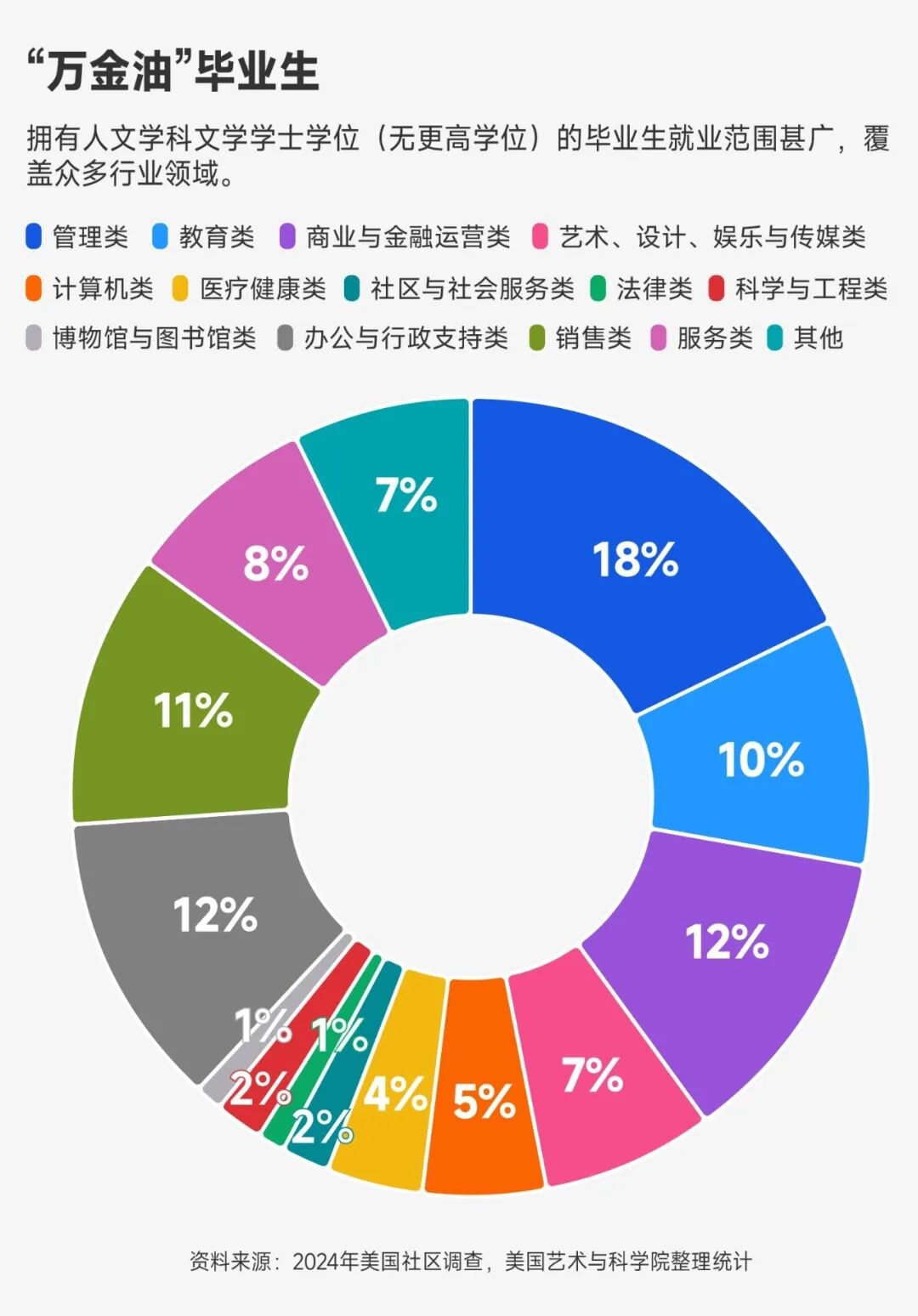
The latest Humanities Indicators data from the American Academy of Arts & Sciences show U.S. colleges awarded 164,847 bachelor's degrees in the humanities in 2025—the lowest since 1991, down 30% from the 2012 peak. Overall, humanities degrees were just 8% of all bachelor's degrees, versus 13% in 2012. Over the same span, English degrees fell 44% and history 41%.
Yet the numbers also hint the slide may be bottoming. From 2024 to 2025, total humanities degrees fell only 0.4%—the smallest annual drop since 2012. Philosophy enrollment, after years of decline, rose in both 2024 and 2025 and is back to 2015 levels.
Robert Townsend, who leads the Academy's humanities, arts, and culture programs, isn't ready to call a nationwide recovery. A report based on 2025 focus groups with high school students found they struggle to connect humanities degrees to careers. Many “can't even imagine what they'd do after studying the humanities in college,” Townsend says. “They can list the social value—better citizens, better community members—but the career piece is much less clear.”
That “career piece” is a big deal. Rising tuition and student debt push students toward majors with clearer returns.
Meanwhile, unemployment among young college graduates keeps climbing, AI fuels anxiety, and data show entry-level roles are hit hardest by AI. Students have noticed. National Student Clearinghouse data show spring 2026 enrollment in computer and information sciences at four-year colleges down 8.4% year over year—though still well above five years ago.
English and literature still look weaker, extending a long decline through last spring. With universities under their own financial pressure, humanities departments have been—and will remain—early targets for cuts unless major counts grow. Townsend notes: “When deciding whether to keep a major or program, enrollment is hard currency.” Whether students start seeing humanities majors as career pathways directly affects whether humanities professors keep their jobs.
Townsend argues professors must get better at conveying the value of the skills they teach. Writing a term paper on the French Revolution, for example, means posing high-quality questions, arguing critically, tracing sources, and communicating efficiently—all essential for working well with AI. He encourages faculty to spell out research, organization, and communication skills on syllabi.
It may be no coincidence that one campus showing humanities warmth has long stressed practicality across majors: Pace University in New York City, which since its 1906 founding as an accounting school has blended career education with liberal arts. This year first-year applications to English rose 28% to 299; actual enrollments nearly doubled vs. last year—though at 32 students in a freshman class of 1,992, the group is still small.
Kelley Kreitz, associate provost for academic strategy and student success at Pace—and herself an English professor—says renewed interest in the humanities is emerging “amid the big conversation about AI and how it will shape future work.” She adds: “I tell my students they need to become better writers than AI.”
Kreitz says Pace's mix of liberal arts, experiential learning, and industry networks—to help students land internships and full-time jobs—“seems to fit what students need right now.” In an era when graduates can't count on training for one specific role for career security, they need to be ready for jobs that “may not even exist yet”—and Pace's model matches that.
She also argues students never had to choose between practicality and intellectual growth. “Our view is you actually need both. Even if you only care how much you'll earn after graduation—which is completely understandable—you still need both.”
### Source:
https://www.forbes.com/sites/lisachambers/2026/09/21/move-over-stem-humanities-degrees-are-poised-for-a-comeback-thanks-to-ai/
相关文章