



On October 12, Unitree Robotics founder Wang Xingxing dropped more quotable lines in Shanghai. That day, the 26th China International Industry Fair opened at the National Exhibition and Convention Center (Shanghai) under the theme “Intelligent Economy, Boundless Smart Manufacturing,” running through October 16.
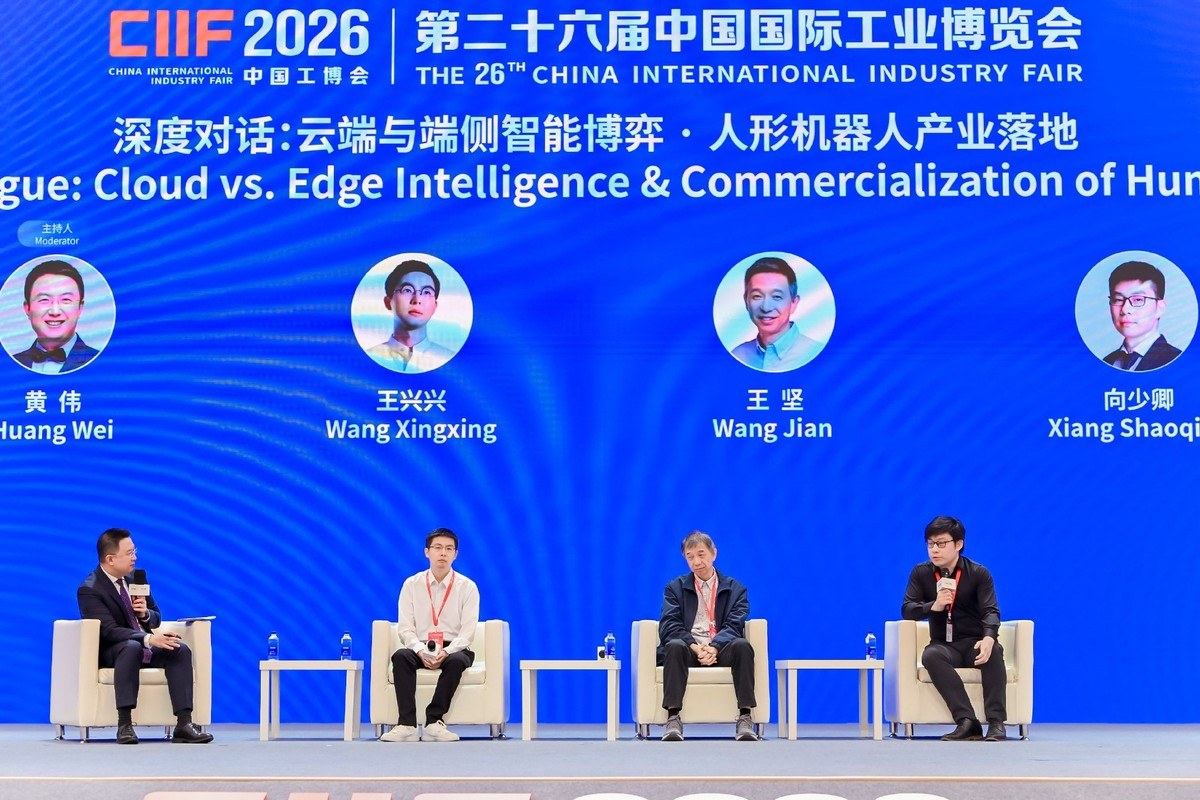
At the opening ceremony, Wang joined Zhijiang Lab director and Chinese Academy of Engineering academician Wang Jian, and Sharpa co-founder Xiang Shaoqing, in a deep dialogue on robot compute, training data, and real-world use—drawing wide attention.
Asked how long until robots move from exhibits to products, Wang gave a clear call: the tech tipping point for embodied intelligence “could even arrive within one or two years if things move fast.”
He said global AI progress is very rapid—“major updates every month or two”—and that GPT-6 in particular reset how practitioners in embodied AI think. Unitree has already deployed it on robots for task tests, with “actually very good results.” He even predicted that when GPT-7 arrives next year, it “might punch straight through the embodied-intelligence problem.”
An IDC report on September 29 showed nearly 25,000 humanoid robots shipped globally in H1 2026, up 432.1% YoY, with China over 19,000 units. Still, research/education, performance demos, and government data-collection centers account for 69% of global shipments—industrial manufacturing, retail, and logistics are not yet the main destinations.
That stance is more bullish than about two months ago.
At the World Robot Conference in August, Wang’s timeline was still “as fast as 2–3 years, or as slow as 5–10 years.”
On his personal path, Wang admitted: “My personal faith in AI is actually growing by the day. The biggest mistake I made over the past decade-plus was not believing in AI enough”—liking and believing can “increase more than 10×.” He also said many people still don’t use AI fully enough, and tech change may outrun what the industry previously expected.
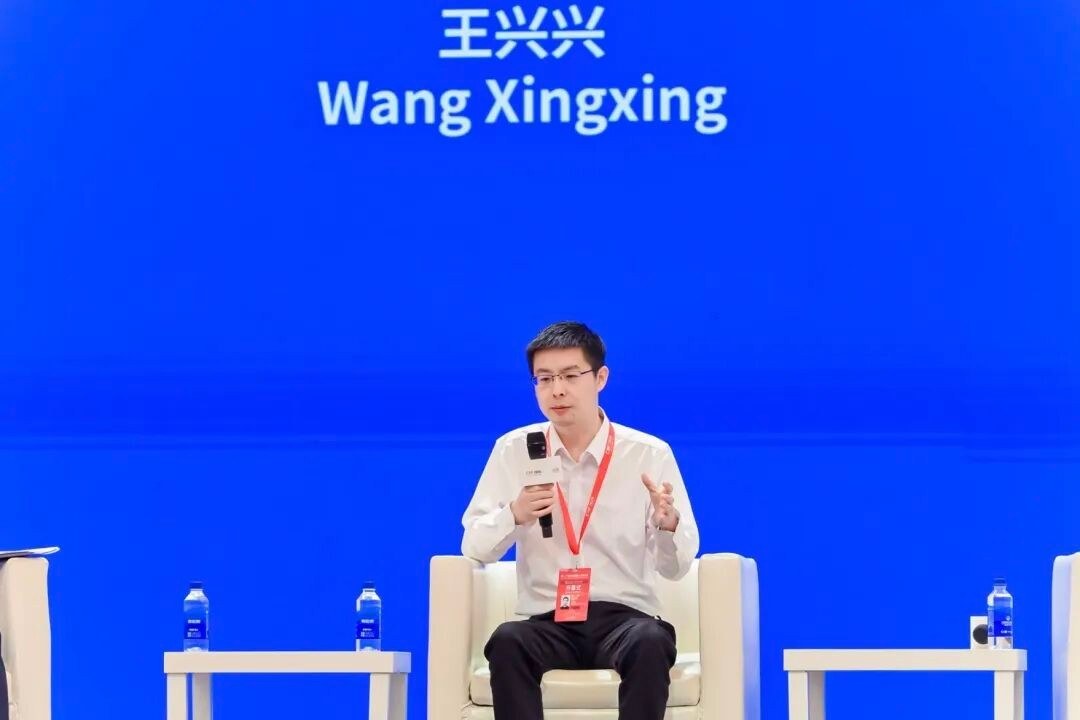
On deployment pace, Wang said Unitree began factory pilots with several automakers as early as 2024—“robots entering plants isn’t starting from zero”—but turning single-site trials into large-scale use still needs better generalization and work efficiency. “These problems are very likely to be solved in the next few years.”
He thinks commercial service scenarios may land faster than industrial ones; home settings demand more complex-environment adaptation, so they may not lead the rollout order.
On compute split, Unitree keeps high-realtime work like motion control on the robot body, while complex decisions and wide-scene adaptation lean on the cloud; onboard compute can be configured by customer need.
Wang also revealed Unitree has begun trying a “physical AI self-evolution” system—closing a loop of coding, model training, deployment, testing, and feedback so AI joins more development and evaluation. He stressed “humans still need to take part in evaluation” for now—judging whether motions match expectations and results truly meet needs.
He noted many robot-model companies are still in a primitive mode: engineers dig papers, write code, train and test, then manually feed results into the next iteration—links AI could already automate.
The high-profile remarks contrast with ongoing share-price pressure.
As of the October 12 close, Unitree finished at RMB 421.29, down 2.48%, with 1.6027 million shares and RMB 675 million in turnover; the session low was RMB 414.95.
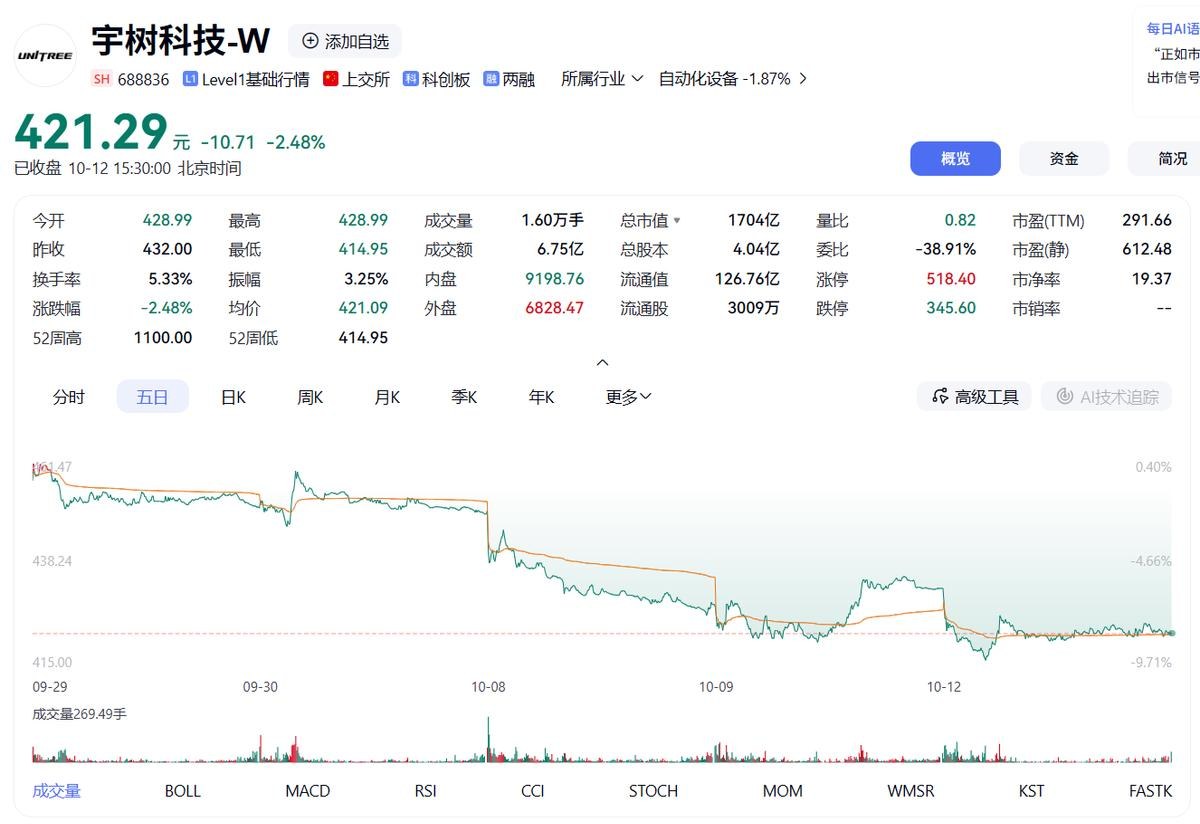
Over recent sessions, the three trading days after the National Day holiday saw an overall pullback.
October 8 closed at RMB 427.80, down 5.02%; October 9 rebounded slightly to RMB 432.00, up 0.98%; October 12 fell again to RMB 421.29—about 6.5% down across the three days. Versus the September 18 interim high of RMB 514.98, the cumulative drawdown is about 18.2%.
相关文章