

Tsinghua×Berkeley Open-Source uni-robot-agent: Unified RUA Harness Beats Astra’s Old RoboDojo Baseline
Tsinghua researchers (Ding Ning, Liu Zhiyuan, Xu Mengdi, Zhou Bowen, et al.) with Berkeley’s Pieter Abbeel / BAIR open-sourced uni-robot-agent (arXiv:2611.01560)—a modular harness so language models drive diverse robots and sims through a standard Robot-Use Agent (RUA) tool API. On RoboDojo, open-weight Qwen3.8-Flash-Next scored 31.39, above the previously posted GPT-6 Astra + RoboProbe 28.97; the same harness lifts Astra to 51.90. On 19 real dual-arm tasks without task-specific finetunes, Qwen hit 53.50 and Astra 80.50.
Why it matters: Computer Use for robots needs one interface
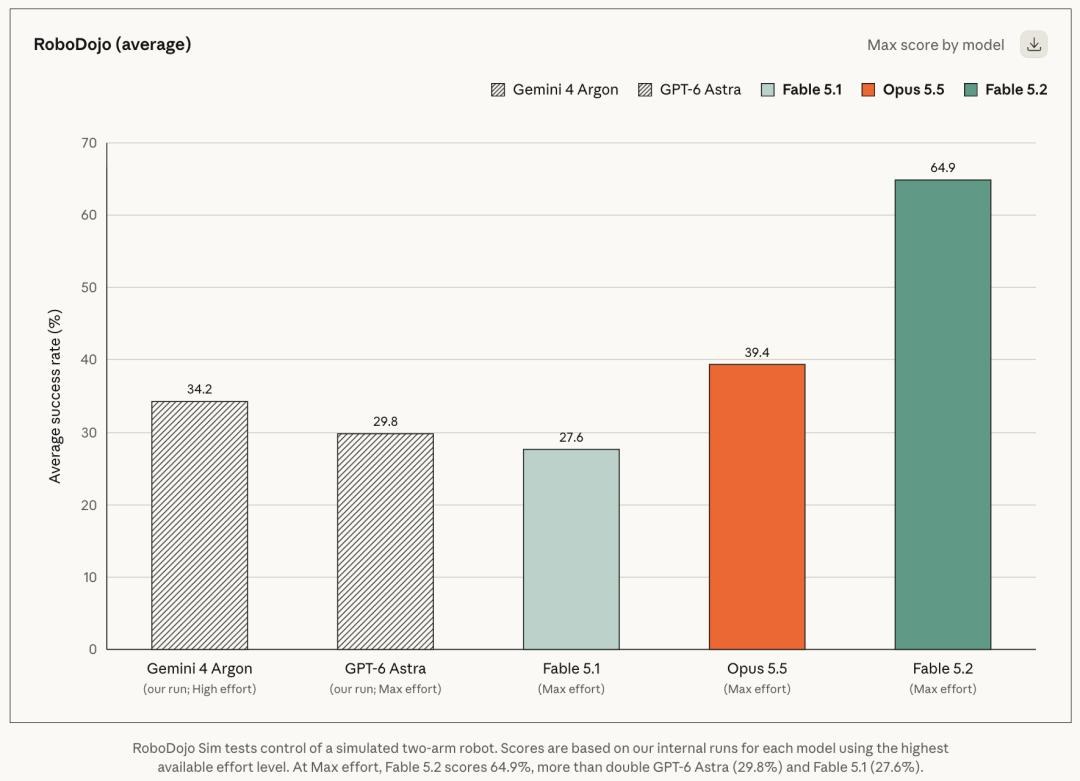
Anthropic’s Fable 5.2 reportedly reached 64.9% on RoboDojo Sim vs 29.8% for GPT-6 Astra in Anthropic’s matched setup; we also covered Astra’s embodiment push on RoboDojo. Closed models show skill, but weights are locked and hard to keep training on robot traces; hardware APIs stay fragmented. RUA (System-2 planning + System-1 action) needs reusable tool semantics—the same lesson as our note on managing Coding Agents: interfaces and verification beat prompt piling.
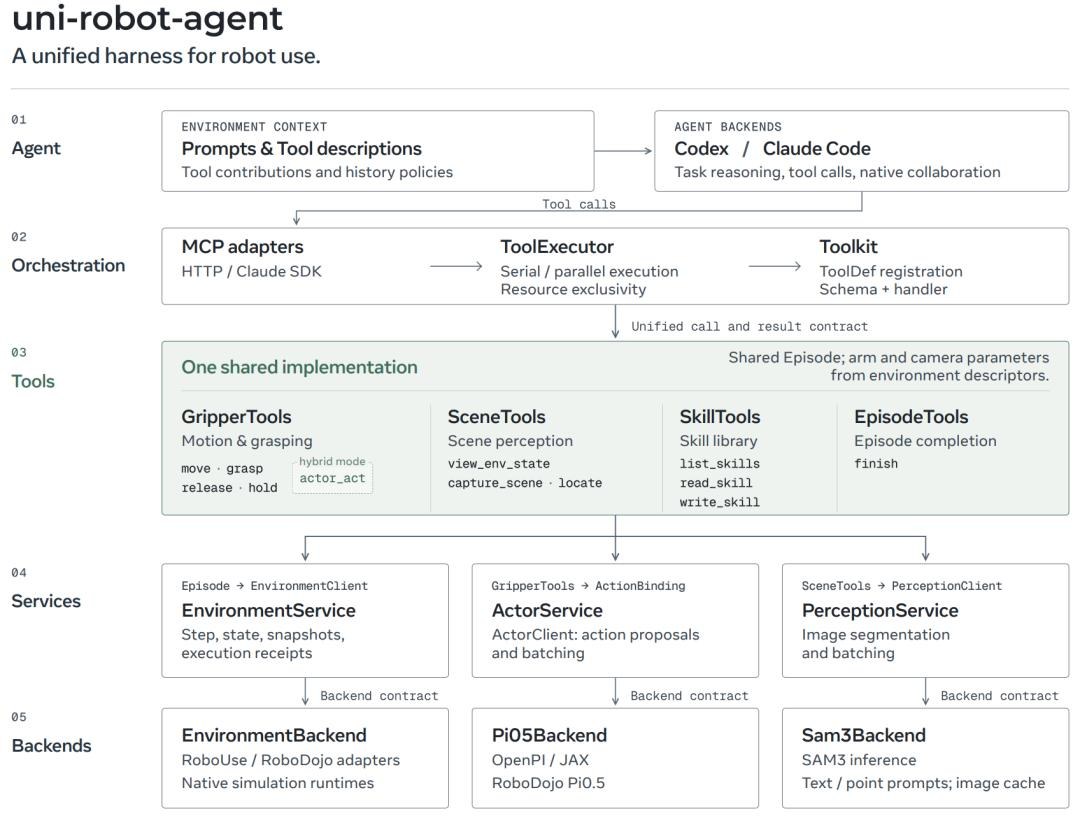
Five layers: hide hardware, tighten eval privileges
The stack is Agent / Orchestration / Tools / Services / Backends. Franka stacking, ALOHA handoffs, YuMi peg-in-hole—all call the same perception, motion, skill, and task APIs while adapters absorb differences. Main sim runs expose only RGB, camera calibration, proprioception, and instructions—no depth GT, object CAD, hidden labels, success oracles, or web access. Engineering details bind image+state timestamps, dedupe requests, detect stalls, and queue same-arm motions under async execution.
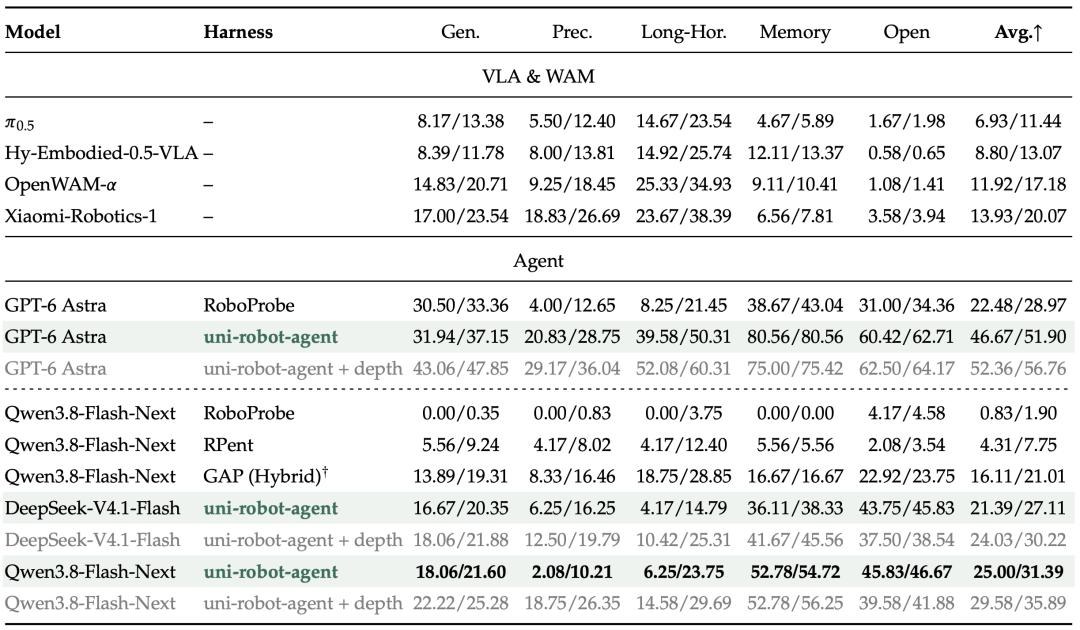
Beyond scores: harness, geometry, and cost set the ceiling
Same weights, different harness: Qwen3.8-Flash-Next scores 1.90 (RoboProbe), 7.75 (RPent), 21.01 (GAP Hybrid), then 31.39 (25% success) with uni-robot-agent. DeepSeek-V4.1-Flash 27.11; Astra 51.90 (~46.67% success). Ablations: depth+calib → calib only → RGB+proprio drops Qwen ~35.89 / 31.39 → 9.13 and Astra ~55.83 / 55.04 → 31.29. Turning off the skill library barely moves Qwen (31.39→30.31, ~96.6% retained)—not mostly a canned-skill cheat.
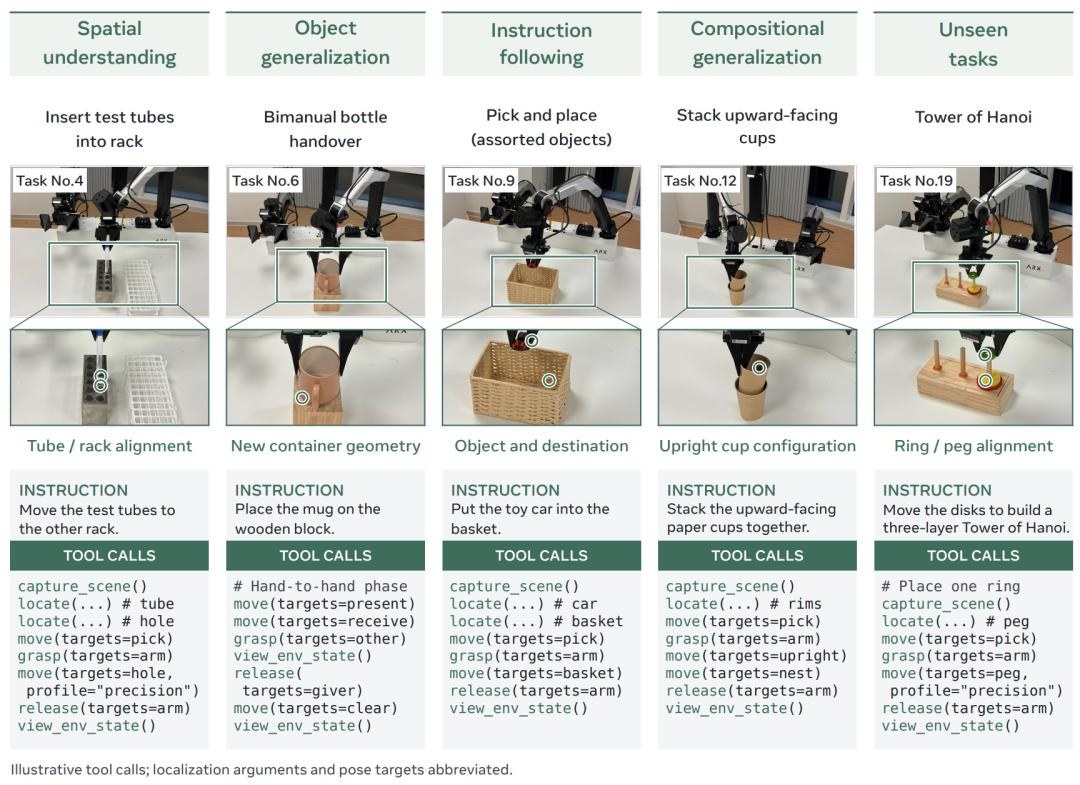
Cost: ~$1.09 / $0.94 API per task for Qwen / DeepSeek vs ~$21.29 for Astra; async pipelines cut selected-task wall time ~4.8–73.7%. Cross-generation sweeps show robot skill is not a simple size curve; failure taxonomies highlight vision, spatial localization, geometry, and embodied reasoning. The harness also supports Code-as-Policy, VLM+VLA Hybrid, and a four-tool Clean Mode that keeps ~90% of full-tool scores while cutting tokens ~35.7% / 78.8% for Qwen / Astra. Real platforms already include ARX One and AgileX Piper-X, with AgiBot G2 and Unitree G1 in progress—OpenRUA built the rails; continual training on interaction data is the next act.
FAQ
Q: What problem does uni-robot-agent solve? A: A unified tool API and modular harness so one agent loop spans robots/sims and yields consistent interaction traces.
Q: Can open models beat closed ones? A: On RoboDojo, Qwen3.8-Flash-Next + this harness beats the old Astra+RoboProbe baseline; under the same harness Astra still leads—both model and harness matter.
Q: How is this unlike specialized VLAs? A: It emphasizes general models driving many embodiments via adapters; specialized policies stay hardware-tied and costly to port.
相关文章