


AI Drug Discovery Turns to the Lab: Terray Feeds Models with Ultra-HTS Data, Clinic Slips to 2027
AI can propose oceans of molecules in seconds; making and testing them still burns lab capacity. As design and in-silico screening accelerate, experiment throughput and a data feedback loop become the bottleneck. Founded in 2018, Terray Therapeutics binds ultra-high-throughput chips, automation, and its multi-model EMMI stack so the lab is not only a verifier but a continuous training-data engine. In October 2026 it also detailed Nvidia work fine-tuning Nemotron VLMs to parse reaction schemes from papers—while its fastest wholly owned program’s IND timeline slipped from a 2026 aim to 2027.
Why it matters: from “can design” to “can run and learn”
Public datasets vary by assay and under-cover misses, especially on cold targets. Terray’s ultra-dense microarray immobilizes vast small-molecule libraries for parallel protein binding reads; as of June 2026 it cited >420 billion individual measurements and >17 billion unique target–molecule interactions. Modules split the workflow: chemistry foundation model COATI, route planner TerraSynth, potency model TerraBind, and experiment chooser EMMI Select—the real question is which batch deserves scarce wet-lab bandwidth, not who scored highest.
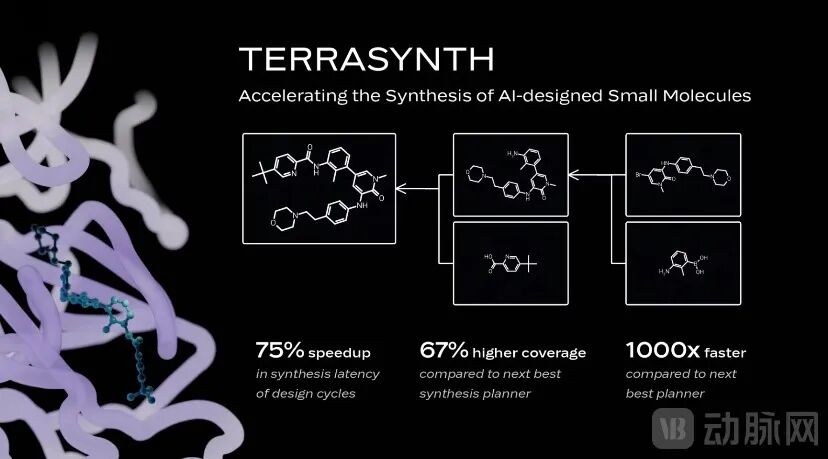
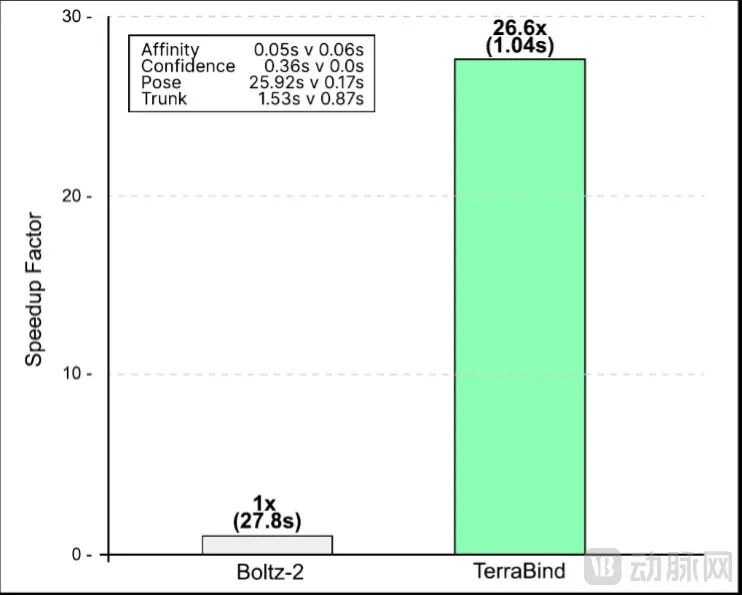
Terray says TerraSynth sped synthesis ~2–4× and cut synthesis delay up to ~75% across 17 internal programs; TerraBind-Struct runs ~26× faster than Boltz-2 end-to-end per complex on one A6000, with Pearson correlation ~16–20% higher. The Nvidia RxnCaption HybridMatch F1 rose from 59.8 to 63.4—better reaction extraction, not proof the synthesis line itself sped up.
China’s AI drug-design financing wave asks the same lab question—see our note on Toursyn’s AI drug-design raise.
Partners first; owned pipeline still preclinical
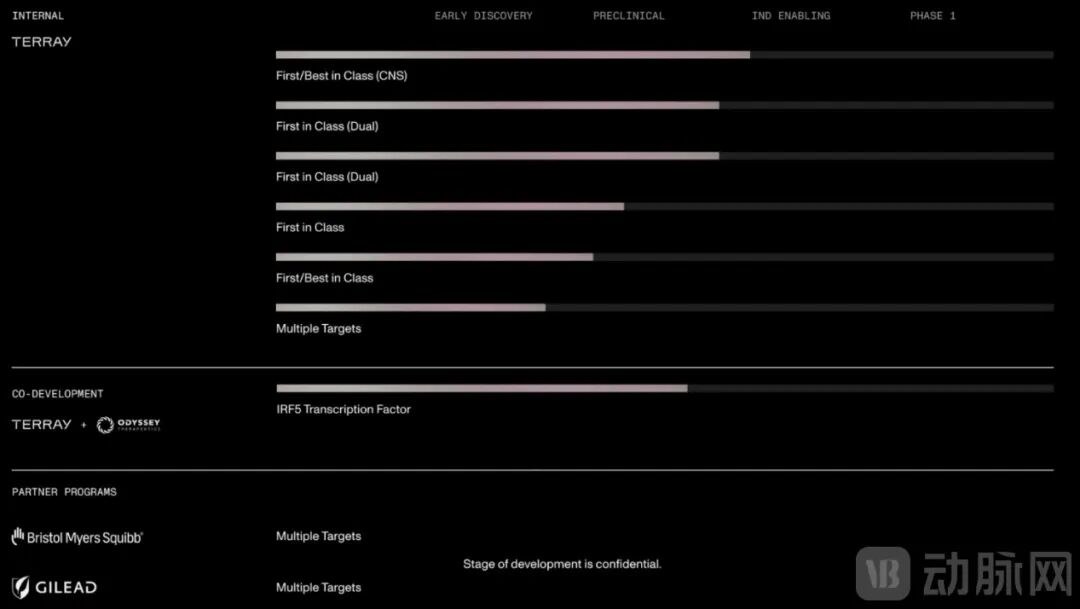
Terray partners with pharmas that supply targets and biology while it runs HTS + AI discovery. Under the Gilead-style structure, if the partner takes exclusive rights it leads later development/commercialization and Terray can earn upfronts, milestones, and royalties; in December 2025 it said a BMS collaboration hit a first discovery milestone (target and dollars undisclosed). CEO Jacob Berlin said in February 2026 the fastest owned asset is a brain-penetrant MS inhibitor aiming for clinic in 2027—a year later than the 2024 “2026 clinic” talk track. Platform expansion and clinical progress are different curves: partner milestones show utility; owned drugs still need candidate lock and clinical data.
Not every lab produces the same data
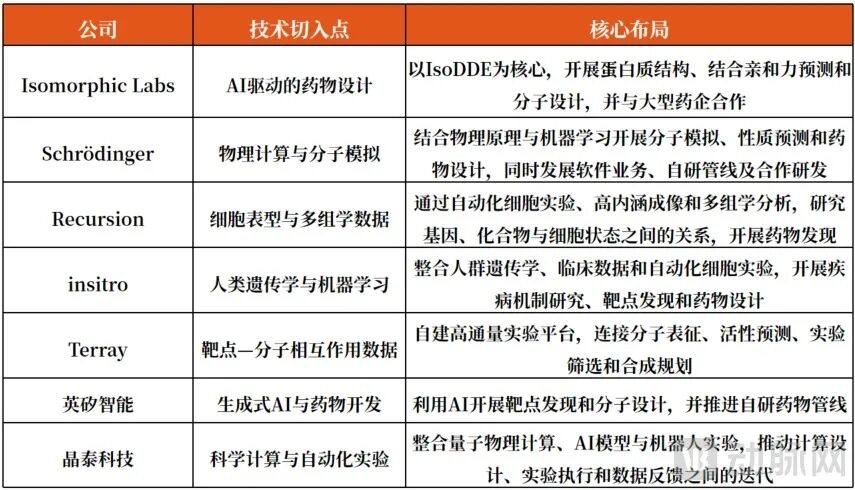
Paths diverge: Recursion leans on cellular phenotypes and high-content imaging; Insitro joins phenotypes with population/genetic data; Schrödinger and Isomorphic Labs emphasize compute/design models; Insilico pairs generative discovery with owned clinical assets (Rentosertib reportedly entered Phase III in 2026); XtalPi orchestrates quantum/AI with robotic labs. The split is what data you mint and whether it flows back into models. Terray’s bet is ultra-HTS small molecule–target binding wired into prediction, selection, and synthesis—aligned with the “real data + native devices” pitch in our Qingxi Zhiyan AI-for-Science financing note.
The lab is the entrance; the drug is the answer. Whether 420 billion measurements yield better candidates, whether efficiency gains generalize, and whether the first owned asset hits the new clinic date still need results—scale alone cannot substitute for assay quality, coverage, and cost.
FAQ
Q: What is EMMI? A: Not one model—a platform name linking lab hardware, automation, and modules like COATI, TerraSynth, TerraBind, and EMMI Select into a small-molecule discovery loop.
Q: Does the Nvidia deal mean faster wet labs? A: Published gains are about extracting structured reaction info from papers—data enrichment, not a direct claim of higher synthesis throughput.
Q: What does AI pharma compete on next? A: After design sped up, rivalry shifts to experiment capacity, closed-loop data, and whether partner or owned programs produce clinical evidence.
相关文章