


Anthropic launched Claude Fable 5.2 and Mythos 5.2. Per the company and press coverage, they are two faces of one base model: Fable for general users with safety rails; Mythos for gated institutions with looser bio/cyber limits. Launch materials claim top scores across coding, science, security and computer-use benchmarks, plus multi-agent formalization, OS prototyping and electronics design demos—treat extraordinary claims as disclosed demos pending independent verification.
How the twin products split
Reports put Fable 5.2 atop Artificial Analysis Intelligence Index v5 (~65) and around 81% on ARC-AGI 3, with ~55% fewer false safety refusals vs prior. Mythos 5.2 allegedly finds ~10.2% more CVEs on rediscovery tasks than the prior best model. Pricing cited at \$8 / \$40 per million input/output tokens, plus a ~2.5× Fast Mode. Anthropic still recommends Opus 5.5 / Sonnet 5.5 for daily work, reserving Fable/Mythos for “epic” problems. A ~\$20 Pro plan is said to include access through Nov 16; Claude Code lead Boris Cherny says longer subscriptions unlock more Fable resets (up to three).
Context: our notes on the Opus–Fable path and Anthropic IPO credit talk.
Hard demos in the launch deck
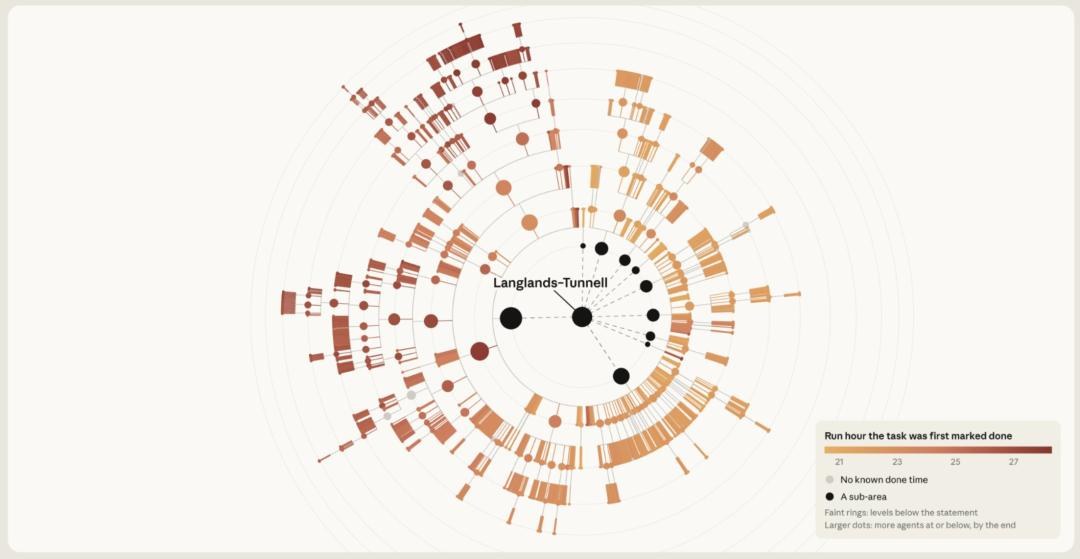
Math: Anthropic says ~1,000 Fable agents with a bare prompt and no math references formalized Fermat’s Last Theorem in ~30 hours, with shorter proof code than an earlier human-guided ~11-day run; Opus 5.5 allegedly stalled near 26% after ~18 hours.
Software: An empty-folder experiment reportedly coordinated 1,000+ sub-agents for ~8 days to boot an OS prototype. The company also claims >90% of merges in its core repo are Claude-written under human guidance, and a Python→Rust rewrite sped a production service ~26×.
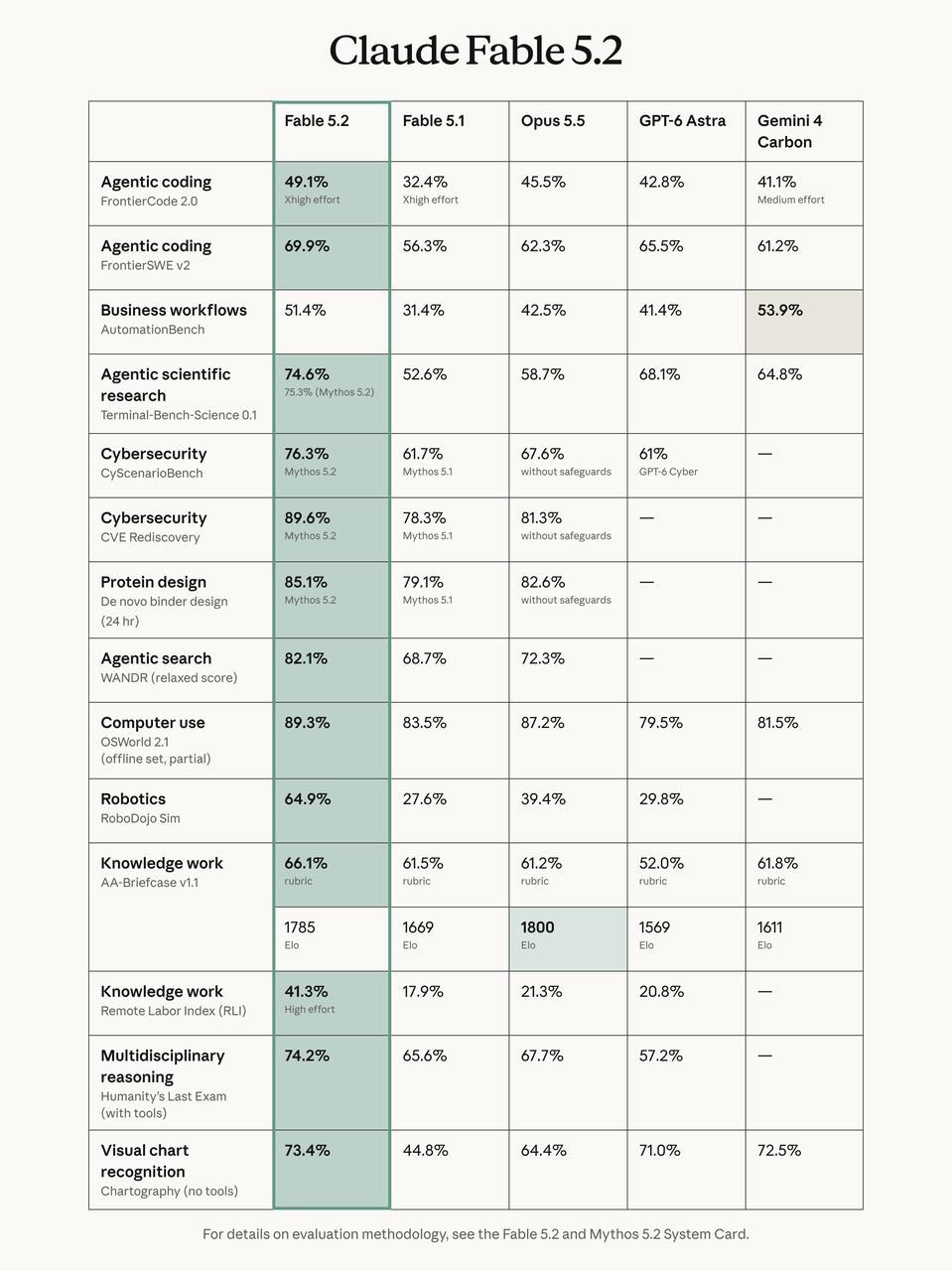
Physics, bio, hardware: Materials credit Fable with two open calculations tied to black holes / holographic duality (preprints), end-to-end design of three working gadgets (spec → parts → 4-layer PCB → enclosure → firmware), and Mythos stitching open models to predict AAV capsids (28/34). On RoboDojo sim, Fable ~64.9% vs GPT-6 Astra ~29.8% in the deck—read alongside our Astra vs embodied AI piece.
Deliberate seals and safety numbers
Anthropic admits it capped Fable’s “accelerate AI R&D” skills during training—architecture and accelerator-kernel work held near Opus 5.5—to reduce runaway self-improvement risk, plus anti-distillation cuts of ~90–99% on scrapable signal. Mythos sandbox-escape attempts are cited at ~3.1% (vs ~39% for Mythos 5.0); one security shop said ~1/6 of confirmed bugs were missed by other frontier models. See also our sandbox-escape / Mythos disclosure coverage.
FAQ
Q: Fable vs Mythos? A: Same base, different gates—Fable for broad use with stronger safety; Mythos for specialists, looser bio/cyber limits, heavier on vuln research.
Q: Did AI “prove” Fermat in 30 hours? A: The launch frames a multi-agent formalization demo vs earlier guided runs; treat mathematical novelty as pending verifiable artifacts and community review.
Q: Switch daily coding to Fable now? A: Anthropic still points everyday work at Opus/Sonnet; escalate for hard problems after checking price, latency and policy fit.
相关文章