



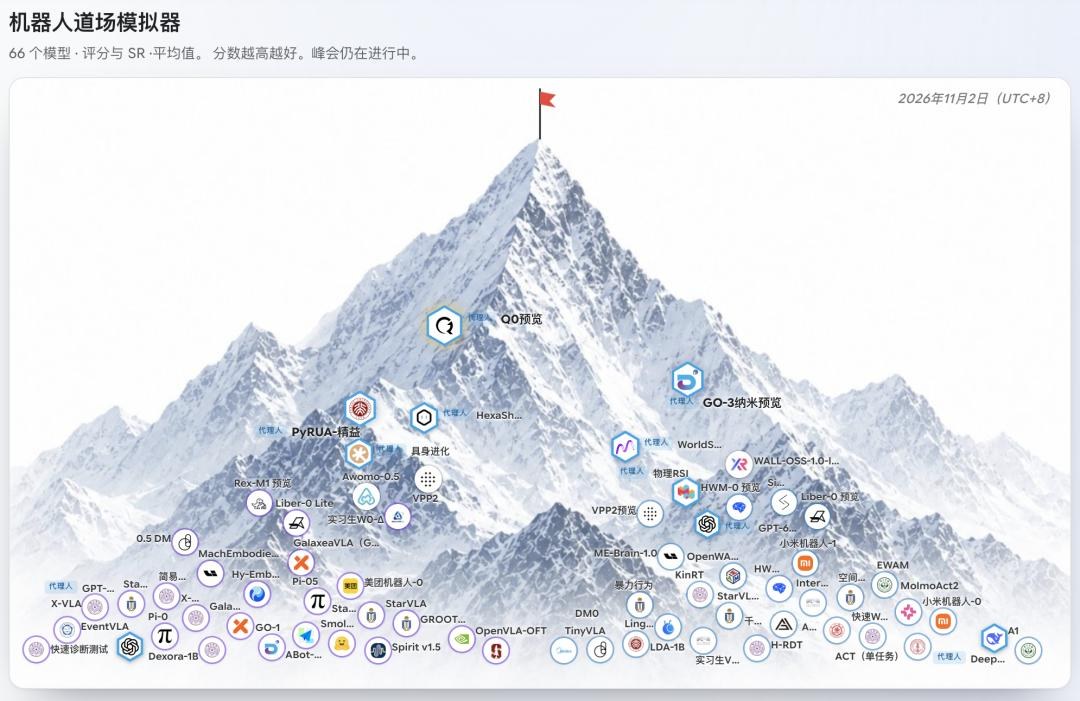
About two months after GPT-6 Astra and with GPT-6.2 Astra in the rumor mill, embodied-AI teams are feeling a direct hit from “general models + robot tooling.” QbitAI reports some companies are cutting algorithm roles; on RoboDojo-style benchmarks, wiring in Astra / Robot-Use-Agent (RUA) can lift systems that scored ~20–30 to ~50–60—forcing a budget question: keep pouring money into native embodied foundation models?

Where the shock comes from
Practitioners say embodied research still lacks a new paradigm breakthrough, while Astra-class general models “vertically strike” robot tasks via coding/agent workflows. The pressure is not only Silicon Valley—domestic teams also watch Kimi, DeepSeek, Zhipu and peers closely.
Chen Tianxing (HKU MMLab; first author on RoboTwin/RoboDojo baselines) says teams that once insisted on native embodied base models are now submitting RUA-style stacks that lean on general LLMs. Scores rise; roadmaps get rewritten. See our note on the GPT-6.2 Astra rumor.
Three old “startup theses,” one general model
Chen’s analogy: embodied self-training still adds 0.1 on an 80, while Astra can jump 80→90 in one leap. In some tests Astra needed no task-specific post-training and no demos—language instructions alone sufficed for many manipulations.
The early RoboDojo assessment highlights three capabilities that used to justify standalone research (and fundraising stories):
1. ICL — demos raise success; after camera/action-frame shifts it can adapt online over a few tries. 2. OOD + correction — when objects move mid-grasp, it re-plans from new vision instead of replaying the old trajectory. 3. Open-vocabulary manipulation — paraphrase the ask and it still executes, weakening the need for task-specific language–action fine-tunes.
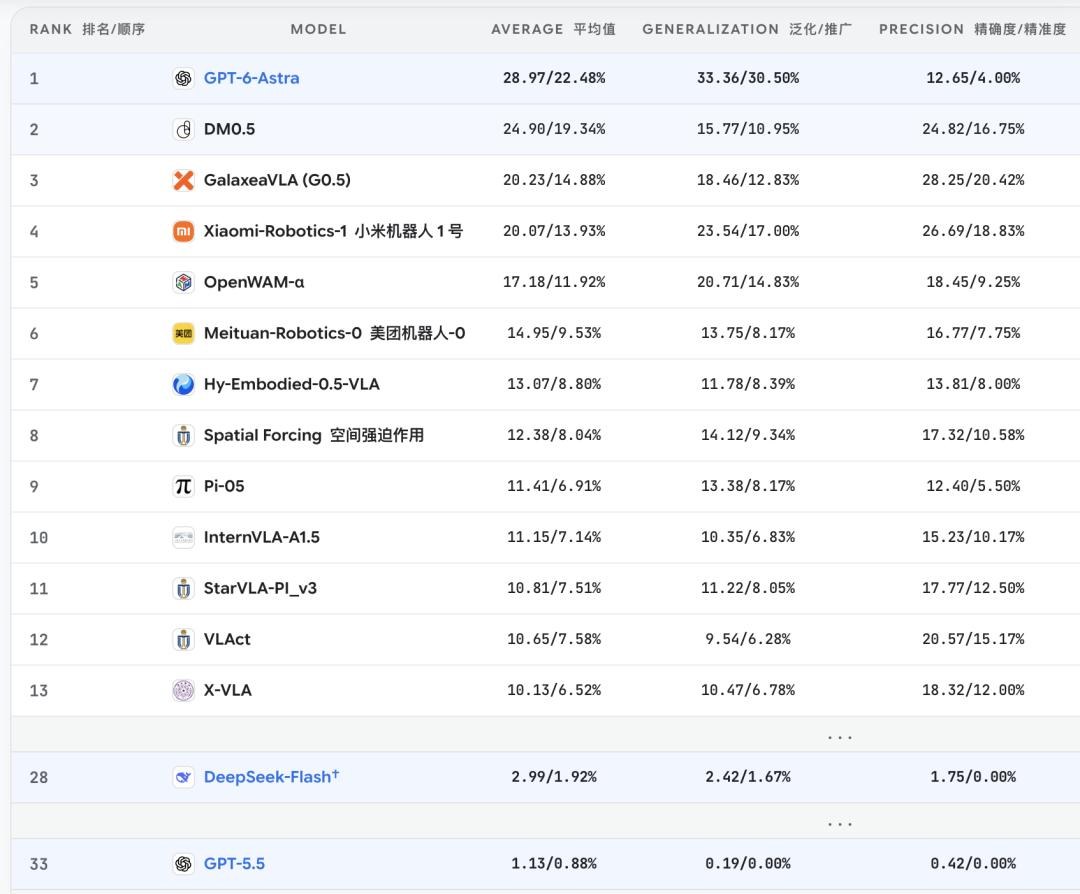
RoboDojo also notes Astra real-robot tests were halted over safety; sim leaderboard gains ≠ reliable factory productivity. Still, the asymmetry is clear: general models arrive with language/vision/reasoning/coding priors, while many embodied teams grind each skill from scarce robot logs.
Keep self-training—or re-order it?
Xie Huazhe (破壳) splits competence into semantic, spatial, and physical generalization: Astra shines on the first two; rich contact, force, deformation, and high-precision work remain hard. Benchmarks likewise favor Astra on geometry/language, while continuous contact and multi-step physics still leave room for today’s VLAs. Wang Qian (自变量) stresses robot data, real-world eval, hardware, sim, and deploy infra do not vanish because the LM got smarter.
Latency is a real complaint—cloud Astra is slow for tight control loops—but quantization/distillation/on-device stacks can help, and model inference Hz ≠ low-level control Hz. On predictable lines, slow high-level planning with fast low-level control can still work.
Chen’s takeaway: compete on economic value, not “who is smarter.” Standard lines care about yield, takt, and cost—a tuned small model or rules may beat calling Astra every cycle; open home tasks may favor stronger general models. His “scene demand × model capability” axes match themes we covered on embodied scenes and physical agents.
So self-research is not dead—it must be re-prioritized: borrow general models for understanding/planning; invest R&D in contact physics, embodiment control, real-scene fit, and deploy efficiency. Whether to keep training ever-larger native embodied bases depends on durable, measurable edge. Investor mood is cooler; the demo-and-burn phase is entering a shakeout. More: AI News.
FAQ
Q: Has Astra replaced embodied specialist models? A: It shocks sim and instruction tasks, but real-robot runs were safety-stopped; rich contact and precision work still leave room for VLAs / scene models.
Q: Why do score jumps threaten budgets? A: RUA + general models lifting ~20–30 to ~50–60 forces boards to ask whether native pretraining at the old scale still pays.
Q: Factory: big model or small? A: Repetitive, cost-sensitive lines favor rules or light specialists; open, changing tasks favor general models—price success rate, takt, human recovery, and long-run deploy cost.
相关文章