



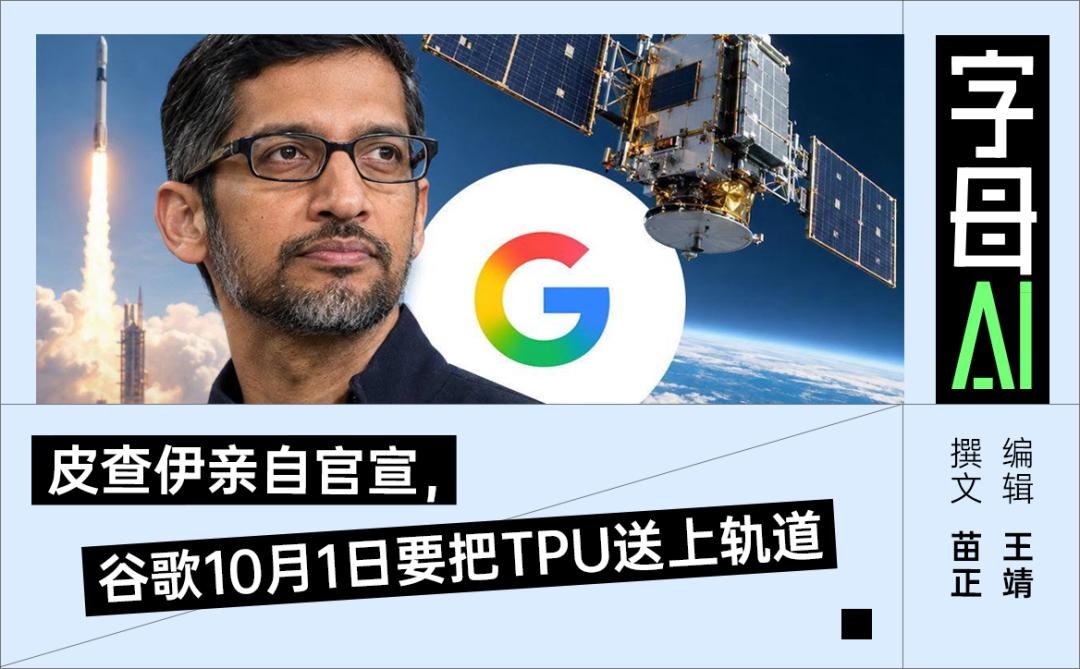
Google is about to go to space.
Sundar Pichai posted a long note: on October 1, Project Suncatcher will begin its first on-orbit test—compute roughly equal to one ground server.
Google had already disclosed Suncatcher last November.
It was framed as “long-term research”: how to run compute at scale in space. At the time Google said it would partner with Planet, aiming to launch two prototype satellites in early 2027 to validate the idea and laser links between satellites.
People say the end of compute is energy. In orbit you can soak stronger sunlight for longer—and skip building terrestrial data centers for the servers.
But that is only the surface. Behind Suncatcher sits a meeting of Google’s founding moonshot romance and today’s AI-shaped commercial reality.
What kind of project is this?
Precisely, what Google is sending up is an MVP (Minimum Viable Product) satellite, hitching a ride on SpaceX’s Transporter-18 on a Falcon 9 from Vandenberg Space Force Base into a low Earth orbit that is almost always sunlit.
The craft is about fridge-sized; the bus comes from San Francisco imaging firm Planet Labs.
Inside sit four Google TPUs whose combined compute roughly matches one server in a ground data center.
Power comes from solar panels at about 1 kW—enough for a microwave or hair dryer. Google plans to run Suncatcher for about a year. The satellite can stay on orbit up to six years before reentering and burning up.
Pichai said the mission mainly tests hardware performance and cooling—whether TPUs can survive launch, radiation, and heat.
Orbit matters too.
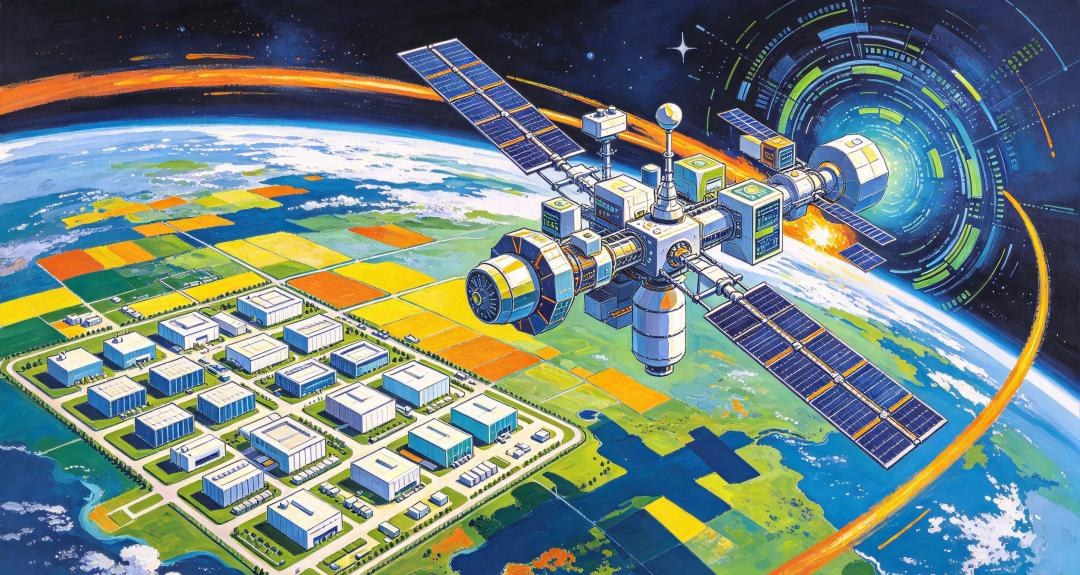
MVP enters a dawn-dusk sun-synchronous orbit (SSO), hugging Earth’s terminator so it stays almost constantly in sunlight.
On the ground, panels face intensity limits, day/night, and weather. In space solar radiation is stronger—the same panel can put out up to 8× ground power and nearly continuous supply.
Google’s plan: 81 satellites in an array about 1 km in radius, average altitude ~650 km, linked by laser intersatellite links (free-space optical) into one compute cluster.
Space is big, yet the satellites still “crowd” together—because to match ground data centers, satellite comms must be fast and stable.
Today’s laser links between sats often run 1–100 Gbps and were built for long range, low bandwidth.
Google’s core goal is training AI, so the array needs “very short range, very high bandwidth.”
Google projects that distributed training needs about 10 Tbps aggregate per link. Closer distances slash required receive optical power.
The precision is like two fast-moving satellites locking onto a coin-sized target miles away.
As noted above, putting AI chips in space means three gates for Google’s engineers.
First: launch itself. About 10 minutes to orbit, sustained acceleration, local parts seeing 50–100 g spikes, plus violent vibration.
Before flight the team shook the satellite on three axes to mimic rocket frequencies.
Second: radiation.
Cosmic rays and solar weather can flip bits—one particle turns a 0 into a 1 and corrupts compute.
To harden against it, Google put TPUs in a UC Davis accelerator, blasted them with a 67 MeV proton beam while running AI workloads.
Early results: the chips survived a radiation dose equivalent to 5+ years of mission life.
Memory still saw some uncorrectable errors; Google said the rate is “probably acceptable for inference,” while training impact needs more study.
Third: cooling.
Space is vacuum—no convection, fans useless—and AI chips run hot.
Google’s fix: a deformable thermal-interface layer couples the chip to aluminum/copper heat pipes that dump into a radiator panel radiating into space.
Radiator capacity is limited, so in this test TPUs can only run in bursts—about 15 minutes each—then idle while the panel sheds heat.
Google will run Gemini models for the test, but not continuously.
The project is led by Google senior director Travis Beals in a group called Paradigms of Intelligence.
Pichai stressed this is a stepping stone toward “orbital data centers,” not a product launch.
In 2027 Google still plans two more prototypes focused on laser intersatellite links.
When Suncatcher becomes a product rather than a project, Pichai said, is still many years away.
What’s the motive?
How power-hungry large models are is no secret.
In 2026 every hyperscaler is hunting electricity worldwide—from Virginia’s data-center alley to Ireland. Ground power that can be grabbed is largely spoken for.
Google’s bet: instead of fighting for power, land, and water on Earth, look to space.
Beyond solar itself, space has no residents, farms, or community pushback—and skips the whole stack of building halls, grid ties, and water cooling.
In its paper Google notes the sun’s output is more than 100 trillion times humanity’s total electricity generation.
Another Suncatcher trait is modularity.
In sci-fi, space compute hubs are often megastructures packed with machines.
Google rejected that. The paper discusses monolithic designs and concludes they need people or robots to assemble on orbit, complicate collision avoidance, and drive mass and complexity for structural strength.
Google’s choice: many smaller sats flying in tight formation.
The upside is scalability—need more compute, launch more birds; in theory stack like bricks until the dawn-dusk orbital band fills.
Theoretically sound ≠ economically viable.
Google’s math: putting a kilogram into LEO now costs about $1,500–$2,900. That is conceptual; mission specifics usually push actual cost higher.
For Suncatcher to truly work, cost must fall to roughly $200/kg.
Why $200?
U.S. data-center electricity runs about $570–$3,000 per kW per year. At $200/kg launch, amortized over satellite life on a per-kW basis, space could roughly match ground energy cost.
Google says hitting $200/kg needs two premises: SpaceX Starship in service, and about 180 launches a year afterward.
Hence Google’s timeline: not before about 2035.
Only then might space data-center launch-and-ops cost, per kW-year, draw even with equivalent ground energy cost.
By then ground electricity prices themselves will have moved—higher or lower.
2035 is far away—but the space race has already started.
Musk long said SpaceX “will do” space data centers. After Pichai announced MVP launch, Musk replied with two rocket emojis.
Then: “The total amount of compute in space will obviously tend towards 100% of all compute.”
Amazon founder Jeff Bezos has said similar things—gigawatt-scale data centers in space within a decade. Former Google CEO Eric Schmidt acquired Relativity Space to put data centers on orbit too.
Startup Starcloud already flew a satellite with an NVIDIA H100 and talks of a 5 GW space data center across a 4 km solar array someday.
Google’s moonshot
Read Suncatcher only as commerce and there is little to say. Spend fortunes lofting chips—just to save some power?
Commerce is the outer skin. What makes the project possible is a culture Google buried at founding: the moonshot.
The story starts in 2005.
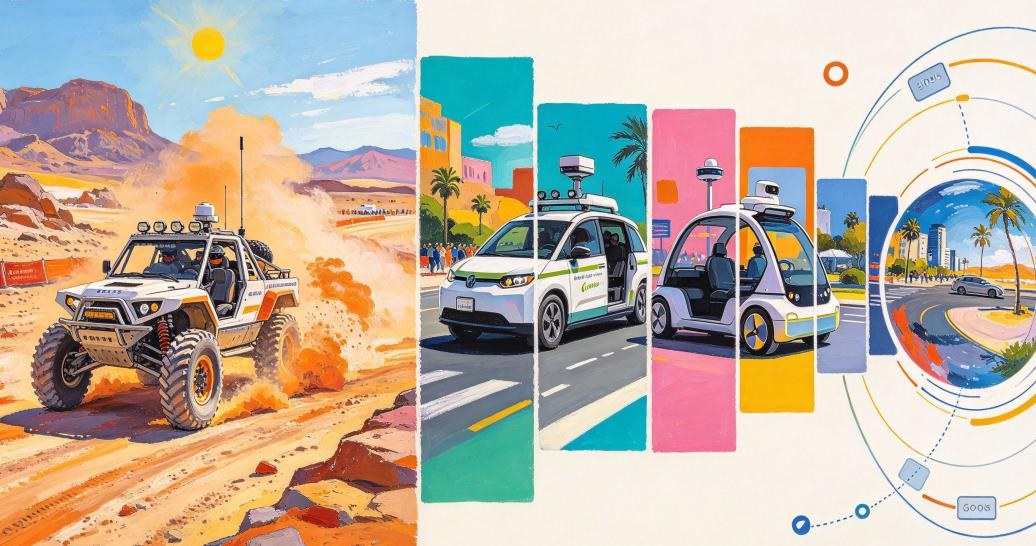
Stanford professor Sebastian Thrun and students built Stanley, an autonomous car, for DARPA’s Grand Challenge—a 132-mile off-road course in California.
Stanley finished and won.
Among the spectators were Google founders Larry Page and Sergey Brin—reportedly in disguise.
They came not only to watch but to recruit.
In 2007 Page brought Thrun into Google with nearly unlimited resources.
Thrun delivered. The 360° vehicle camera stack became Google Street View. In January 2009 he launched Project Chauffeur—what grew into today’s Waymo.
Page gave him an unprecedented title: Google’s first “director of other”—for things investors don’t get but that are cool.
Thrun alone wasn’t enough. Page also wanted Astro Teller.
Teller, a Carnegie Mellon AI PhD, had founded BodyMedia and AI investing fund Cerebellum Capital before Google.
Page said he liked Teller’s record of turning crazy ideas into businesses and hired him as “director of new products.”
On September 12, 1962, President Kennedy told Rice University, “We choose to go to the moon in this decade.” By 1969 Apollo 11 was there.
Since then “moonshot” in English means a public, time-bound, technically outrageous goal that still gets resourced and done.
Page and Brin both attended Montessori schools. Page once said that training—not obeying rules on command, self-driven, always questioning the world, doing things differently—made them a bit different.
In 2010 a semi-secret lab, Google X, sprang up under Teller and Thrun to house that moonshot culture.
Teller called Apollo the spiritual prototype of X: turning impossible into possible.
He also distilled a counterintuitive rule: asking people to make something 10× better is easier than asking for 10%—10% still races everyone on the old road; 10× forces a new one.
Google X later became X, the Moonshot Factory—and Teller “Captain of Moonshots.”
X is not a typical corporate research lab. Those improve the parent’s core business; X’s job is hard problems outside Google’s core—no revenue targets, no product deadlines.
Seen that way, Suncatcher finally makes sense.
In its official blog Google explicitly pairs it with two elders: quantum computing started 10+ years ago and self-driving 15 years ago.
Suncatcher is a new member of Google’s moonshot lineage.
Like its predecessors, it looked mad at birth. And that culture—“try the impossible first, worry about the spreadsheet later”—is the real reason Google dares to put servers in the sky.
相关文章