



a16z investors Olivia Moore and Justine Moore, with The Prompting Company, ran shopping tests on four agents: Grok Bot, Muse, Instinct, and Dots. The set was 1,270 prompts and 11,307 runs, set against YipitData's record of what people actually spent. The study says that once one agent picks a product, there is a 73 percent chance at least one other agent picks it too. In nearly a quarter of cases, all four agents' first choice was the same product.
The shortlist is short, and the winner flips when the use case is specific
The overlap comes partly from looking at very little. Meta's Muse usually searches Meta's own catalog first and pulls at most 50 candidates. Even with an extra web search, it opens three product pages on average. A person can browse for half an hour and change their mind. An agent, limited by time and search cost, often keeps a few items that are priced acceptably and reviewed well enough.
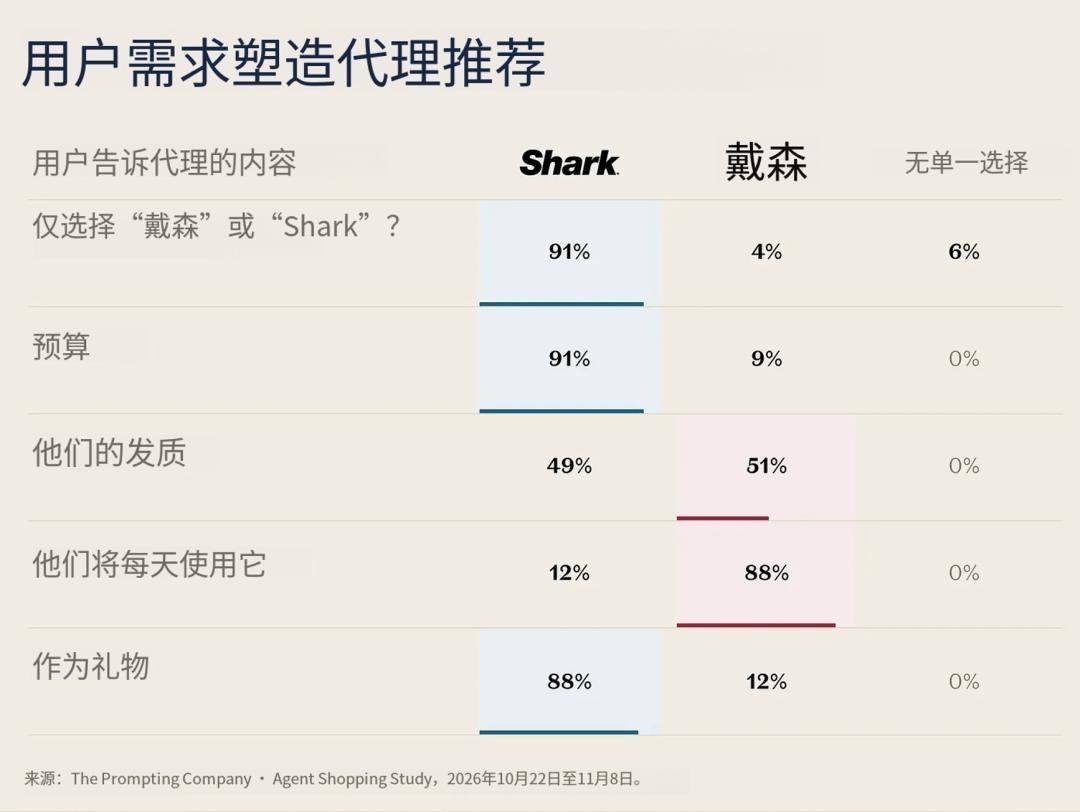
With no special need, public reviews of the Shark FlexStyle and the Dyson Airwrap were close, and 91 percent of the agents picked the cheaper Shark. When the user said they had fine hair or dyed hair, Dyson's win rate rose to 51 percent. When they said they would use it every day, Dyson rose to 88 percent. The comparison then included weight, maximum temperature, and noise. The price gap holds only in those scenes.
Software did the same thing. For ordinary graphic design, 78 percent recommended Canva and none recommended Adobe. When the user asked for professional-grade output, Adobe was every agent's first choice. The study reads that as a shift toward a product that is recognizable in a specific job, rather than one that lists more features.
Renewal, returns, and reputation get added up
When two retailers sold the same item at the same price, agents picked the one with the better return policy in 86 percent of tests. A discount under 10 percent rarely changed the decision. In 275 merchant comparisons, a cheaper seller with a weaker reputation faced a pricier one that was more trusted, and the trusted seller won 72 percent of the time. Buying a Sonos speaker, Grok Bot passed on a 200 dollar listing and recommended the same model at 250 dollars from an authorized dealer, because it included a warranty.
Domain registration makes the arithmetic plain. By agent transaction volume, Porkbun ranked ninth, the highest of any tech product. Cloudflare was 17th and GoDaddy 112th. Those two register 2.6 times and 4.8 times as many domains a month as Porkbun. The study attributes the gap to Porkbun's pricing: no cheap first year followed by a sharp renewal increase, and no complicated contract. People often look only at year one, and moving a domain is a nuisance. An agent adds up the cost over the next several years.
A checkout an agent can finish matters more than the screen, and platforms still take more than half
Dots was asked to make ten ads from a product photo and to choose the image tool itself. It looked at Midjourney first, found no general API and limits on automated use, and switched to Ideogram. Ideogram has an API, an official MCP interface, and sample code in the docs for generating and downloading an image. Image-tool listings are on AI image tools.
In stores that allowed guest checkout, agents finished the purchase 81 percent of the time. In every test that required a login first, the agent stalled early in the flow. It either asked the user for login details or changed stores.
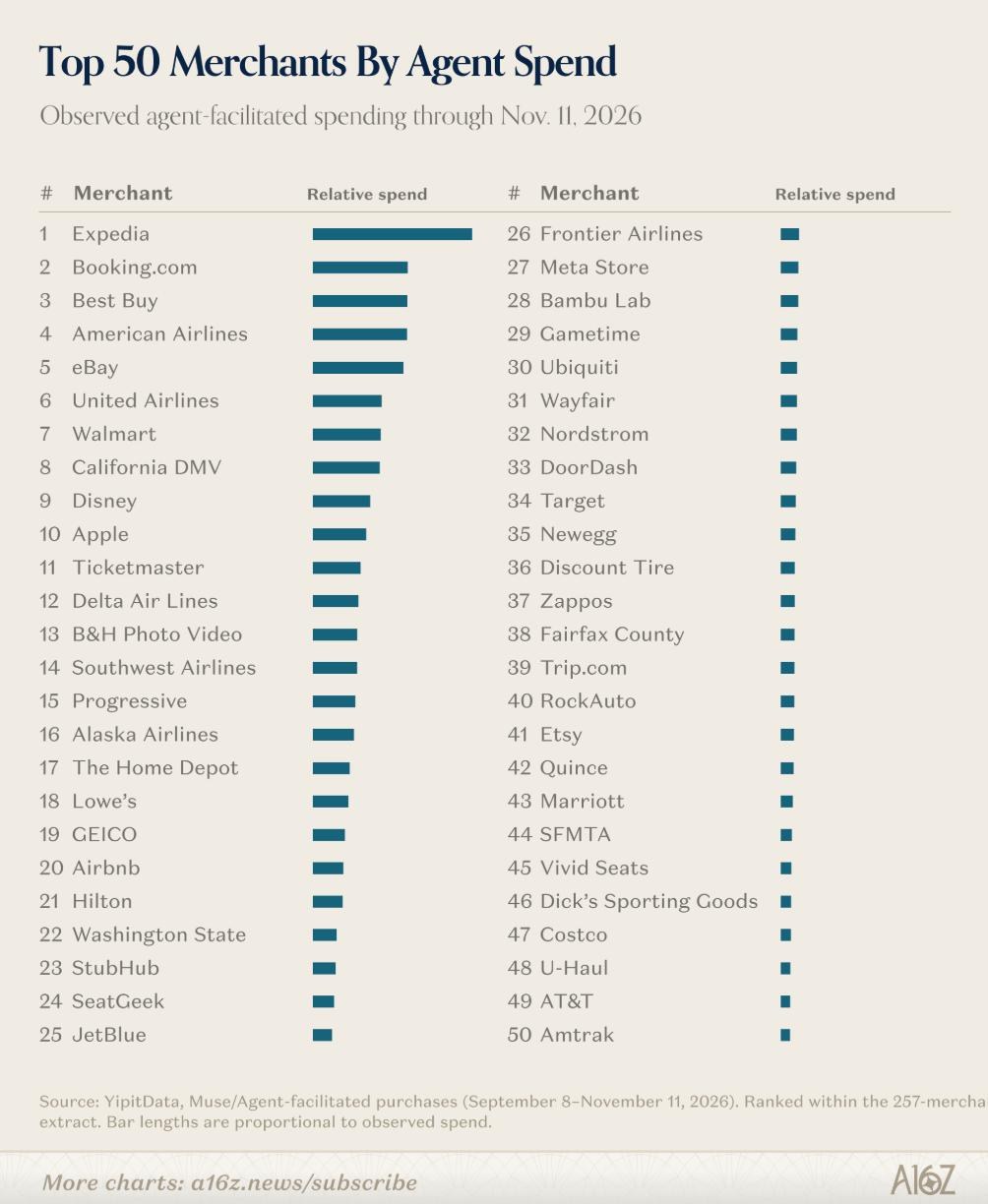
Among the top 50 merchants by agent spending, nearly a third of the money went to marketplaces and aggregators. Add retailers that also run a third-party marketplace and the share is 46 percent. Add traditional multi-brand retailers and it is 55 percent. In travel spending, Expedia and Booking.com were first and second. The same hotel was 476.20 dollars on the hotel's own site and 476 dollars on Expedia. The gap is negligible. Expedia also offered pay-now or pay-at-the-hotel. The study says that unless the user names the hotel site, the agent has little reason to go around Expedia.
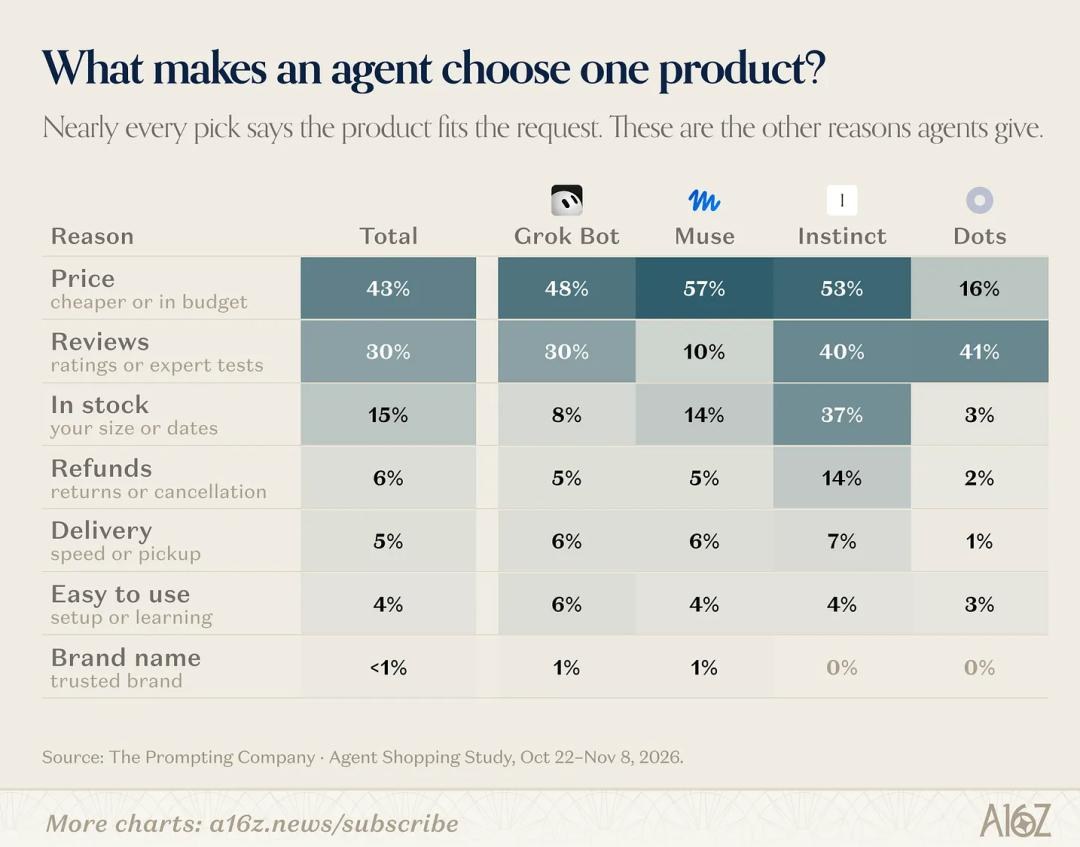
Channel preferences are already split. Of Grok Bot's search results, 17.5 percent pointed to Amazon. Each of the other three agents was under 1.6 percent. Muse pointed 26 percent of results at Walmart and 22 percent at Best Buy. Muse mentioned user reviews in only 10 percent of recommendations. The others did so 30 to 41 percent of the time. Dots weighted professional reviews more. Instinct weighted return and cancellation rules. In Amazon checkout tests, Grok Bot added the item to the cart every time. The other three were blocked. The study traces these gaps to each agent's search system, product database, and site access. It does not show that they are already paid placements.
Stripe, Shopify, and OpenAI are building catalogs, payments, and checkout for agents. a16z calls this kind of distribution B2A, business to agent. That is their label, not a market census.
FAQ
Q: What did the 11,307 runs cover? A: Four agents, Grok Bot, Muse, Instinct, and Dots, and 1,270 prompts. After one agent picks a product, there is a 73 percent chance at least one other agent picks it too.
Q: When does Dyson beat the cheaper Shark? A: With no special need, 91 percent pick Shark. If the user has fine or dyed hair, Dyson's win rate is 51 percent. If they will use it every day, it rises to 88 percent.
Q: Do agents skip the big platforms? A: Of spending at the top 50 merchants, 55 percent still went to platforms and multi-brand retailers once those retailers are included. In travel, Expedia and Booking.com were first and second.
相关文章