



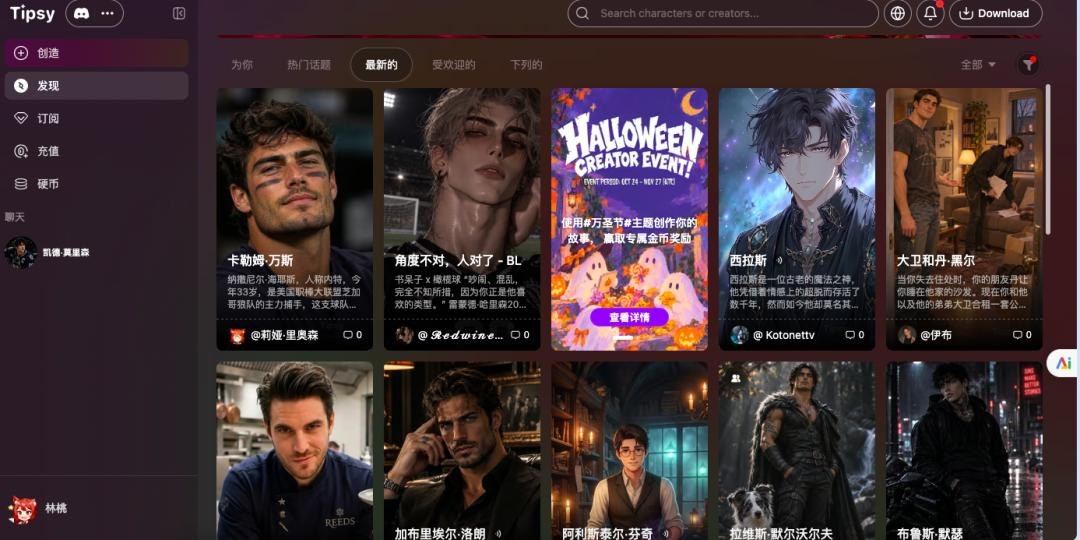
Tipsy Chat is an AI companion app founded in 2024 by former ByteDance and Alibaba employees. Users set a character's personality, looks, voice, and world, then talk by text, voice, images, video, and branching scenes. Tech Planet says the app is profitable and calls it the first profitable Chinese AI application. The public rankings show revenue, not audited profit. Sensor Tower puts Tipsy's monthly recurring revenue in August 2026 at 17 million dollars, with daily active users under 500,000.
The charts are not the same measurement
The download spike was in August 2025. The article says downloads rose 991.55 percent from the previous month, close to tenfold, with more than 350,000 new users. It showed up first in Spanish-speaking markets and later in North America. Early growth was organic. Airbridge saw active Meta ads rise from August 24 and approach a thousand by October, alongside TikTok creators and invite codes. Airbridge estimates monthly revenue rose about 21 times in 90 days, to 11.3 million dollars. That is not the same statistic as Sensor Tower's 17 million dollars in August.
Appfigures says Tipsy made 15.2 million dollars in the first half of 2026, second among AI companion apps worldwide. On Insightrackr's October ranking of overseas AI social apps it was still second, up 61.4 percent from the month before. First place was Zeta, from a Korean company. In an October interview with Silicon Star Pro, Zhu Xiaohu of GSR Ventures said two Haidian companies might reach 1 billion dollars in annualized revenue: LiblibAI and Tipsy Chat, and that Tipsy's pace showed up only in the last two months. That is a projection, not a result already booked.
ByteDance's Maoxiang is on a different chart. Sensor Tower says that in the first quarter Doubao was first in China for iOS generative-AI downloads and active users, while Maoxiang was first in revenue. Maoxiang's iOS in-app purchases alone topped 22 million dollars that quarter, ahead of Jimeng AI and Kimi. A Changjiang Securities compilation shows Maoxiang's monthly active users rising from about 3.07 million in August 2024 to about 6.88 million in December, then falling. In July 2026, after Doubao and other general apps changed their agent features, some role-play demand moved to standalone companion apps. Jimeng's tool page is Jimeng.
Sensor Tower also says AI companion revenue rose from 316 million yuan in January to 656 million yuan in August. The gain was concentrated in the leaders. One app was close to 20 percent of the total, and at least one app was taking in more than 100 million yuan a month. In January the highest single app was a little over 20 million yuan. The article does not name Tipsy or Maoxiang as that 100 million yuan app. Kimi's annualized revenue above 1 billion dollars in August, still unprofitable, is a comparison in the same piece, not a companion-app figure.
Gems and cat food, not unlimited chat
Character.AI once charged 9.9 dollars a month for unlimited conversation. Figures cited in the article put its August 2026 revenue at about 5.3 million dollars, 2.8 million from subscriptions and 2.5 million from ads, against about 13.3 million dollars in monthly operating costs, a net loss of 8 to 9 million dollars. Compute averaged as much as 13.8 million dollars a month in the second half of 2024 and totaled 56.1 million dollars in the first eight months of 2026.
Tipsy runs an in-app gem loop. Creators earn gems from invite codes and content. Users spend gems to unlock scenes. A subscription does not mean unlimited use. Maoxiang uses "cat food." Chat can start free, and the paid steps appear as the relationship deepens. A rolling monthly membership is 25 yuan. Cat food is priced from 1 yuan and 8 yuan up to 98 yuan. An industry observer estimates Tipsy's revenue per paying user at 90 to 100 dollars a month. That is an estimate, not a company filing.
Zhang Chenfa, CEO of Endless Love (Shanghai) Technology, says plain text is relatively cheap, while voice, video, and multiple characters can cost ten to several dozen times more. Tokens are still the largest cost for many products. He expects content to take a larger share later. A founder in the category says everyday chat can run on a tuned cheaper model, and that a stronger model is needed for complex plot, emotion, long memory, and turning points in a relationship.
Fewer users, with time spent and repeat pay called out separately
In July 2026 Doubao had 338 million monthly active users. Jimeng's app was in the tens of millions. Maoxiang was mostly between 1 and 2 million, with a peak above 3 million. Tipsy's monthly active users in August were 3.07 million. That is not the same measure as the "under 500,000 daily active users" in the opening. Analysys Qianfan says that in July Maoxiang's average daily use was 14.8 minutes, against 11.6 for Doubao and 7.5 for Jimeng. One founder says repeat payers on some companion apps reached 30 percent.
A person familiar with the business says Tipsy is already profitable, with margins moving toward those of mobile games, and that Maoxiang has the users but profitability is still open. An intern's Xiaohongshu post in October said the parent company, Xinghe Juexing, already had a mature product and the ability to make a profit. A job listing that says the company has found product-market fit, and an intern's post, are not financial statements.
More than one founder told Tech Planet that the core users are women over 30, possibly more than 90 percent. That is what practitioners said. The article does not cite a survey.
Appfigures says that as of July 2025, among 337 AI companion apps worldwide that made money, the top 10 percent took 89 percent of revenue. A hit character is copied quickly. Zhang says that outside the large labs, few startups train a foundation model from scratch. The gap is in product definition, prompts, the knowledge base, memory, relationships, IP, and distribution. Remembering basic facts is the easy part. Keeping a personality steady over dozens or hundreds of turns, carrying shared history forward, and still allowing the character to change, is where the engineering cost climbs.

FAQ
Q: Is Tipsy profitable, and did it beat Maoxiang? A: The profit claim comes from Tech Planet's sources and an intern's post, not an audited statement. On overseas companion-revenue charts Tipsy is second, behind Zeta. Maoxiang was first in China iOS AI app revenue in the first quarter.
Q: Why do 17 million dollars and 11.3 million dollars both appear? A: 17 million dollars is Sensor Tower's monthly recurring revenue for August 2026. 11.3 million dollars is Airbridge's estimate of monthly revenue after a roughly 90-day rise.
Q: Which app makes more than 100 million yuan a month? A: Sensor Tower's category data says at least one app has crossed that line, and that one app is close to 20 percent of category revenue. The article does not name it.
相关文章