



On Nov. 24, ByteDance's Doubao announced that its personal assistant, Xiaodou, was opening a public beta on the Apple and Android app stores. Access uses an invite code, and the beta includes a limited free allowance. The company describes it as a Doubao that knows you and can go do things for you. It is an experiment in personal agents. The same capabilities are meant to reach the main Doubao app over time. The day before, some coverage was still asking whether the large Chinese internet companies would hold back. Tencent's Xiaowei is still in a small gray test. Alibaba's Qianwen Go sits inside the Qianwen app and requires an application. Xiaodou went straight to a public beta.
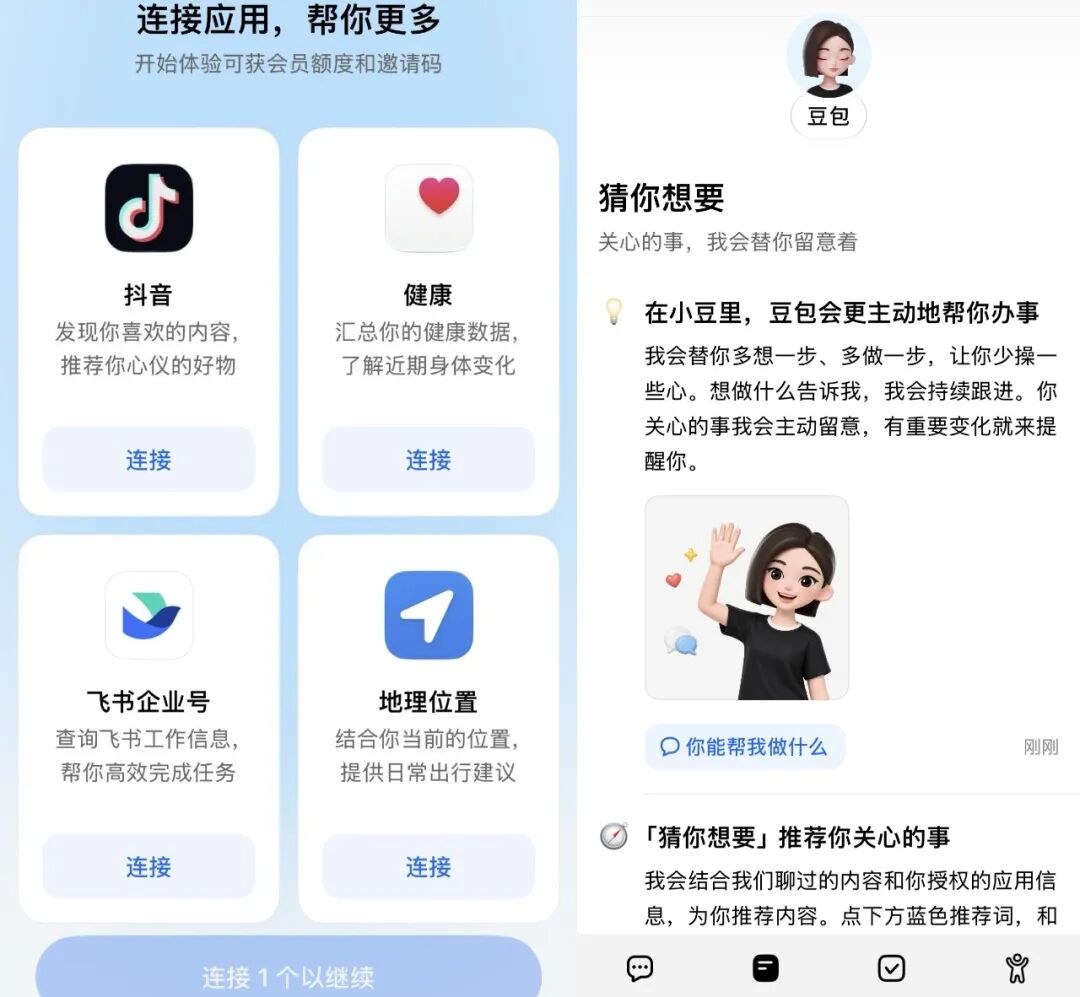
It keeps working after you leave, and it can call a shop that has no API
From the published features and the article's own tryout, the product is built around memory, proactive service, and task execution. A user states a task in text or voice and can leave the screen. Xiaodou continues in the cloud. It can create calendar items, to-dos, and timed reminders, watch a product's price and a group-buy coupon's expiry, and warn about a schedule conflict. With permission, it can take the next step.
After login it asks to connect Douyin, Feishu, system health, and the calendar, so meetings, private plans, exercise, and sleep sit in one place. Life services currently run mainly through Douyin: orders, after-sales, nearby stores, and restock reminders based on how often someone buys. The article's example is cat food. After a purchase, Xiaodou can use the buying and usage pattern, ask whether to reorder when it expects the bag to run out, and set the next reminder.
The other distinct feature is placing a phone call. For a restaurant or hotel that still has no full online API, Xiaodou uses the time, party size, and preferences the user gave, calls with an AI voice, asks about seats, private rooms, and fees, then sends back the recording and the result. That is the article's description of the path, not an independent check of each call.
The services were not built from nothing. In September Doubao and Cao Cao Chuxing launched AI ride-hailing, first in Beijing, Hangzhou, and Suzhou. On Sept. 30 Doubao added flights, train tickets, rides, and route navigation under one entry called travel with Doubao. On Nov. 24, the same day as the Xiaodou beta, the Doubao app began a gray test of Doubao Shopping, with its own top-level item in the sidebar. A user describes what they want in ordinary language. The shopping page is tied to the Douyin mall. The main app holds instant questions and the transaction entries already connected. Xiaodou is the test of longer tasks, cross-app permission, and a report back on what was done.
Muse's retention, and three different walls
Meta launched Muse in North America on Sept. 8. The article says it passed 10 million users in a little over two months. OpenAI's Dots, Google's Gemini Spark, xAI's Grok Bot, Huawei's Celia, and the Chinese startup Today AI are also building personal assistants. How Muse shops is covered in the four-agent shopping test.

Siana Marketing, in a report dated Nov. 17, said that as of Nov. 1 Muse had about 12.92 million accounts and about 3.09 million daily active users, with 7-day retention of 29.4 percent and 30-day retention of 17.1 percent. The account and daily-active counts say people arrived. Retention under one in five at 30 days says handing work to the agent every day is not yet a habit.
Alibaba's Qianwen Go, launched Oct. 13, can call Taobao, Alipay, Amap, Fliggy, and Damai after the user authorizes it. In public tryouts it has handled a delayed flight, a Taobao price-protection claim, and a restaurant booking. Inside the group, Taotian, Amap, and Ant's Lingguang 2.0 are still building their own vertical agents. On Tencent's side, the Yuanbao open platform takes third-party skills, and office work sits in WorkBuddy. Xiaowei is still a gray test around WeChat and mini programs. The article says it has not yet reached the open internet, and sensitive actions still ask the user to confirm.
345 million monthly users is not the same as handing over the errand
QuestMobile says that in the first quarter of 2026 Doubao had about 345 million monthly active users, about 140 million daily, and 54.8 uses per person per month. That is the base of a chat product. In a public conversation in late October, Zhu Xiaohu of GSR Ventures said most people do not have a secretary and do not need one. His point is that high-frequency life services in China already live in super apps and mini programs, and that Muse scenarios such as trip planning and negotiating a bill may not be strong demand there. Renewal reminders, one-tap price protection, online customer service, and mini-program bookings are a few steps inside an app people already open.
Cost is not covered by a published Xiaodou price. One technical team's estimate puts the hard cost of a separate computing environment and a reliable network identity at close to 50 dollars a month per user, before the tokens spent on continuous monitoring. That estimate is not Xiaodou's price. Muse overseas uses a free tier and paid tiers. Zhu's judgment is that even a heavy knowledge worker might pay only 50 to 100 yuan a month for an office agent. If the model shifts to a cut of transactions, the more an agent skips search and recommendation pages and goes straight to checkout, the more the platform's existing ad revenue has to be rebuilt.
FAQ
Q: Who can use Xiaodou now? A: It opened a public beta on Apple and Android stores on Nov. 24. It requires an invite code and includes a limited free allowance. The company says the capabilities will later reach the main Doubao app.
Q: How is it split from the main Doubao app? A: The main app already has rides, flights, train tickets, and a gray-test shopping entry. Xiaodou is testing long-term memory, proactive reminders, background tasks, and phone calls to offline businesses that still have no API.
Q: Are Muse's 10 million and 12.92 million the same count? A: Passing 10 million users is the article's figure for a little over two months after launch. The 12.92 million accounts, 3.09 million daily users, and 17.1 percent 30-day retention are Siana Marketing's report as of Nov. 1.
相关文章