


OpenAI has reportedly broken up its robotics team again this week, about five months after Sam Altman posted a hiring call in May. The original group moves into core research and reports to Mark Chen. Applied robotics and hardware move under president Greg Brockman. At the Conference on Robot Learning in Austin the same week, the app and the map still listed OpenAI, and booth 208 had no robot.
The people remain, the dedicated team does not
This is the second time OpenAI has pulled the robotics team apart. The report says the first break-up, in 2020, followed Altman’s view that collecting robot data was too slow and that large language models were the path to AGI. The team was rebuilt in 2024 and partnered with the humanoid company Figure. In February 2025 the two sides split. OpenAI said it would build robots itself and talked about a first public demo in 2027. This week’s change comes before that date. The cooling of humanoid funding is in funding cools.
The report stacks two reasons. General models are starting to drive robot control, and OpenAI is cutting work that does not pay. It reportedly lost $10.9 billion in the latest quarter, and had already shut Sora, which was not making money.
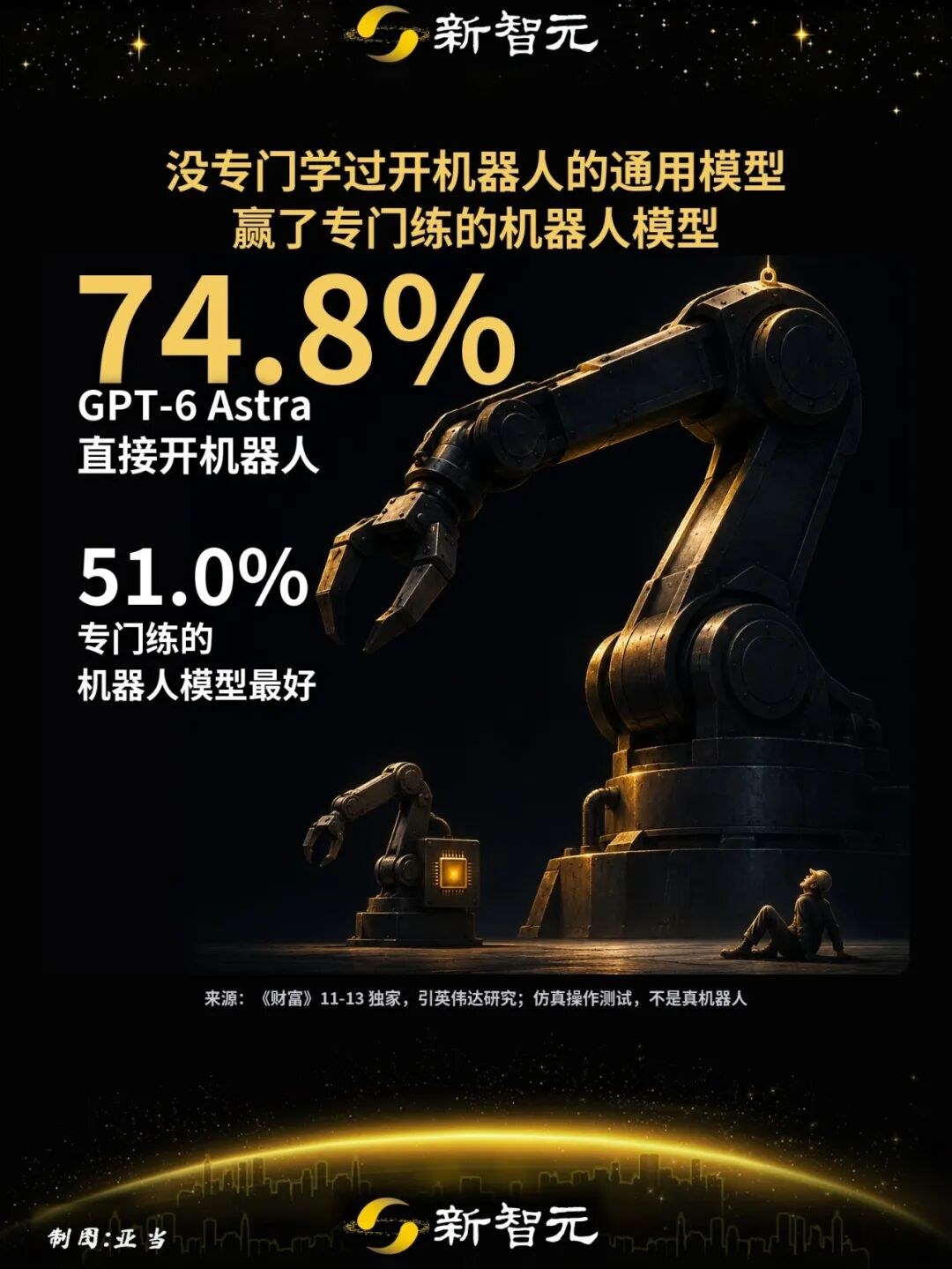
74.8% is a simulation, not a factory robot
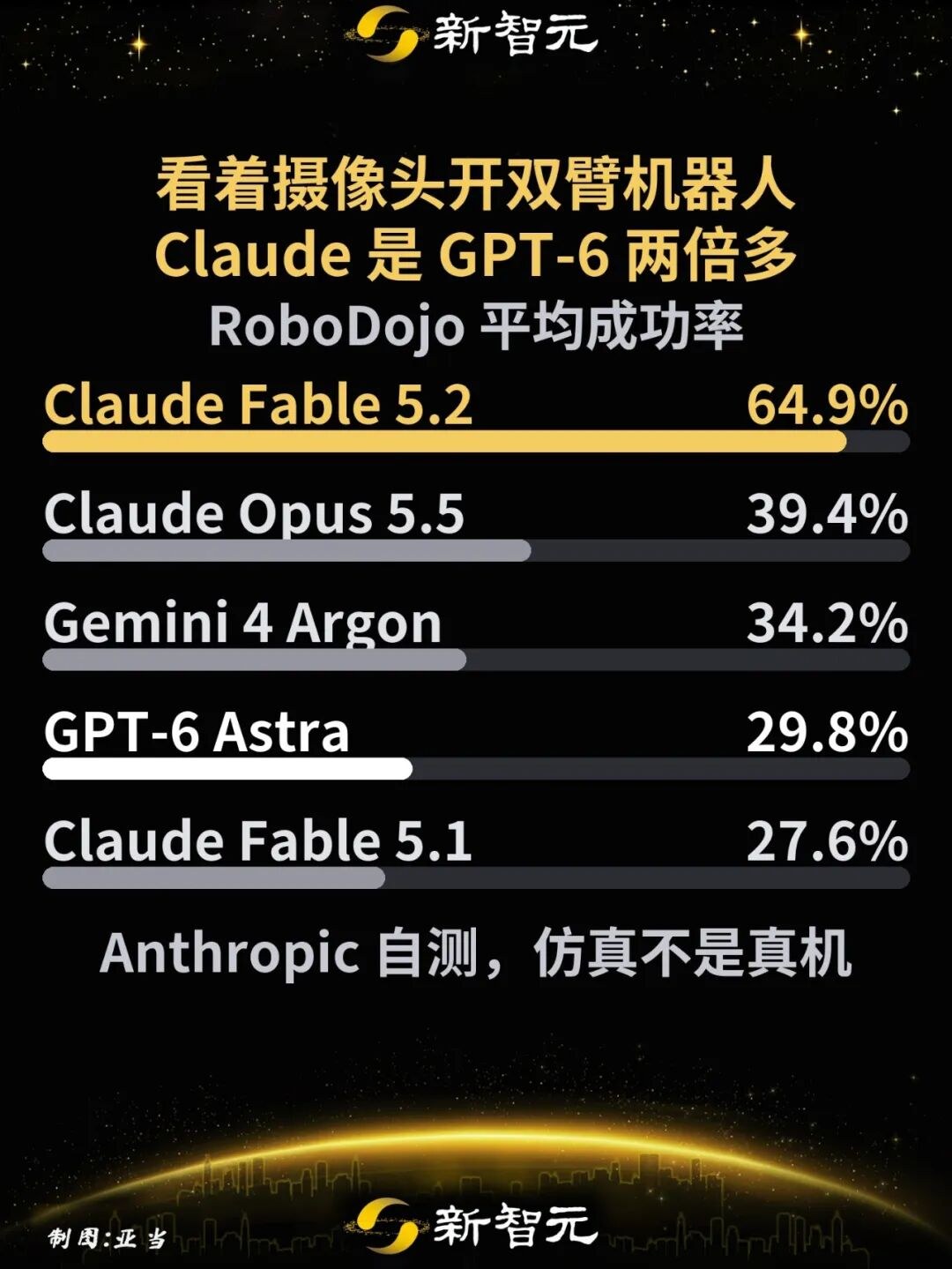
The report says GPT-6 Astra was given three inputs in the test: camera frames, the robot’s own state, and a control line. It was not trained the old way, with real-world data and a separate model for one job. In an Nvidia simulated-arm test, the agent driven by Astra succeeded 74.8% of the time. Specialized robot models in the comparison, trained task by task on real machines, topped out around 51%. In the same simulation, GPT-6 Astra’s success rate was less than half that of Claude Fable Astra.
Five days earlier, Anthropic posted an official Fable 5.2 video: two arms solving a cube, opening a bottle cap, fitting gears, and drawing a robot with a pen. Anthropic said the model had not been trained on those tasks. The video is not at real speed. The cube took 40 minutes. About four months earlier, Claude, driving a robot dog, said a bin was on the left, then caught a leg in it and dragged the bin more than two meters. The gap shows how fast the demos moved, and how unsteady the spatial call still was.
What a robot company still has
The report quotes a Carnegie Mellon professor: inside OpenAI, robotics is no longer a special problem. It sits downstream of general intelligence, like coding, legal, and finance tools. An MIT professor’s point in the same piece is the part labs cannot take: real work data from the factory. The stronger the base model, the more that data is worth. The report says Figure’s valuation was talked up to $40 billion on the bet that a robot needs a custom brain.
The limits are in the second half. The model runs in the cloud, so a motion waits on the network. A stall, and the cup can already be broken. A test by Tsinghua and others put the cost of one run of Astra on a dual-arm robot, at the highest setting, at $12.50. Following an instruction is the easier part. Force and two-hand coordination still need a small model trained for the job. The 74.8% figure is a simulation rate, not a line that has already changed brains.
FAQ
Q: Did OpenAI stop doing robotics? A: The dedicated team was reportedly broken up this week. Those people join core research under Mark Chen, and applied robotics and hardware report to Greg Brockman. The report does not say that no one at OpenAI works on robots.
Q: Was the 74.8% measured on a real robot? A: No. The report describes an Nvidia simulated-arm test. The specialized models it compares topped out around 51%, and those were trained task by task on real machines, so the training conditions differ.
Q: Why is a general model not yet a robot’s brain? A: It runs in the cloud and waits on the network. A Tsinghua-led test put one dual-arm run at the highest setting at about $12.50. Force and two-hand coordination still depend on a small model trained for that job.
相关文章