



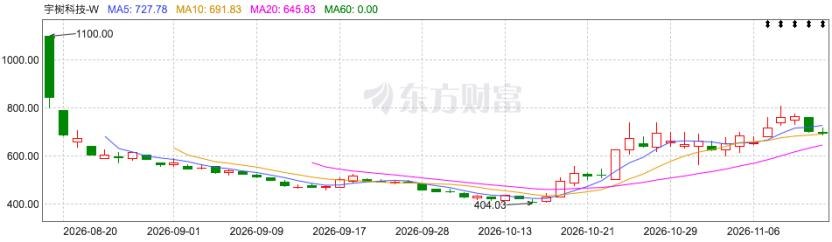
In the second half of 2026, China’s humanoid-robot boom turned into a funding squeeze. Embodied-AI companies raised about RMB 93.5 billion in the first half, roughly five times the year-earlier period. October brought only 33 deals, about half of September’s 60. Unitree listed on the STAR Market on August 19 at a first-day market cap of about RMB 444.9 billion. On November 13 it closed at RMB 696, with a market cap of RMB 281.5 billion, about 36.7% below that first-day value.
Prototypes were enough to raise money in the first half
Industry tracking put first-half 2026 embodied-AI funding at about RMB 93.5 billion. Companies valued above RMB 10 billion rose to 20, and more than 50 robot firms were aiming at an IPO. The private-market rule of thumb was simple: a humanoid prototype was enough for a high valuation. For two years, a framework agreement could be folded into a valuation, a data-center letter of intent could be packaged as revenue, and a walking demo could support a multi-billion-yuan round.
The second half cut deals in half and narrowed the IPO window
October saw 33 embodied-AI financings, against 60 in September. Leju, Zhongke Innovation and Zhejiang Huandong ended their listing processes. Zhiyuan turned to private financing. Regulators are asking who actually paid, and investors are counting how many months of cash are left. Some companies with a clearer delivery story are still raising, including Youliqi Robot’s RMB 500 million Pre-A, but those are no longer the default.
Unitree wrote the reversal into its share price. The issue price was RMB 150.80. It opened at RMB 1,100 on day one, implying a market cap of about RMB 444.9 billion, then fell as low as RMB 404. By the November 13 close it was RMB 696, and the market cap was RMB 281.5 billion. Early buyers priced it as an embodied-intelligence platform inside the AGI chain. After the drop, the filings showed the tension: revenue growth came from whole machines and parts, while the humanoid share stayed low; R&D and inventory kept rising and ate into profit; many deliveries were prototypes and pilots, not repeat factory orders.
Three tests: use case, revenue, and valuation
On use cases, most robots sold so far go to research, education, data collection, performance and display. Unitree’s interim report split revenue as 73.6% research and education, 17.39% commercial and consumer, and only about 9% combined for industrial manufacturing, inspection and logistics. A real production line has to clear economics, uptime and liability. That is a different demand from a demo.
On revenue, Mech-Mind founder Shao Tianlan criticized “arranged” companies in September. The pattern is a loop: sell robots to a related party, a shareholder-controlled data center, or a partner; that buyer collects physical data; the dataset is sold back to the robot company. Each invoice can be real, and still not point to demand that lasts. The loop can dress up a filing, support a valuation, and help an IPO.
On valuation, the old yardstick was technology, a prototype, a famous team and a hot round, a bet on landing in three to five years. Buyers now want ROI in one setting, whether in-house parts keep cutting cost, repurchase by unrelated third parties, and engineering numbers such as downtime and maintenance cost. If a general-purpose humanoid takes eight to ten years, or longer, the present value of that option shrinks. Foreign reports say the China Securities Regulatory Commission, in a closed-door meeting, told large brokers and banks to slow IPO work, finish deals already under review, and not take new filings for now.
The next contest is delivery, not the story
Guotai Haitong says humanoids have entered a “delivery pricing” phase, with attention moving from technical feasibility to repeat orders and the ramp of capacity. CICC is blunter: the global industry’s driver is shifting from theme investing on a technical vision to volume production and orders in real settings.
Over the next three to five years the fight sits in three places. First, a foothold in dirty, repetitive work such as industrial inspection, logistics sorting and special operations, where a single commercial loop can be closed. Second, cost and volume, as domestic core parts pull the machine price down and scaled delivery sets the profit floor. Third, data and models, where the volume and quality of data from real robots set the ceiling of the “brain.” The private-market funding cliff and the public-market rerating point to the same change: capital will not pay for the story alone. More of this coverage is in AI news.
FAQ
Q: How much did humanoid funding cool in 2026? A: Embodied-AI firms in China raised about RMB 93.5 billion in the first half, about five times the prior-year period. October had 33 deals versus 60 in September. Leju, Zhongke Innovation and Zhejiang Huandong dropped their IPOs, and Zhiyuan moved to a private raise.
Q: How far has Unitree’s market cap fallen since listing? A: It listed on August 19. The first-day open implied about RMB 444.9 billion. On November 13 it closed at RMB 696, a market cap of RMB 281.5 billion, about 36.7% below the first-day value. The intraday low was RMB 404.
Q: What is “arranged” robot revenue? A: Robots are sold to a related party or a shareholder-controlled data center, which collects data and sells the dataset back to the robot company. The invoices can be genuine without showing durable outside demand.
相关文章