

After Huang’s Exit, Wall Street Says Nvidia’s Next Compute Financing Round Gets Harder and Pricier
After Jensen Huang stepped down as Nvidia’s CEO, Wall Street put the pressure on compute financing, not on contracts already signed. Goldman Sachs kept a Buy rating but cut its price target from $300 to $220, arguing that deals of the same scale will be harder without his pull. As of July 26, Nvidia’s equity-investment book was about $99 billion, and future purchase, lease and guarantee commitments totaled about $530.5 billion.
How large the commitments already are
Equity stakes are only the visible part. About $99 billion sits in AI labs, newer cloud providers, customers and suppliers. The largest piece is $30 billion in OpenAI. Nvidia also has a roughly $20 billion Groq licensing deal and a proposed $12.9 billion acquisition of Hugging Face. Many of the companies it backs later buy its chips, which is why the market calls it the “AI central bank.”
Off-balance-sheet promises are larger. As of July 26, future commitments for chip purchases, cloud services, data-center leases and compute buybacks, plus guarantee caps, totaled about $530.5 billion. Chip and capacity purchase commitments were about $279 billion. The guarantee for OpenAI’s Ohio data center was about $105 billion. The leadership timeline is in the petition to bring Huang back.
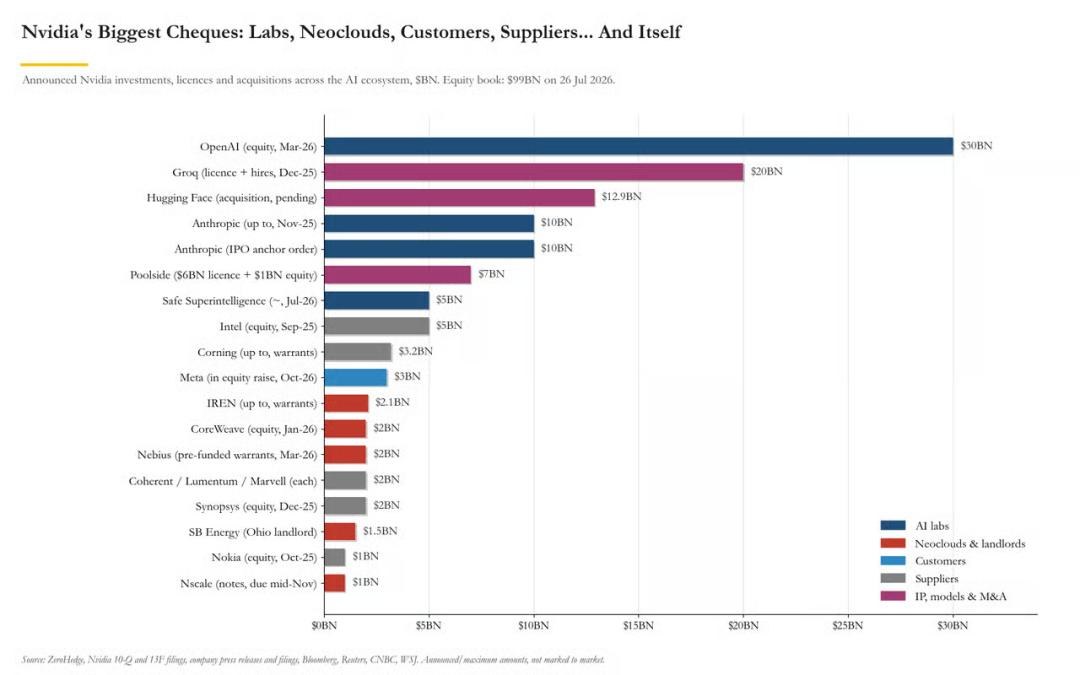
Dark blue marks AI labs (OpenAI, Anthropic). Purple marks licensing and M&A (Groq, Hugging Face).
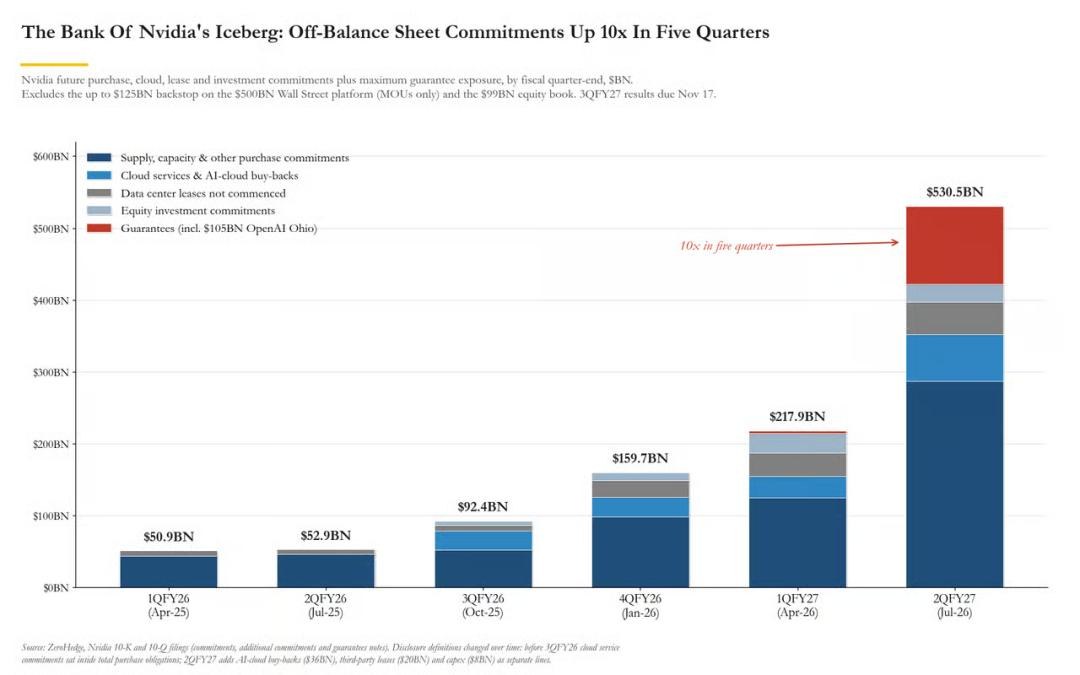
Dark blue is purchase and investment commitments. Red is guarantees, including the OpenAI Ohio project and site power for cloud providers.
Analysts worry about the next round, not the old contracts
Goldman analyst James Schneider kept a Buy on November 13 and cut the target from $300 to $220. He expects Nvidia to honor what it has already announced, but says matching multi-party deals will be harder without Huang’s vision and convening power. He also noted that the stock had traded at a clear discount to the market partly because investors fear AI-infrastructure growth could slow if Nvidia and peers stop providing financing.
UBS analyst Tim Arcuri ranks financing as the area most exposed to the departure. Even if new leadership keeps the strategy, the willingness and ability to push these deals may pause. UBS estimates that a large share of quarterly free cash flow has been recycled into the AI stack. A pause could pull more than $50 billion out of the ecosystem, at least for a while, just as rates rise and some credit markets tighten.
William Blair analyst Sebastien Naji says signed contracts do not fall away with a CEO change. The risk is the next round of deals, and Nvidia’s share from 2027 onward could face a harder push from Broadcom and AMD. One cloud provider, according to reports, is already reconsidering Google or AMD chips because of the uncertainty.
The guarantees matter because many borrowers are weak credits on their own. Cash-burning labs and smaller clouds pay up to borrow alone. Nvidia’s name is what lets lenders offer a lower rate. Stress is already visible: Australian AI cloud Firmus withdrew an IPO in October, and CoreWeave’s euro bonds still trade around 80 cents on the dollar. Raymond James’s Sunaina Sinha Haldea says money will not necessarily leave, but lenders can demand more return for the uncertainty and ask harder questions about who bears the risk.
A $500 billion platform with no first deal after three months
In August, Huang and six Wall Street asset managers launched a $500 billion AI financing platform. Three months later it still has no closed deal. The idea is to let companies borrow against GPUs to buy chips, with Nvidia backstopping up to $125 billion.
The sticking point is the backstop ratio. Nvidia said it would cover at most 25% of the loss on a deal if GPU collateral falls in value. Over the past month, some customers and Wall Street partners have asked for a higher share, because Broadcom guarantees far more. In May, Broadcom guaranteed $30 billion of a $35 billion Anthropic debt deal, and it is discussing a guarantee of about 72.5%, or $43 billion, on another $63 billion transaction.
Reports say the platform’s first deal could be announced as early as January. Whether that date holds after Huang’s exit is unclear. Nvidia and the six managers still have only a preliminary letter of intent. A definitive agreement is not signed.
The interim CEO is tighter on terms, not opposed to the strategy
Interim CEO and CFO Colette Kress, who now oversees investment and guarantee decisions, has been more cautious on these deals, according to reports. During Huang’s financing push she asked how deals were screened, how guarantees were valued and how returns were calculated, and she tried to rein in financing projects led by his son-in-law, Nico Caprez. She is also credited with renegotiating the OpenAI Ohio project and cutting Nvidia’s initial commitment in half.
At an internal meeting in August, Huang cut off her presentation and called her “a deer in the headlights.” In public she has defended the deals. In late August she said some people would call it circular financing, but the company sees it differently, and that the returns would be excellent. Her caution shows up in terms and risk, not in rejecting the strategy.
Nvidia reports fiscal third-quarter results on November 17 Eastern time, Kress’s first earnings call as interim CEO. Progress on the $500 billion platform, and the guarantee policy after that, will be what analysts press. More coverage is in AI news.
FAQ
Q: How much has Nvidia already committed across the AI stack? A: As of July 26, the equity book was about $99 billion. Future commitments for chips, cloud, data-center leases and compute buybacks, plus guarantee caps, totaled about $530.5 billion.
Q: Do signed investments and guarantees lapse because Huang left? A: Goldman and William Blair both expect announced commitments and signed contracts to be honored. What they doubt is the next round of deals at the same scale, which they expect to be harder and more expensive.
Q: Why has the $500 billion GPU financing platform not closed a deal? A: Three months in, nothing has closed. Nvidia will cover at most 25% of losses if GPU collateral depreciates, and some customers and partners want a higher share because Broadcom guarantees more. A definitive agreement is also still unsigned.
相关文章