


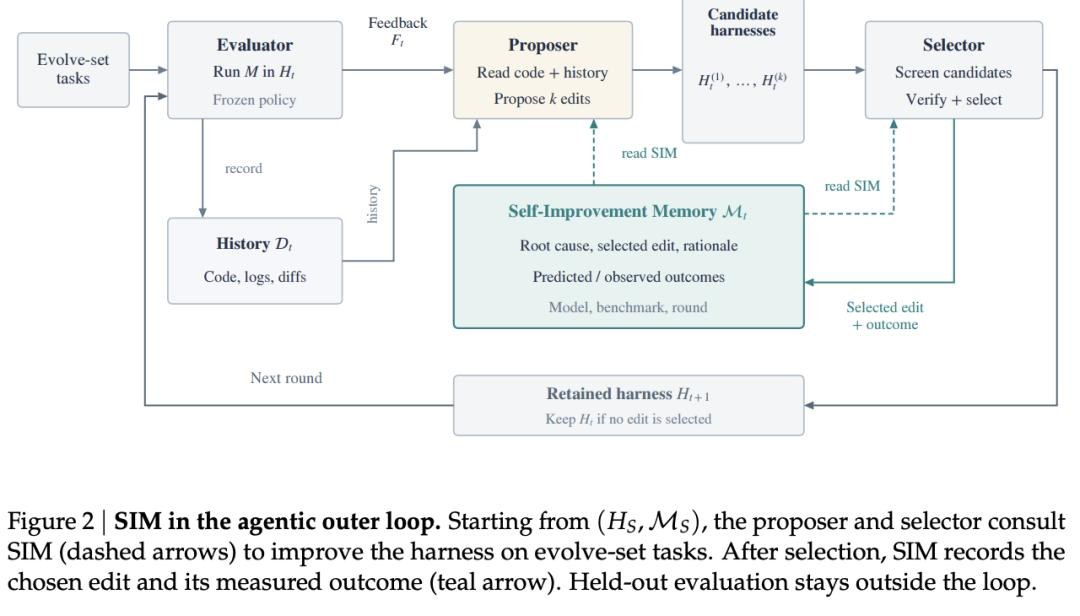
On Nov. 13, researchers from Google Cloud, Google DeepMind, and Penn State posted Self-Improvement Memory Enables Continual Recursive Self-Improvement on arXiv (2611.18856). The paper is about the harness around a model: prompts, tools, and gates. It does not change model weights. Self-Improvement Memory (SIM) records what the optimizer changed, why, the predicted and observed outcomes, and which model and dataset were used. Policy weights stay frozen in the experiments.
Passing the code alone is often worse after a model switch
The setting is called CRSI: harness optimization that continues after a compatible benchmark or policy model changes. There are four conditions. Cold Start begins from the seed harness. Harness Transfer inherits only the evolved code. Problem-Only Memory passes the earlier problems without the edit details and results. Full SIM passes the harness and the full log.
In the cross-model setup, source RSI uses Claude Opus 5.5, then Gemini 3.8 Flash continues on the same benchmark. On the workspace tasks, an Opus-evolved harness starts at 68.41 on Gemini, below the seed harness at 73.89. From that same 68.41, code-only continuation ends at 73.42 and Full SIM at 84.75, a gap of 11.33 points. Across four domains, Full SIM beats code-only continuation by 3.60 to 11.33 points, and it also finishes above the root-cause-only condition. Code-only continuation still finishes below Cold Start in three of the four domains.
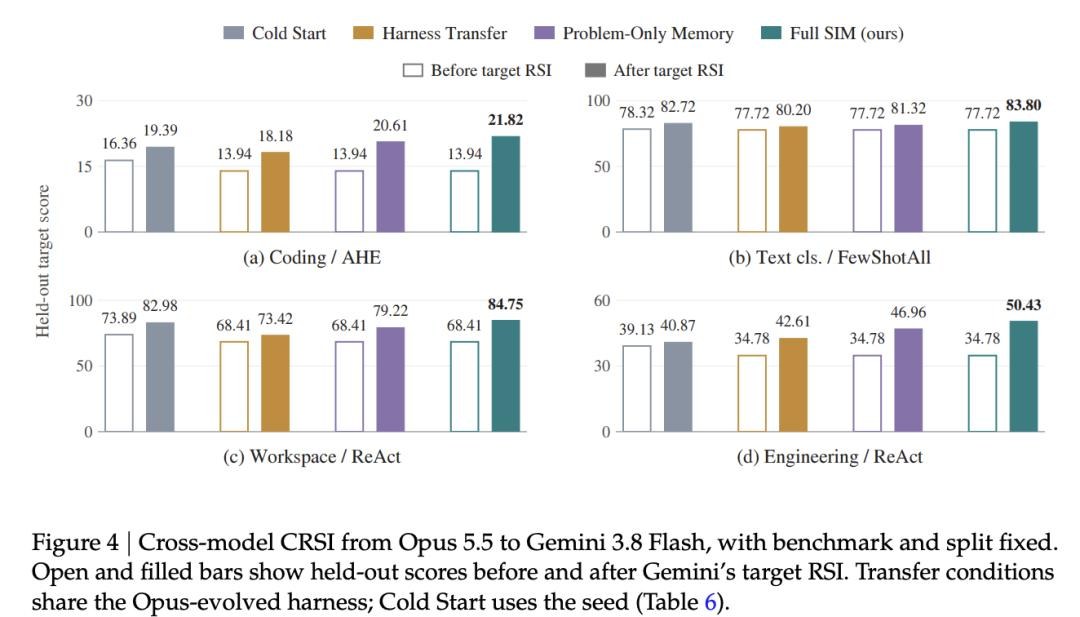
On coding, ten independent source runs are continued as pairs. SIM is ahead on nine of the ten, by 2.36 points on average, with p=0.003. Text classification shows the same kind of drop at the start: a source-evolved FewShotAll harness scores 72.92 on the target suite, below the seed at 75.72. The cross-dataset runs use Gemini 3.8 Flash on both sides. The paper says that, under the stated budgets, Full SIM beats harness-only and root-cause-only continuation in six cross-dataset settings and four Opus-to-Gemini settings.
One appendix case is a completion gate. Without SIM, the same run edits that gate four times, twice to repair completion deadlocks it created, and attributes the inherited gate to its own first round. The paper notes that a gate which only checks whether commands ran may also need to check whether a feasible solution is optimal once the task changes. That is the harness rule carrying forward. It is not the model weights remembering the previous model.
One row does not beat starting over
A separate table reports success rates on held-out TB2.1 for an unevolved seed, a fresh RSI run, and CRSI with SIM. Gemini 2.5 Flash is 17.8, 21.4, and 22.4. Gemini 3.5 Flash is 70.2, 73.3, and 76.8. Gemini 3.8 Flash is 87.2, 88.9, and 90.5. Gemini 4 Argon is 89.7, 95.6, and 94.8. On that last row, optimizing from scratch at 95.6 is above continuing with SIM at 94.8. The paper does not show that every next generation scores higher.
Gemini 4 Neon, released in the same period, is a product model. See Gemini 4 Neon and Genie 4. The paper does not say that SIM caused that release. A footnote says the work was done while first author Xin Yu was an intern at Google. His affiliation also lists Penn State.
FAQ
Q: Is SIM the model's own memory? A: No. The paper assigns it to the harness optimizer, and the policy weights stay frozen. The log groups recurring problems and stores the rationale, predicted outcome, observed outcome, and the model and dataset used for the evaluation.
Q: Can a harness evolved on Opus be dropped onto Gemini? A: In the workspace experiment it starts at 68.41, below Gemini's seed harness at 73.89. With the full SIM log it later reaches 84.75. Code only reaches 73.42.
Q: Does SIM win every comparison? A: Against code-only and root-cause-only continuation, the paper's cross-dataset and cross-model comparisons favor Full SIM. Against starting over, Gemini 4 Argon on held-out TB2.1 is 94.8 versus 95.6, so the SIM cell is lower.
相关文章