



Megaspeed Imported 4.13 Billion Dollars of Nvidia Products as the US Extends Rules to Remote Compute
7 Road, registered in Singapore in 2015, was renamed Megaspeed in 2023. It moved from overseas game publishing into cloud computing and joined Nvidia’s cloud-partner program. Disclosed trade records show 4.13 billion dollars of Nvidia products imported by the related business from May 2024 through February 2026. In November 2025 alone it imported 17,454 GB300 chips, worth about 787 million dollars. The model is to buy complete GPU servers, put them in data centers in places such as Malaysia, and rent out the compute. On 16 November 2026 the US Commerce Department brought remote access to advanced chips into its license review.
The chips sit in Malaysia. The customer is on the network
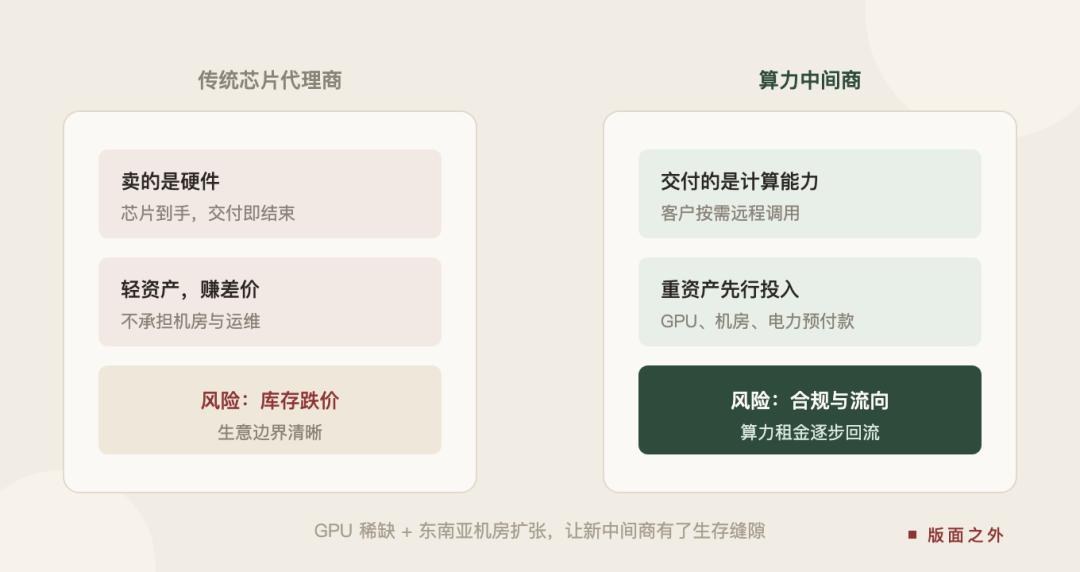
A traditional reseller sells hardware. Megaspeed delivers compute that can be called remotely. Singapore is the region’s data-center and money hub, but land, power, and energy limits constrain new halls. Johor, next door in Malaysia, has more land and power and has taken the data-center investment. A GPU can sit in Malaysia while the user is in another country. Remote use is not itself illegal. What matters is who the end user is, what the compute is for, and whether the service fits export controls. The other side of scarce compute is in the next round of compute financing.
Financial material reported by Reuters shows assets rising from about 32.9 million dollars in 2023 to nearly 3 billion dollars in 2024, about 90 times. Revenue in 2024 was 294 million dollars, and the after-tax loss was still about 20 million dollars. GPUs, data-center rent, power prepayments, and depreciation are paid first. Rent has to come back before the business can make money. Bloomberg’s count of Malaysian and Indonesian customs records, through the end of November 2025, puts Nvidia hardware imported by Megaspeed and its affiliates at at least 4.6 billion dollars, about 136,000 GPUs. That is not the same cut as the 4.13 billion dollars: the latter is related imports from May 2024 through February 2026, the former includes affiliates and runs through November 2025. Buying, customs clearance, and operations sit in different related entities.
On 14 July 2025 Malaysia’s investment, trade, and industry ministry said US-origin high-end AI chips need a strategic-trade license to be exported, transshipped, or moved in transit. That does not ban import and deployment inside Malaysia. It asks whether the chips move on after they arrive. In March 2025 the Wall Street Journal described a separate case, with no known direct link to Megaspeed: four engineers flew to Malaysia, each carrying 15 hard drives, about 80 terabytes of training data in all, trained on rented local servers, and sent the model weights back.
A gap of about 50,000 chips is not a closed case
On 24 June 2025, staff from the US Commerce Department’s Bureau of Industry and Security visited Megaspeed’s Singapore site for an end-use check and questioned then-CEO Huang Le. The same day Singapore police questioned her and held her passport. The US question is whether advanced chips reached a restricted end user. The Singapore question is whether server purchases were falsely declared, and whether the equipment went somewhere other than the declared place. Police asked the US Justice Department and the FBI for help reaching server maker Supermicro, and got limited help.
In February 2026 Singapore police said the evidence was not enough to find that Huang Le committed the server-declaration offense under investigation. They also found that she gave information she knew was inaccurate, to play down her role at the company. She received a stern warning and was barred from entering Singapore again. That is not a finding that Megaspeed broke the law. The investigation of the company and six other people is still open.
Bloomberg compared trade records with Nvidia’s inventory and concluded that chips Nvidia sold to Megaspeed through hardware partners may be about 50,000 fewer than the number Nvidia reported to the US government. Nvidia’s account is that an extra check of other warehouses found equipment that had not been counted, and it did not publish the number. A gap is not the same as missing chips, and it is not a smuggling finding. A GPU passes through a server maker, a trader, related companies, and a hosted hall. Inventory, customs, and what is actually installed do not always match in real time.
In the summer of 2025 Nvidia’s general counsel, Tim Teter, called Jeffrey Kessler, the Commerce deputy for export controls, to ask whether BIS had taken part in Singapore’s questioning of Huang Le. After that, internal BIS communication and information requests about Nvidia were put under extra limits, with some matters handled by Kessler. That drew questions in Congress. In November of that year Axios reported that Treasury Secretary Bessent asked Commerce Secretary Lutnick, in a White House meeting, why Megaspeed was not yet on the entity list. The report said Treasury, Defense, State, and the trade representative’s office had supported restrictions.
Remote access now sits inside the license question
On 16 November 2026 the Bureau of Industry and Security published an interim final rule that extends review to remote access to advanced computing. The threshold is 12 million TPP, roughly 750 H100 or H200 chips. A data center that meets the conditions and offers remote compute to companies in certain restricted places may need a US export license. Access arranged through a third-party intermediary is also in scope. The rule also covers export, re-export, and transfer licenses for advanced chips involving Malaysia, Singapore, Indonesia, Thailand, and Brazil. Not every cross-border cloud service is banned. The test is the compute threshold, the location, the end user, and the specific access.
For a middleman, that adds a check that has to be done customer by customer: who receives the compute, whether a license is required, and whether the remote access complies. In November 2026 the Malaysian government said it was investigating whether chips imported by Speedmatrix, a Megaspeed affiliate, were exported again. It also said earlier routine inspections of data centers were not a government endorsement of compliance. The US Commerce and Justice departments confirmed that the Megaspeed investigation is still open.
FAQ
Q: Does Megaspeed sell chips or compute? A: It buys complete Nvidia GPU servers, installs them in data centers in places such as Malaysia, and rents the compute for remote use. The customer does not have to buy the servers.
Q: Does the gap of about 50,000 chips mean smuggling? A: No finding says that. Bloomberg’s comparison suggests the number sold to Megaspeed may be about 50,000 below what Nvidia reported to the US government. Nvidia said other warehouses held equipment that had not been counted, and it did not give the count. Singapore also did not find the declaration offense against Huang Le, for lack of evidence, but warned her and barred her re-entry for giving inaccurate information. The company investigation is still open.
Q: Does the new rule ban renting GPUs in Malaysia? A: It is not a blanket ban. The rule of 16 November 2026 puts remote access under review. Above roughly 750 H100 or H200 chips, remote compute offered to companies in certain restricted places may need a US license. Since July 2025 Malaysia has also required a strategic-trade license for export, transshipment, and transit of US-origin high-end AI chips.
相关文章