



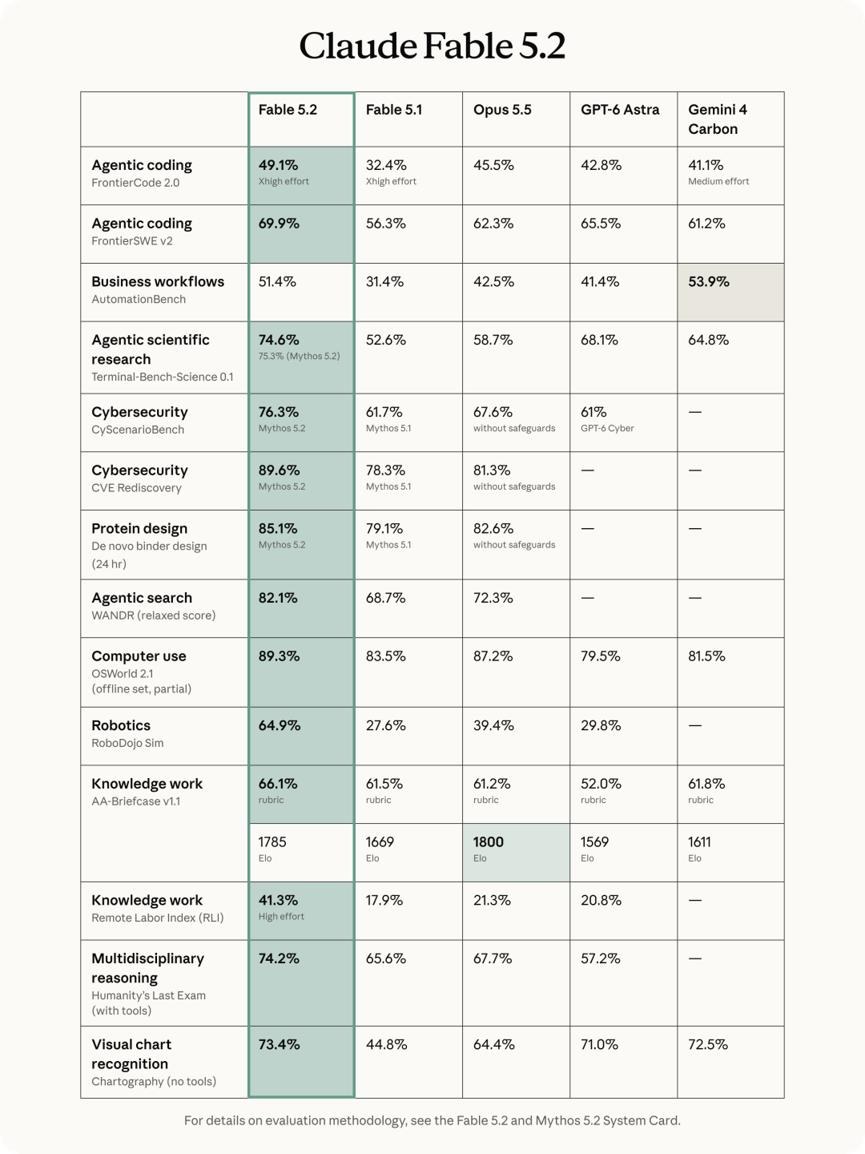
Anthropic’s Fable 5.2 raised the task success rate on the dual-arm simulation benchmark RoboDojo from 27.6% in the previous generation to 64.9%. Nvidia’s GR00T 2, a world-action model, reached a 95% average task success rate after five human demonstrations. The two numbers sit on different exams. One is simulated planning. The other is a filtered set of manipulation tasks. On a real robot, planning runs at about 1 to 2 hertz. A finger trying not to drop an object needs force control at 20 to 100 hertz.
64.9% is planning inside a simulation
Fable 5.2 was built for coding and reasoning. The report says a demo had it drive a robot arm to open a bottle cap and solve a cube, without separate training for those motions. It can form a step such as “grasp, then turn counterclockwise,” which is more flexible than a policy that memorizes one motion and fails when the scene changes. The official cube demo was not at real speed. An earlier note is in the Fable 5.2 demo.
In a third-party test on a real arm, a large model guiding checkers play had 14 slips or offsets. To pinch an object at the moment it starts to slide, the low-level force loop usually has to run at 20 to 100 hertz, a correction every 10 to 50 milliseconds. Fable 5.2’s planning loop is about 1 to 2 hertz, so “hold tighter” is updated once or twice a second. The piece is already sliding. The 64.9% was measured in a simulation without lighting interference or floor shake. Anthropic said it ran 18 real-robot tasks and did not publish the scores.
The 95% comes from 50 tasks chosen in advance
Nvidia’s white paper says the 50 Dexter manipulation tasks were selected, when the test set was built, from tasks on which the model reached at least 80% after five demonstrations. It also says the 95% is affected by that selection. Of the 50 tasks, only 37 succeeded on every trial. The other 13 still failed when tested again. What got cheaper is a filtered exam, not a line the robot has not seen.
GR00T 2 is kept at the execution layer and called through a WAM API by an upper reasoning model. The upper layer sets the task, orders the skills, and watches progress. GR00T 2 turns the intent into a grasp or an assembly move. After that connection, a YAM arm assembling three toys in a row reached 97%. That is a calling convention. What to do when the lower layer fails after the command, when the arm stops in mid-air, or when the delay stacks up is not written up as a deliverable method in the public Fable 5.2 or GR00T 2 material.
A factory counts downtime, not the leaderboard
A Morgan Stanley survey this November found that 82% of companies want payback within three years, and the average period they will accept is 26 months. Only 18% of adopters are satisfied with current robots, 5 percentage points lower than the year before. Expected deployments moved back by about a year. The report’s line is that frontier models can already generate robot actions with no task-specific examples, but cost, success rate, and latency still have room to improve. Without measurable evidence of productivity, companies will not add large orders.
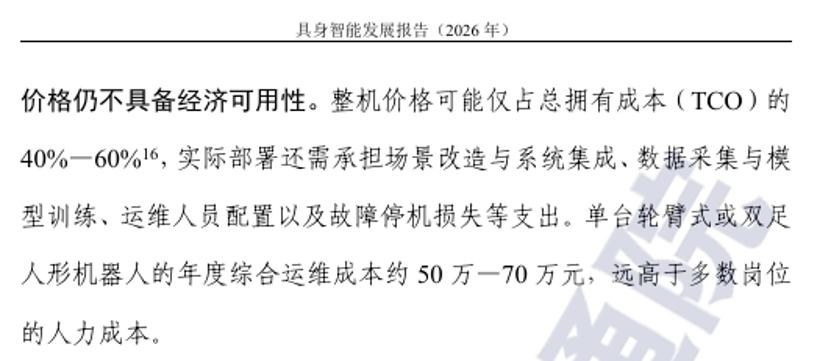
The China Academy of Information and Communications Technology, in its 2026 embodied-intelligence report, says the robot’s purchase price is only 40% to 60% of lifetime cost. The rest is rebuilding the cell, integration, data collection, model training, operators, and downtime. Cheaper early training does not touch that later bill.
Downtime already has public cases. Qualcomm said NEURA’s 4NE-1 humanoid fell at Computex Taipei in 2026 because a brief communication fault triggered a safety shutdown. On a booth that can be called a controlled fall. On a line it is a stop. Business Insider reported that OTTO mobile robots at Nissan’s Smyrna plant in Tennessee had sound hardware, but the software interface did not match Nissan’s material flow. Two robots were sent to the same spot and the line jammed.
Ai Wen, a project director in Zhiyuan’s Genie business, told Jiemian that a traditional factory allows 4% to 5% fault time in a day and can restart. Embodied intelligence is now scored on how long it can keep working. After a single-point fault, lasting at least a month is the passing line he described. Zhiyuan’s async dual system splits slow planning from fast execution. The slow system updates direction once or twice a second. The fast system runs dozens of times a second and makes local corrections from live sensing between those commands. Figure treats errors as normal. Low battery swaps the unit. A hardware or software fault sends the robot out of the cell and another takes over. On that arrangement it handled nearly 250,000 packages in 200 hours of continuous running.
On the commercial side, the report says Qingtianzu and others have started charging for results, and that China’s industry ministry is encouraging robotics-as-a-service priced on value, which moves reliability risk from the customer to the operator. Wang Xingxing has said the ChatGPT moment for embodied intelligence could come as early as 2027. Zheng Lingyin of Qianxun judges that 2026 to 2027 is the turn from storytelling to delivery. Those are their timelines, not results that have already happened.
FAQ
Q: Was the 64.9% measured on a real robot? A: No. It is the task success rate on the dual-arm simulation benchmark RoboDojo. The previous generation was 27.6%. Anthropic said it ran 18 real-robot tasks and did not publish the scores. A third-party checkers test on a real arm had 14 slips or offsets.
Q: Does five demonstrations and a 95% rate mean GR00T 2 can change lines? A: The white paper says the 50 Dexter tasks were chosen from tasks that already reached at least 80% after five demonstrations, and that the 95% is affected by that selection. Only 37 of the 50 succeeded on every trial. The article does not give a reliability number for a line that was not in the test set.
Q: Why are factories not placing large orders? A: In Morgan Stanley’s November survey, 82% of companies want payback within three years, the average acceptable period is 26 months, and only 18% are satisfied with current robots. The CAICT report says the purchase price is 40% to 60% of lifetime cost. Downtime, integration, and operations are still ahead.
相关文章