



Today AI (Huihe) said on October 21 it closed a first round of more than $200 million from IDG Capital, Tencent, Source Code Capital, Ant Group, Sequoia China, Transsion, Tongge Ventures and Shanghai Jiao Tong University’s Hanyuan Asset. The product is pitched as a “personal assistant”: after users authorize data and apps, it builds memory across ongoing chat and organizes help around the person, not tasks. Founder Qi Junyuan built Teambition and later shipped products at Alibaba and ByteDance; the team formed early this year and launched international then China versions from September 9. As Muse, Instinct and peers heated up Personal AI—Muse reportedly hit 5 million downloads in 22 days, faster than ChatGPT’s 56—the team used an interview to answer demand skepticism, why a standalone app, memory and proactivity, moats and monetization.
Beyond the check: apps training models
They say the vision is not only an app but training models—an interaction model that cuts unit intelligence cost while sounding and acting more like someone who knows you. Manus also launched a Personal Agent “Cue,” disclosed a >$500 million raise, and is training its own model. App companies climb upstream; model companies climb into apps; the border shrinks. Our earlier financing note: Today’s $200M+ round.
Ecosystem access remains hard: China has seen phone assistants blocked by ride-hailing, shopping and food-delivery partners; on September 20 Amazon limited Muse’s access and shopping as an “unauthorized AI agent.” Today launched in the U.S. first, then China about two weeks later, wiring Feishu, DingTalk, WeCom and TickTick—shipping early is treated as part of the competition.
Product bet: person-like, one session, mass users
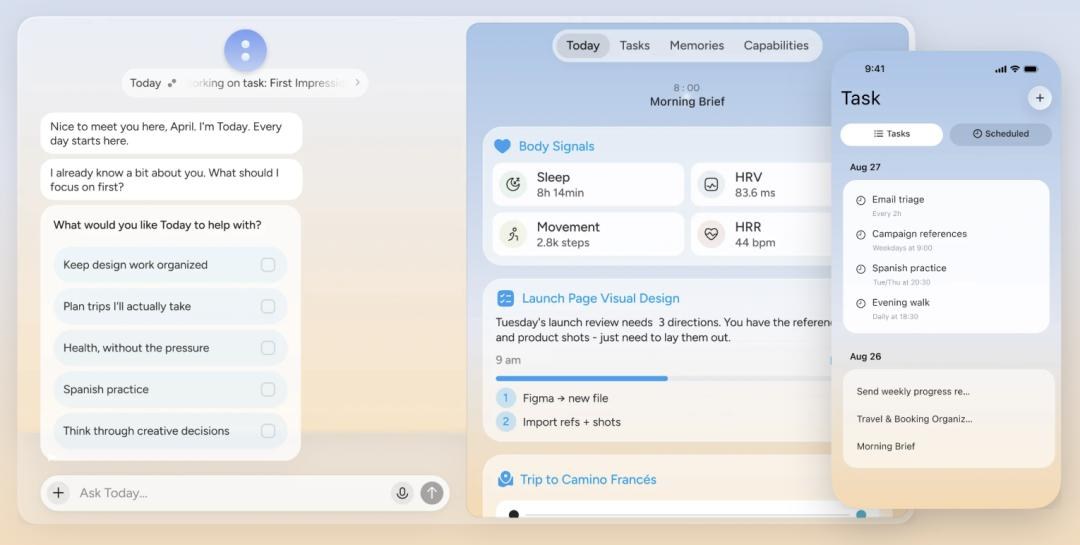
Unlike work agents that open a session per task, Today makes users name the assistant and keeps a single chat thread, arguing life goals need continuity that task windows cannot hold. In March they tried an Instinct-like “live inside IM, no app” path and hit two walls: without a GUI, mainstream users barely discover capabilities; without a client, some device permissions are missing. Technically they want an OS agent extensible across devices; for users the value is Personal AI—booking a flight is about the trip outcome, not necessarily driving a specific app.
The key design is lowering delegation cost—people skipped AI for tiny chores because restating context cost more than doing it. Memory comes from connectors (Feishu, health, calendar) and chat; proactivity is tuned by whether users reply or at least read, to avoid spam. They admit Personal AI run-cost is far above prior chat products; market chatter puts Instinct around $1–3 per day.
Moats, verticals, privacy
They are frank that the field is homogeneous: everyone sees memory and proactivity, and single features get copied. What they weight is the bundle—person-like UX, one session, usable by normals, long-horizon goals, proactive discovery—and switching friction from deep context. Vertical agents, they say, burned 80–90% of effort on shared infra and only ~10% on scene-specific tuning, so a general personal assistant should be the entry; ultra-special work stays vertical. Privacy: memories are visible and deletable, authorization is progressive, calendar and payments still need user confirmation; beta auth rates were high but skewed early-adopter.
On monetization they reject “only works overseas”: China context lives in Feishu-class apps, and users mostly want help with non-acquaintance chores, not WeChat social. U.S. free competition also makes subscriptions hard; they will explore subscriptions but fear shopping ads; the business model may not look like today’s. Calling yourself a pure “AI app company” worries them—you need model, engineering and infra, ideally a more human interaction model that can still execute. Claude Code and Cursor’s self-trained models are cited as the flywheel. Muse’s breakout context: Muse goes viral.
FAQ
Q: How is Today different from work agents? A: Work agents often spin a session per task; Today keeps one ongoing thread with memory and proactivity, aimed at mass users and long personal goals.
Q: Why insist on a standalone app? A: Without a GUI, ordinary users struggle to explore what the agent can do; without a client, some device permissions are unavailable. IM-only suits early adopters more than a mass market.
Q: After fundraising, is it only an app layer? A: No. The team plans to train its own interaction model to cut cost and raise quality, and expects pure app vs pure model companies to blur.
相关文章