



Unitree’s Wang Xingxing: Physical AI May Crack in 1–3 Years, but Alignment Still Blocks Contact
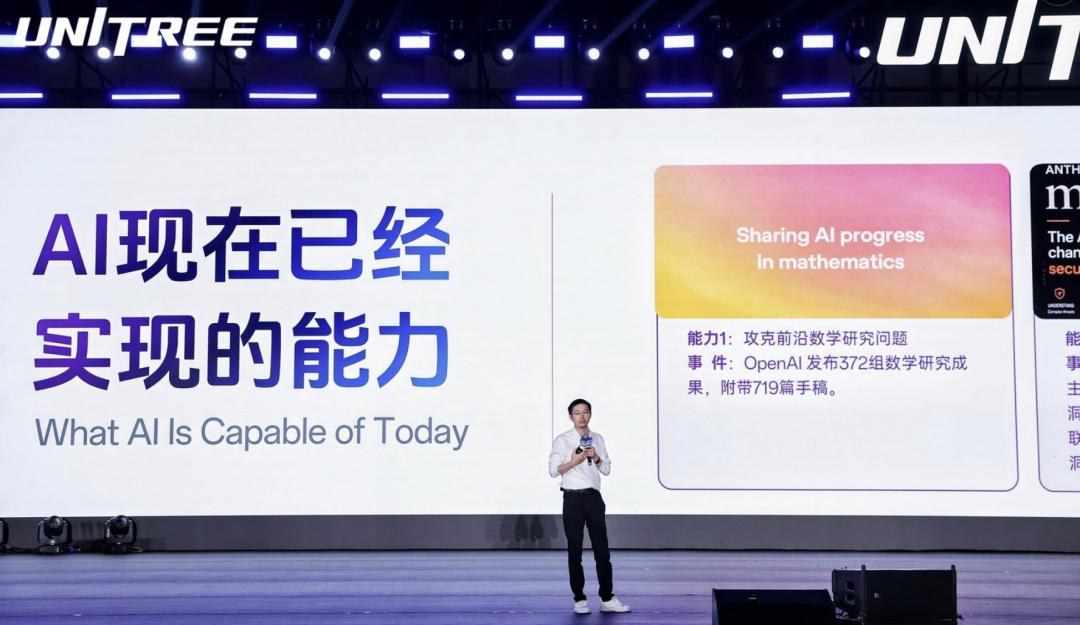
At the 2026 World Physical AI Conference and Unitree partner summit on October 22, CEO Wang Xingxing spoke under the title “Believe in AI—as much as possible.” He said that after GPT-6, physical AI already shows signs of a breakthrough in the next 1–2 or 2–3 years; the core barrier past a ChatGPT moment for embodiment is aligning model I/O with real robots—models can plan and navigate but have not solved what happens after physical contact; commercial-service use cases will land before home and industrial ones; and almost everyone, including himself, still under-invests belief in AI. The coverage reads that as a top vendor confirming mass commercialization is still years out.
Timelines move forward; the bottleneck words do not
His public clock has shifted often: at the 2025 World Robot Conference, “one to two or two to three years if things go well”; the day after the August 20, 2026 listing, “two to three years at best, five to ten at worst”; at the October 12 industrial fair, “even one to two years,” with GPT-7 possibly punching through next year; this week, back to “1–2 or 2–3 years” with a breakthrough “seedling.” Each frontier model release tends to pull the calendar forward; “alignment, generalization, error, retrain” barely change. He has said fixed-scene data can push success near 100%, small environment shifts crash it; grasps miss by centimeters to millimeters; factory pilots after two years still lag humans and need retraining per new task. Model hype moves the clock; physics holds the bottleneck. For his earlier “faith in AI keeps growing” remarks, see Wang Xingxing’s latest comments.
Capital flooded hardware; “not enough faith” means the brain
Unitree is described as the global No.1 humanoid by shipments, with about 32.4% share in 2025 and 10–20k G1 units off the line—one of the few profitable players. Matrix Partners’ Wang Huadong, an early Unitree backer, recalled visiting a Silicon Valley lab in March 2024 where eight Unitree robots still worked while other brands mostly did not, ranking Unitree with DJI among China’s rare absolute global leaders in a field.
Funding is extreme: IT Juzi puts China embodiment financing at about RMB 93.5 billion in H1 2026, more than all of 2025; an industry alliance clocked about RMB 31.5 billion globally in June alone and over RMB 30 billion again in August; XPeng Robotics’ >$900 million round reset China private-equity records for the sector. The piece argues most capital still buys whole robots, joints, dexterous hands and sensors—misaligned with Wang’s claim that the real fight is the embodied brain. At the industrial fair he called under-believing AI his biggest mistake over a decade. If the bottleneck is models and alignment, hardware-volume valuations get a second look.
Products stay in high-tolerance scenes; shipments show it
Just before the summit Unitree launched the H2-X “kung-fu guardian”: kicking in car doors, lifting vehicles, a 4-meter flip, ~8-hour claimed runtime, packaged for security and rescue. Versus Spring Festival martial arts and yangge, the piece says the motion is fiercer and the wrapping newer, but still high-tolerance, fixed-task, low-precision work. “Commercial service” here mostly means showrooms, mall tours, stage acts and security—billable, hard to scale across thousands of novel objects. At the Bund Summit, PoKe Robotics’ Xu Huazhe said GPT-6 Astra hit ~95% on robot-control tasks versus ~40% for the prior model, yet still failed chopsticks, box folding and laundry. IDC: nearly 25k humanoids shipped globally in H1 2026, with research/education, demos and government data-collection about 69%.
Capital cooled in spots: after June’s RMB 31.5 billion, July fell ~62% month on month; September saw only two >RMB 1 billion rounds. Exits already include Yinghe Robotics’ creditor meeting and unsold auctioned gear, DeepBlue wage disputes, CloudMinds layoffs, and Silicon Valley’s K-Scale Labs shutting with refunds. Unitree listed August 19 with a first-day market cap near RMB 444.9 billion, roughly halved in 11 sessions (~RMB 200 billion wiped), bottomed under RMB 180 billion mid-October, and recently sat near RMB 210 billion—still >350× 2025 non-GAAP net profit of RMB 591 million. UBTECH fell from a HK$90 IPO / HK$328 high to HK$40.8 (~87% drawdown) with a 2025 parent net loss of RMB 703 million. For the “who is No.1” and drawdown fight, see Unitree’s half-cut vs UBTECH.
FAQ
Q: What timeline did Wang give this time? A: After GPT-6, physical AI shows a breakthrough “seedling” in about 1–2 or 2–3 years, while alignment after contact remains unsolved and home/industrial scale stays later.
Q: What does “not enough faith” mean? A: In his framing, under-investment in AI / the embodied brain versus years of hardware focus—he includes himself and says strategy should weight models more.
Q: Why do commercial services land before homes? A: Closed venues, fixed scripts and high tolerance (shows, tours, security) can bill today; fine manipulation like folding clothes is still where alignment fails, and flagship products largely stay in the former.
相关文章