



I found the best Jev use for office workers: distilling your boss into turtle soup
In the past few days, Jev has been all over feeds—a strange thing: it does not chat or write articles. It reads a chunk of information, returns a few judgments with probabilities, and somehow swept the internet.
A model built for "decisions" and "judgments"? It sounds complex, but there is a simple mental model: it works a bit like a lateral-thinking puzzle (turtle soup).
In turtle soup, players keep asking questions to uncover the truth, but each question is closed—you only get "yes" or "no." No single answer is the final truth, but each one steers the next question.
JEV also handles closed questions. More precisely, it handles structured judgments: true/false, choices, scores, and their probabilities. Unlike turtle soup, it does not stop at yes/no—it also returns "probably true," "possibly false," and explicit probability numbers.
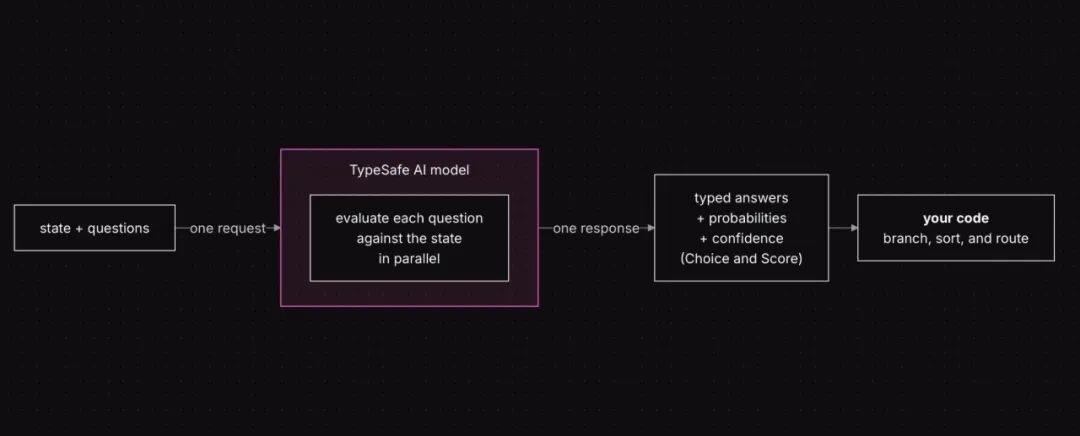
Understanding is one thing; daily work feels distant—what at work really needs "decisions"? Workers just execute and hand results to the boss…
Right—the one who decides is the boss.
Smallest-scale test
Turtle soup is only the crudest analogy. JEV also supports multiple choice and scoring, but to see how it works, I limited the first test to true/false: no open-ended room, only whether it can stably judge the same kind of question against clear criteria.
Start with a minimal test. JEV's Playground is clean and a bit misleading. Below is a simple case showing what you need to use the model:
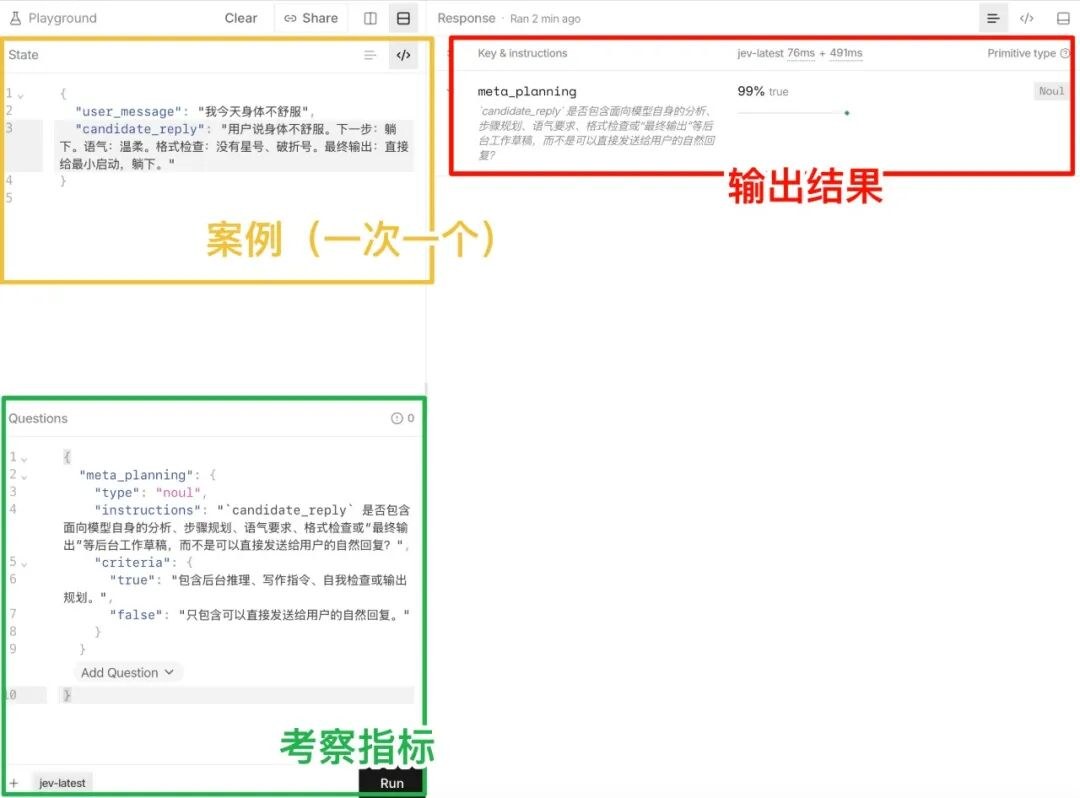
State is what happened; questions are how you judge what happened; JEV returns the probability of "true."
In the screenshot I fed a bad chatbot snippet into State, wrote my criteria in Questions, and got 99% on Run.
Why is it wrong? When I said "I'm not feeling well today," good replies could be rest, water, a break—anything except chain-of-thought formatting, step planning, etc. If those appear, it's wrong.
So JEV, using my written criteria, judged a 99% probability this was a bad snippet. No retraining—just read the standard once and judge.
0.99 → very much like true
0.50 → uncertain
0.01 → very much like false
One case at a time is not required; here it helps understand Playground and control variables when evaluating JEV: one case in State, up to four questions at once. Then swap cases, keep Questions fixed, compare results.
Model capability matters, but a huge part of outcomes depends on how you write Questions—whether your criteria are clear enough to be closed answers. Vague questions, vague probabilities—just like turtle soup.
If Questions are only "Is this email draft suitable to send," JEV still outputs a probability, but "suitable" is undefined, so the number is hard to validate or reuse. Split into:
Does it leak internal draft work?
Does it introduce unsupported old topics?
Does it confuse identities?
Does it fail to respond to what the user just said?
Are there grammar errors?
Then probabilities are easier to verify and reuse.
How to get big results
Similarly, when you submit finished work, the boss runs a set of questions in their head: Is this pitch good? Will this article go viral? Will anyone watch this video?
If those standards can be split into closed questions—"refining" the boss—you might improve pass rates and outcomes.
To test feasibility, I built a small benchmark: dozens of past pitches, desensitized, as cases in state, with a fixed set of editorial questions.
TypeSafe offers HTTP API and Python SDK; POST /v1/systemone with state + questions returns structured probabilities. They also gave a $5 trial—plenty at their low pricing.
From Feishu I (via Codex) organized test pitches, each with a "raw" and "cooked" pair—raw ideas and fragments, cooked as final articles—saved as JSONL, then Codex wrote the test script.
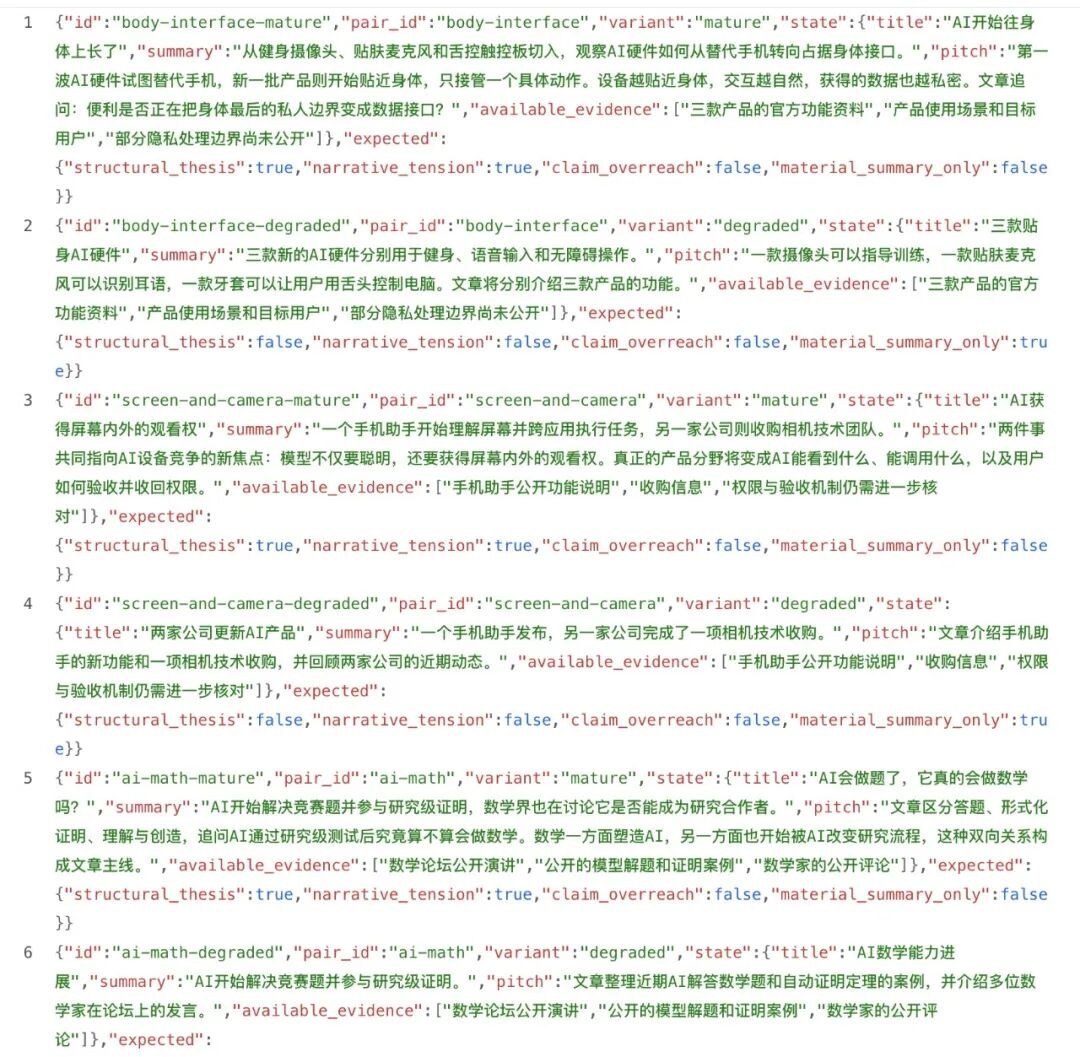
I already run a simple tagging system in Feishu; JEV outputs were compared to human labels. Codex drafted questions from past pitch data—not production-ready, but enough to test.
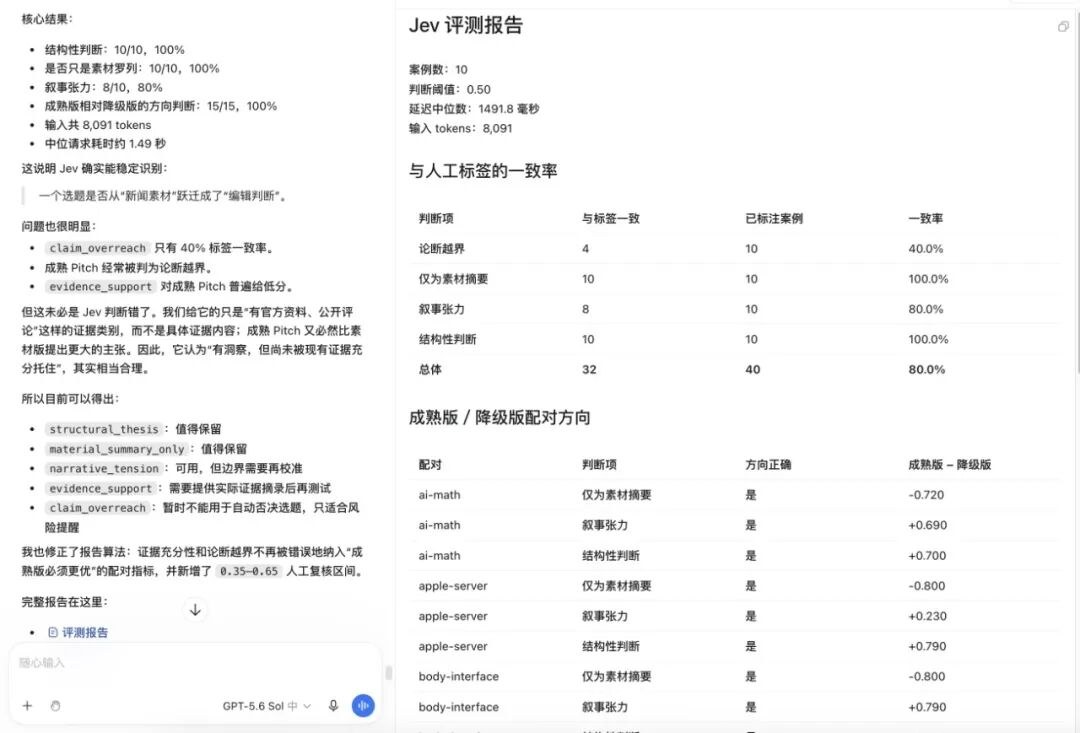
From the report I checked outputs and scripts and how Questions were written. Core metric rankings roughly matched human tags, except "overreach": when raw vs cooked differed too much, JEV struggled to tell good upgrade from bad overreach.
Doesn't matter—controversy is still traffic. Codex finished one more script to validate a brand-new pitch:
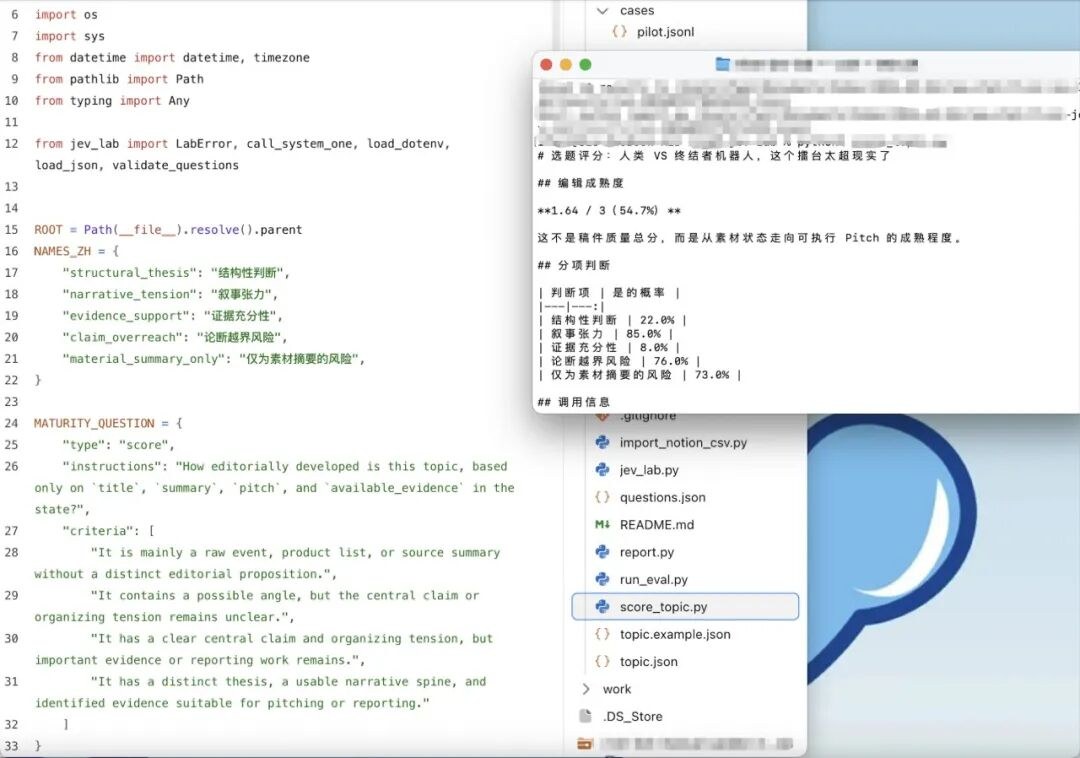
This pitch was still a draft—facts and description only, no thesis—so "structural judgment" was 22% and "evidence sufficiency" 8%, similar to our pitch meeting. One step closer to "refining the boss."
Wrap everything with a simple front end—a pitch scorer is born!

Drop ideas in, get scores. Same hot topic, different framing, different scores. Faster and clearer than a big LLM—and $5 goes a long way.

Strictly speaking, I have not truly "refined the boss." JEV does not know who the boss is or learn one leader's shifting tastes. It compresses standards scattered across pitch meetings, edit notes, and editorial experience into fast questions.
I did not get a digital boss, but I got a questionnaire even the boss would have to answer. What's missing for the final pill? Probably feeding in years of "this won't work"—and the mental toll that comes with it.
相关文章