



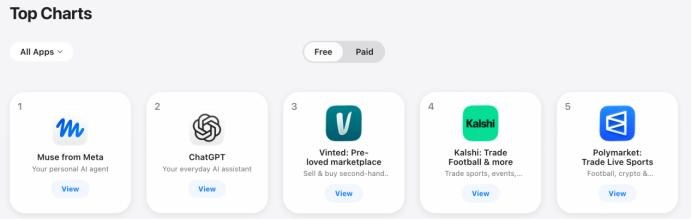
About 10 days after launch, Muse topped the U.S. App Store free apps chart—ahead of ChatGPT.
Around the same time, Manus—another flagship on the personal-agent track—was said to be raising a new round of about $500 million at a valuation near $4 billion.
Agents are giving frontier AI giants a path to leapfrog. Base models still matter, but on the agent track, product design, tool use, task execution, permission control, and user entry points are also the battlefield. Latecomers do not have to beat OpenAI and Anthropic on model leaderboards first; they can win at the application layer.
Meta is clearly taking that "shortcut."
Over the past year, catching up in the model race was not easy. It spent heavily, hired aggressively, and stacked compute—yet results ordinary users could feel remained limited.
With Muse, Meta finally has an AI breakout product of its own.
Why did Muse become a hit?
When Muse first launched, its feature list alone did not look especially unique.
It can browse the web, call tools, handle files, book hotels, send email, and shop—capabilities ChatGPT, Claude, and earlier Manus had already shown.
In principle, those features quickly hit privacy and permission boundaries; users have every reason to worry about agent security risks.
Ask it to manage your schedule and you open your calendar; ask it to read email and it enters your inbox; ask it to shop and it needs addresses, preferences, accounts, and payment details.
Prompt injection is another risk. As an agent browses pages and reads mail and files, it constantly touches outside information. If someone hides a malicious instruction that tricks the model into sending user data out, a high-privilege agent can carry the attack all the way into real accounts.
Building Muse, Meta admitted that no matter how well the model is trained, agents will err and can be attacked.
What set Muse apart is that it did not bet security only on a model that "obeys," but built a full permission system outside the model.

Simply put, Muse gives every user a dedicated computer in the cloud.
Think of it as a always-on remote PC (VM) that belongs only to you—with a browser, file storage, and the ability to run programs. Research, file work, and tasks Muse runs for you mostly happen inside that machine.
Your files, logged-in web sessions, and email/calendar connections are not mixed with other users. Even if Muse works for you long-term, it stays inside that isolated machine instead of roaming the whole system with elevated privileges.
Importantly, Muse living on that computer is not the true "admin."
Meta splits the system into two isolated security zones: Muse lives in one; the other holds truly sensitive pieces—login credentials, security services, and an independent security agent called Sentinel.
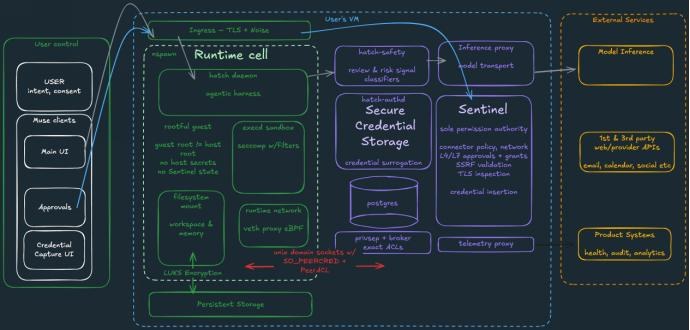
Sentinel specially approves network access and third-party services. Muse can request to send email or call accounts, but Sentinel decides whether to allow it. It can check which site and address Muse intends to hit, which request method, and what content is about to be sent.
Passwords and payments follow similar logic. Credentials sit in separate secure storage: Muse can use them but cannot see the contents; sensitive actions like sending mail or buying goods require another user confirmation. Users can also set per-connector permissions—for example, email read-only versus send as well.
Payments add another layer: after Muse connects Stripe Link, it can generate one-time payment cards so real card details are not exposed directly to the agent or merchants.
Layered safeguards limit how much damage Muse can do.
Only when users trust it—or trust that even if something goes wrong, the blast radius is limited—can it truly enter everyday life.
Security alone is not enough, of course.
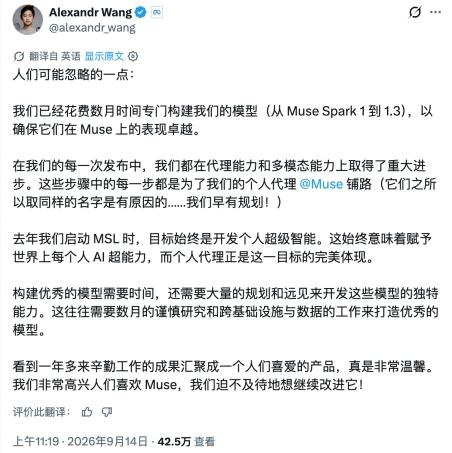
The model behind Muse is Meta's in-house Muse Spark. Alexandr Wang later said that from Muse Spark 1 to the latest 1.3, the whole series was prepared for Muse as a personal agent from day one, with each upgrade focusing on agent and multimodal ability.
Beyond the model, Muse sits inside Meta's product ecosystem.
It can connect Instagram and Facebook, and can be used directly inside WhatsApp.
Meta's official example: if you plan to host friends for dinner, Muse can browse recipe Reels you saved on Instagram, help pick dishes and build a shopping list, remember dietary restrictions, and send the invite.
Axios noted that Muse's rapid rise was not only about the model, but also things Meta has long been good at—turning complex tech into products ordinary people can use, pushing products to large audiences fast, and understanding what users like and need.
About 10 days after launch, Muse hit No. 1 on the U.S. App Store free iPhone apps chart, ahead of ChatGPT.
Meta's loud AI rebuild over the past year finally delivered a result ordinary users can feel.
No longer clinging to SOTA—Meta aims at personal agents
Over the past year, Meta's position among frontier AI companies was a bit awkward.
It spent the money, hired the talent, and stacked ever more compute. Lined up next to OpenAI, Anthropic, and Google, it still felt a step short—Google at least has cloud and a TPU ecosystem to back its AI map.
Meta long lacked a sufficiently convincing big win.
In 2025, Llama 4 disappointed, and the once-hyped Behemoth slipped again and again. Meta, which once rode open source into a wave, gradually fell behind in the SOTA model race.
So Meta began its rebuild.
In June 2025 it spent $14.3 billion for 49% of Scale AI and brought Alexandr Wang in to lead a new AI stack; then it formed Meta Superintelligence Labs (MSL), offered nine-figure packages, and hired heavily from OpenAI, Anthropic, and Google DeepMind, reorganizing AI teams multiple times within months.
Compute scaled with it: Meta's 2025 capex hit $72.2 billion, with 2026 guidance raised to $130–145 billion, plus gigawatt-scale AI data centers such as Prometheus and Hyperion.
In April this year, Muse Spark launched. Meta itself called it MSL's first model answer after nine months of "rebuilding the AI stack from scratch."
It helps to see Manus as a major inspiration for Meta's agent turn.
Last December Meta nearly acquired Manus outright. Manus was best known for stitching models, browsers, tools, and execution environments into a general agent that could finish complex tasks on its own. Regulators later forced the $2 billion-plus deal to be unwound, but Meta's willingness to pay that much already showed it thought the path was worth trying.
Meta did not keep Manus, but it kept the agent logic Manus represented.
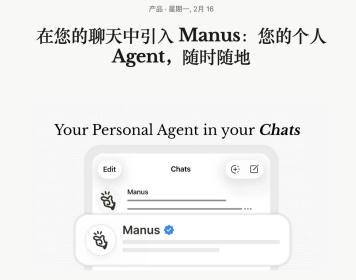
Ironically, Manus itself later moved toward personal agents. In February it plugged into Telegram; official docs said plainly: "Your personal Agent, anytime, anywhere."
An agent is the entry point for tasks. Ideally the user only states a need and the agent finishes the job—without caring whose model or tools sit in the middle.
Meta has not stopped training models, but it no longer waits to win model rankings before shipping products. Models become the base; agents become the more direct breakthrough.
The Muse Spark series aims squarely at personal agents; Muse the product proved the path can deliver striking results.
This lane is not niche—it is full of opportunity.
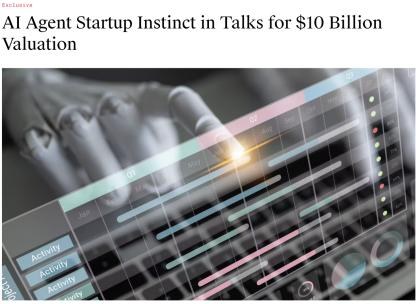
Beyond Muse, a personal agent called Instinct was chased by capital even before a full public launch.
Still invite-only, it can connect email, messaging, calendar, and location; shop, book restaurants, and cancel subscriptions; and recently began testing standalone email and phone calling. In late August it raised at about a $2.5 billion valuation; in September, The Information reported talks of another $1 billion raise that would push valuation toward about $10 billion.
"Choice beats effort"
Zoom out further and the old tech giants that once chased large models together are already splitting paths.
Google is one of the few still playing full-stack: compete on models, build agents, sell cloud, and make its own chips.
There were earlier rumors Google might quit top-tier model competition, but in recent days Arena showed a strikingly strong model labeled "gemini-3.8-flash," widely guessed to be unreleased Gemini 4 Pro. Meanwhile the Flash line updates about every three weeks; in September Google shipped Gemini 3.8 Live and 3.8 Live Extended Thinking back-to-back.
At I/O this year Google declared a "Search Agent era," with agents tracking information for users 24/7 in the background; Google Cloud launched the Gemini Enterprise Agent Platform. Underneath sit eighth-generation TPUs, Google Cloud, and a full AI infrastructure stack.
Microsoft and Amazon chose differently—concentrating advantage on enterprise services and AI infrastructure.
Microsoft still has MAI and Amazon has Nova, but models are no longer either company's top goal.
Microsoft now stresses a multi-model platform. Azure AI Foundry offers OpenAI, Anthropic, xAI, and Microsoft's own MAI models so enterprises can pick by quality, cost, and task. Latest earnings said customers using multiple models grew 5x this year; Foundry and Agent 365 wire those models into enterprise data, permissions, and agent systems.
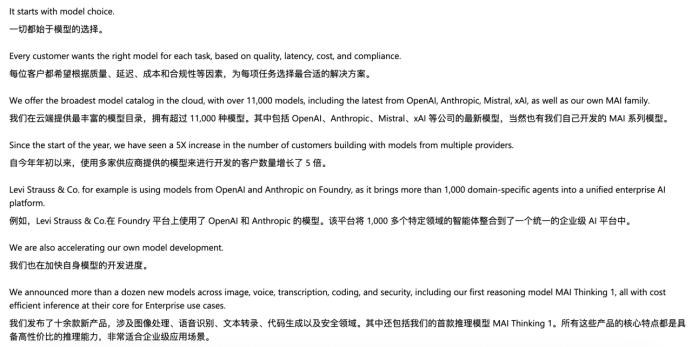
Rather than making its own model the strongest, Microsoft wants to ensure that whichever model wins, enterprises still run it on Azure.
Amazon's turn is even clearer.
In July it cut some AGI-team roles. That once-relatively independent AGI org had already been folded into a larger tech unit alongside chips and quantum; several core leaders including Rohit Prasad and David Luan left. Amazon said it was simplifying priorities and focusing resources where it creates most customer value.
Meanwhile AWS leans harder on Bedrock and AgentCore. Bedrock connects OpenAI models, Codex, and managed agents; AgentCore is explicitly model-agnostic—developers can swap models while AWS handles runtime, permissions, security, and monitoring.
The logic mirrors Microsoft: rather than racing hard for SOTA, make sure others' models and agents ultimately run on AWS.
Meta takes a third path.
It is also building giant data centers and even floated selling some AI compute externally this year, but unlike Google, Microsoft, and Amazon, Meta has no mature public cloud ready to absorb AI demand.
Meta's existing strengths sit elsewhere: billions of everyday users, social graphs, content recommendation, ads, and consumer entries like Instagram, Facebook, WhatsApp, and Threads.
In a SOTA model race those barely help; once the race moves to personal agents, everything changes.
A truly useful personal agent needs more than a smart model—it needs to know what you like, whom you talk to, and what you are about to do; it must enter the apps you use daily and stay with you over time.
Suddenly Meta's old strengths become AI capabilities.
Social ties become context; recommendations become interest understanding; billions of users become distribution; WhatsApp and glasses become more entry points.
That is why Muse matters. From Muse onward, Meta is no longer proving it still belongs at the frontier AI table only with money, chips, and talent.
It has a result it can put on the table—and it did not get there by copying what OpenAI does best.
Meta finally found a battlefield that fits its strengths.
In fact, China's three big tech firms also have their eyes on personal agents. Tencent, ByteDance, and Alibaba each have different built-in advantages—and all have made similar moves lately.
Unlike office agents that lean on workflows, personal agents aim to take over daily life.
On this battlefield, Tencent's strength is relationships and services. WeChat holds contacts, chat, payments, mini programs, official accounts, Channels, and tons of offline services—almost a native console if a personal agent is to handle life chores. The WeChat assistant "Xiaowei," now in gray release, already calls native WeChat features and mini programs to get things done.
ByteDance's strength is content, recommendation, and consumer AI entry points. Douyin knows what users like; Doubao already has large-scale users; Feishu holds work context; the latest Doubao phone assistant goes further into the system layer, operating the phone and cross-app tasks directly.
Alibaba's edge is commerce and business services. Taobao, Tmall, Alipay, Ele.me, Amap, Fliggy, DingTalk, plus Alibaba Cloud already cover shopping, payments, local life, travel, and work. Qwen is starting to string those services together so AI can search, order, pay, and plan trips; Ant's Afu enters from health, trying to manage personal health information over time.
On this path, who builds the biggest personal agent may matter less. As long as the giants race to finish tasks for users, the people who benefit are us.
相关文章