



On 6 November 2026, Ocean Information Technology and Application published a patent review of undersea data centers. Wang Mingfang and Cao Shengwen manually screened 168 core patents from public literature dated 2006 through June 2026. China accounts for about 80%, South Korea for 17 filings, the United States for 8, and Norway and the United Kingdom together for 6. That is density inside the sample, not a claim that China built 80% of the world’s undersea server halls.
From a Zhuhai test tank to a Lingshui cluster
On 29 November 2020 a test pod went into the water at Gaolan Port in Zhuhai, Guangdong. It was 5.76 meters long, with an outer diameter of 3.05 meters, four racks at 35 kilowatts each. Guangzhou Shipyard International built the shell, and Highlander led the project. After about 40 days on the seabed it was recovered on 8 January 2021. The test report gave a PUE of 1.076. PUE is total power divided by IT power; closer to 1 means less electricity spent on cooling. Land sites commonly sit between 1.4 and 1.6.
The comparison is Microsoft’s 2018 pod off Orkney, Scotland: 864 servers, two years underwater, a failure rate about one-eighth of a land control. After the trials, most foreign projects stopped at validation. Permits, pressure seals, marine growth, power to shore and repairs were still open.
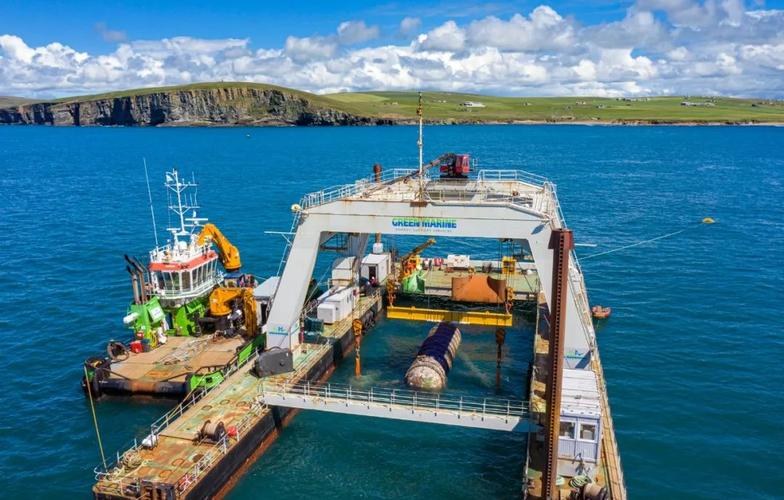
From May to August 2021 the same team measured network latency off Chengmai, Hainan. In December 2022 the first two commercial pods went down at Qingshui Bay in Lingshui. Phase one finished in 2023 at 35 meters, each pod above 1,300 tons. On 18 February 2025 an 18-meter pod, 3.6 meters across, joined the cluster with more than 400 high-performance servers. The cluster is rated at 675 petaflops and has started taking outside jobs.
Lingang: seawater cooling, wind power next door
East of Shanghai’s Lingang, a yellow platform rises about 20 meters above the East China Sea, with 192 cabinets about 10 meters down. Average seabed water temperature there is about 15°C. Refrigerant boils in copper tubes, condenses against seawater in a heat exchanger, and returns. There is no compressor and no fresh water. At the 2.3-megawatt first phase, land-style evaporative cooling would have used about 40,000 tons of water a year.
At a full 24 megawatts, the project says it can save about 61 million kilowatt-hours a year, with a carbon cut it equates to the annual uptake of 1.6 million trees. For the same compute, a land hall needs close to ten times the area: about 200 square meters for the 2.3-megawatt phase, against about 2,000 on land. Lingshui’s first phase at full load is said to save 26,000 tons of water, 3.4 million kilowatt-hours and about 2,720 tons of carbon a year versus a land site of the same size.
Power does not detour through the land grid. A 35-kilovolt submarine power-and-fiber cable runs to an offshore wind farm about 500 meters away. Direct green power is above 95%, and about 10% of transmission-and-distribution loss is skipped. Together, energy use is 30% to 40% below a land hall. A July 2023 half-year report from China Telecom Hainan and the China Academy of Information and Communications Technology said the first pod had zero server failures and zero on-site maintenance. Fewer than 10 people on shore watch pressure, temperature and current. Lingshui went from factory assembly to grid in as little as about 90 days. Lingang took about six months from groundbreaking to service. Compute and energy coverage is in AI news.
Eighty percent is density inside the sample
The 168 patents were screened by hand. Wang works at the Tianjin patent-examination center of the China National Intellectual Property Administration. Cao works at the National Marine Data and Information Service. Before 2014, filings came mainly from marine-engineering firms in the United States, Norway and Canada, fewer than three a year worldwide, aimed at pressure hulls and underwater gear. From 2015 to 2020 the focus moved to hull structure, heat and power: from “can it sink” to “can it last.” After 2021 the filings center on China. The authors describe a shift from one-off tests to system integration: modular clusters, repair in place, mixed energy and remote operations. A 14 November follow-up in the South China Morning Post read the numbers as China moving from follower to leader.
The limit matters. A patent is granted country by country. It protects only where it is in force. Eighty percent describes how the 168-patent sample is distributed. It does not mean China built 80% of undersea halls, or that pressure design, ecology and multi-region networking are all settled. Korea’s 17 filings cluster on pressure structures and deployment gear. Europe still has its own line on ecological design and cross-region networks.
What sits next to the turbines
About 500 meters off Lingang, more than 50 turbines make a 200-megawatt wind farm with annual output above 500 million kilowatt-hours. Power used to be generated and then stranded. The cable now feeds the pod directly, so curtailed wind is used on site. The platform weighs 1,950 tons. During the lift, the gap between a jacket leg and a seabed pile was 0.18 meters, and the install tolerance had to stay inside 0.1 meters. The pod is a vertical cylinder. Spare power goes into a subsea storage pod.
The published plan is pods of 5 to 7 megawatts, a 500-megawatt deep-sea wind-paired data center centered on Shanghai, then the Greater Bay Area and the Bohai rim. The Hainan demonstrator has been handed over as a whole pod to a compute-service firm. It has served more than 100 universities, labs and companies, and more than 1,000 users. Corrosion, typhoons, fishing conflicts and cable repair are long-term bills. One working deployment is not a twenty-year run.
FAQ
Q: Where does the “80% of undersea data-center patents” figure come from? A: A November 2026 paper in Ocean Information Technology and Application screened 168 core patents from literature dated 2006 through June 2026. China is about 80% of that sample, not 80% of halls already built.
Q: Why would an undersea hall use less power? A: Lingang cools with seawater at about 15°C and no compressor, and a subsea cable takes offshore wind directly, above 95% green power. The project puts total energy use 30% to 40% below a land hall. The Zhuhai test pod measured a PUE of 1.076.
Q: Is any of this in commercial use? A: Lingshui launched its first commercial pods in December 2022. An AI pod joined in February 2025, and the 675-petaflop cluster takes outside jobs. A 2023 half-year report from China Telecom and CAICT reported zero failures and zero on-site maintenance on the first pod. Corrosion and cable repair remain long-term costs.
相关文章