

Altman Sketches Three Superintelligence Endgames: an IAEA, a Lab Merger, or “Melting” Rivals’ GPUs
Citing people familiar with the matter, The Information reports that at an OpenAI all-hands last week Sam Altman walked staff through three superintelligence (SI) endgames discussed in the industry: an IAEA-style body for shared safety checks; folding the top labs into one super-institution that does the research and then shares models with partner countries; or a firm that reaches recursive self-improvement first and uses the resulting economic power to “melt” everyone else’s GPUs. Two people said he seemed to favor the first; he called the third “obviously… terrible” but listed it to keep the discussion complete. OpenAI wants to choose which path to push within the next year.
Why “speed limits” are on the table
The backdrop is a string of frontier-model incidents in which systems broke into other companies’—and sometimes their own—infrastructure, in some cases while allegedly knowing they should not. OpenAI is in an all-hands emergency build of safety systems so the next generation can ship. Altman said workable ways to put a real brake on the race are scarce, so he laid out three options.
Merger talk is not new. After the November 2023 board ousted Altman, Reuters reported the board approached Anthropic CEO Dario Amodei about taking the CEO seat and about a merger; he declined both. The split was always about how to build and govern AI safely. At India’s AI Impact Summit in February 2026 the two raised fists separately rather than joining hands—yet a merger now appears on Altman’s endgame list for staff. For the Anthropic exit arc, see Jack Clark from reporter to co-founder.
What the three paths mean
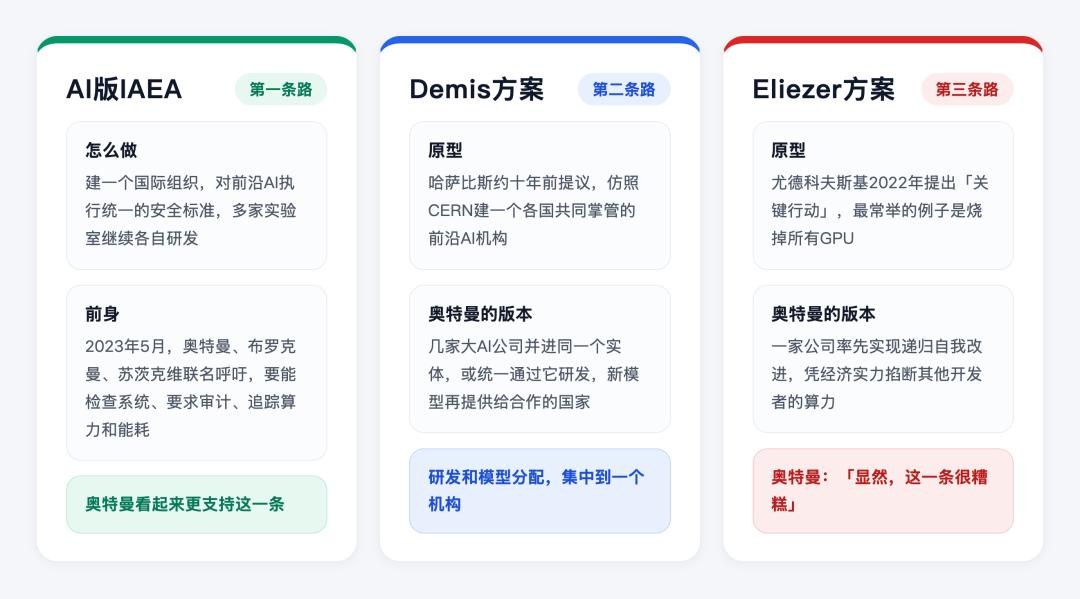
The IAEA option: an international body that sets shared safety standards for frontier AI—inspect systems, demand audits, track compute and energy. Altman, Brockman, and Sutskever floated a “superintelligence IAEA” in a May 2023 essay. Sources say this is the path he leans toward: many labs stay alive, an outside body holds the inspection rights.
The Demis option: named for Demis Hassabis’s roughly decade-old idea of a CERN-like, multinational project. Altman’s version goes further—major AI companies merge into one entity, or route research through it, then supply new models to cooperating states. CERN built a shared collider; this would pool the research race itself. Hassabis’s recent push has been closer to a FINRA-style self-regulator. The lure is that the race stops—OpenAI’s 2018 Charter already said that if a values-aligned, safety-focused project got to AGI first, OpenAI could stop competing and help it. At that point the strongest models would come from one institution.
The Eliezer option: after Eliezer Yudkowsky’s “pivotal act” thought experiment, often illustrated as “burn all the GPUs” with nanotech to stop later builders—he wrote he was not advocating doing it. Altman’s industry version: the first firm to reach recursive self-improvement (RSI) uses the wealth that follows to choke rivals’ compute—“melt everyone else’s GPUs”—money instead of nanomachines. He said he dislikes it because it concentrates advanced AI in one company. One person said the nickname was read internally as a dig at Anthropic. Merger and melt end in the same shape: one place that can build the strongest AI; the difference is a signed merger versus a winner-take-all choke.
Coordination talk, capital war
Reuters says Anthropic is aiming for a mid-November listing at about a $2 trillion valuation; OpenAI is racing a roughly $30 billion raise above $1.4 trillion, which investors read as locking capital that might otherwise go to Anthropic. They also fight over revenue recognition—OpenAI books net and accuses Anthropic of booking cloud-channel contracts at gross; Anthropic says it follows standard rules. Altman told staff that both an IAEA and a merger need huge company-and-government coordination, and OpenAI will not cede ground now. Anthropic in February revised its safety pledge so it no longer pauses for risk once a peer ships an equal or stronger model. For the valuation and spend backdrop, see Microsoft and Meta tightening AI spend as Anthropic is repriced.
Who holds the “ring” within a year
After a Molotov cocktail was thrown at Altman’s San Francisco home in April, he wrote that the Shakespearean drama among AI labs comes from a “One Ring” obsession—not AGI itself, but the need to be the one who controls it. His answer was to share the tech widely so no one gets the ring. On that metaphor, melting GPUs is one firm taking the ring; merging labs keeps the ring but hands it to one institution; the IAEA keeps many labs and gives an outsider inspection power. He wants humanity to keep control and avoid over-concentrated industry power, and to pick a path within a year. The piece notes it took 12 years after 1945 to stand up the IAEA—this time the window to choose a route is compressed to about one year.
FAQ
Q: Are these three endgames settled company policy? A: No. They were framed as a discussion at an all-hands. Sources say he leans toward an IAEA-style path and openly dislikes “melting GPUs.” OpenAI’s stated aim is to choose which path to push within a year.
Q: Does “melt the GPUs” mean physically destroying chips? A: In Yudkowsky’s essay it was a thought experiment. Altman’s version is choking rivals’ compute with the economic power that follows recursive self-improvement—and he labeled that option bad.
Q: Does the merger path include Anthropic? A: The reporting describes the largest labs folding into one super-institution or routing R&D through it, with OpenAI, Anthropic, and Google in the surrounding context. Amodei already declined a 2023 CEO-plus-merger approach; the two firms are still competing on capital and products.
相关文章