



OpenAI released LifeVal, a ~16-page living-agent benchmark that reframes AGI scoring from exam questions toward childcare, government services, and personal finance “getting things done.” Drawing on time-use studies across ~25 countries and willingness-to-pay surveys of 3,800+ U.S.-census-weighted consumers, it selected 148 high-value tasks and estimates Americans would pay ~$1.7 trillion per year for a perfect super-assistant on that set. GPT-6.2 Astra hype runs in parallel; Altman posted that people should always control the future and not hand the wheel to superintelligence. Benchmark math is research framing—not proof of serving 8 billion people. Related: next GPT and millennium problems; GPT-6.1 Terra.
Why Change the Ruler: From Bar Exams to Nannies, Taxes, Moves
OpenAI says AGI should help with the daily tasks people care about most—hence LifeVal as a first “personalized agentic consumer-task” benchmark. Methods combine BLS/multinational time-use data with WTP surveys, yielding scenarios like choosing a preschool after a move, managing volunteers before a flood, finding a home in budget, watching a remote game with grandma, cooking for a diabetic parent, summarizing 26-year brain-cancer records for a new doctor, hiring a full-time CPR-certified nanny at $25–30/hr, and booking Chicago–Geneva with credit-card points. The $1.7T figure is likened to South Korea’s GDP scale as a potential paid personal-services pool, not booked revenue.

How It Scores: Memory Drawers, Browser Agents, Dual Proctors
Tasks stress high value, high context, personalization, and agency. Evals can tap real ChatGPT history and memory (allergies, family health); an RL environment makes models open browsers, log in, filter, fill forms, and deliver PDFs. A GPT-5.6 “examiner” checks whether actions truly completed; an “anti-hacking examiner” zeros shortcut cheats; plus ≥3 human expert review rounds. High scores are rhetorically compared to a $20k+/month private secretary—not a salary study.

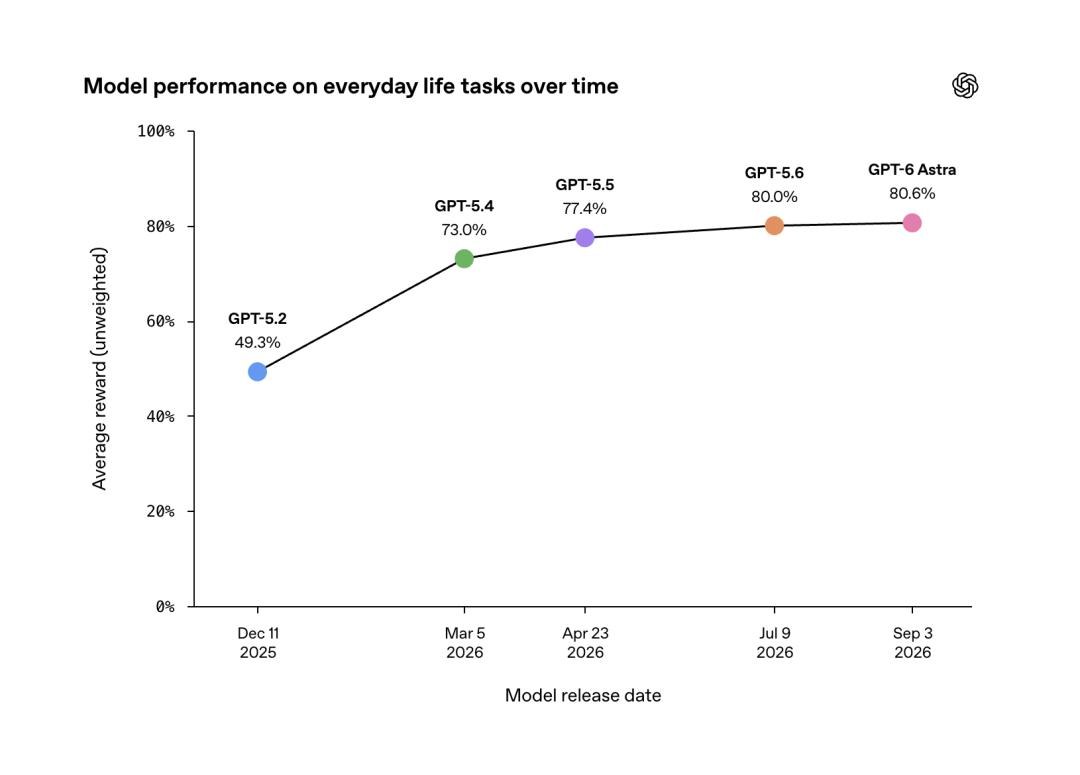
Model Curve: GPT-5.2→GPT-6 Astra; Wrong Advice Still Hurts
Page 7 reports LifeVal across GPT-5.2/5.4/5.5/5.6 and GPT-6 Astra: 5.2 often failed on token exhaustion; 5.4–5.6 jumped after computer-use, browser, and connector training; Astra looks steadiest on private context and multi-site flows, yet still errs with bad info/advice; stripping extra user background causes cliffs—long-history recall remains hard. GPT-6.2 Astra is cast as the next fix—await official GA. Altman’s “humans keep control” line sits beside a product push into real life and machine control: assistants may cut administrative burden for low-income households, or concentrate finance/health/family data and auto-pay power in one stack. More: AI News.
FAQ
Q: Is $1.7T an OpenAI revenue forecast? A: No—it’s an aggregated U.S. consumer willingness-to-pay estimate for perfectly completing the 148 life tasks.
Q: What does LifeVal measure? A: Personalized, high-context agentic errands (browser ops, memory use, multi-site workflows)—not bar/olympiad exams.
Q: How does that square with “humans should control the future”? A: Product aims to enter lived computer use; governance insists control stay with people—the tension needs permissions, audit, and user choice.
相关文章