



Teaching AI to Hear Music: 30 to 45 Dollars an Hour Abroad, a Few Thousand Yuan a Month at Home
An AI can generate a song without hearing what the song is doing. The report calls the layer in between music annotation. Some people mark rhythm, chords, and instruments. Others say where a generated track fails, then turn those errors into feedback a research team can use. Overseas, the AI hiring platform micro1 is recruiting music teachers, players, and producers for model training at 30 to 45 dollars an hour. In China, basic annotation and intern roles commonly pay a few thousand yuan a month.
A hit and a TV show put the argument on stage
In October 2026 the AI song Guolairen spread. Figures including Du Fu, Su Shi, and Liu Bang rap about mortgages, work, and middle age. Some listeners said it was obviously AI. The maker, Wang Kunzhe, did not hand the whole song over. He built a lyric frame, let the model try combinations, generated several versions, then chose, cut, and rearranged them himself.
Jiangsu TV’s Music Fate Project 3 sells original songs and the stories behind them. In the first episode a musician said the track used AI, but that the lyrics were their own. After hearing it, Xue Zhiqian said he could follow the words and that they felt familiar. Many viewers thought the lyrics fused several of his songs. The argument is not whether the song is pleasant. It is whether a track that leans heavily on AI should compete with original work on a show built around originality. Coverage of generated music is in AI news.

Labeling existed before generation made it finer
In 2018, four years before Suno, Liu Xiaoguang started working on how a machine could hear music. He has a chemistry doctorate from Tsinghua and is also a producer. His company, DeepMusic, began with music data, not with asking a machine to write songs first. A recent Hubei Daily report on Yaosheng Shuzhi in Wuhan quotes its head, Huang Binyao. Annotators listen for key and tempo, judge the harmonic direction, measure the beat, split the song into sections, and name the instruments section by section: violin here, brass and woodwind there, strings underneath. A wrong lyric, a wrong instrument, or a rhythm that does not match can all be marked.
Before generative tools, platforms already tagged huge catalogs as pop, sad, or rock, mostly for search and recommendation. After Suno and Udio, a model also has to learn chords, rhythm, arrangement, and structure, and to judge whether its own output is wrong. The jobs split into taking apart the basics, judging whether melody, lyrics, and arrangement make sense, and sorting the errors for the research team.
Three ways to charge, and rights are the expensive layer
In 2023 Liu said large companies were buying data from them for music generation and recognition. Tencent Music is a strategic investor. DeepMusic put AI arrangement into WeSing and shipped a style-change feature. Users had played AI accompaniments more than 300 million times, and the company still lists that as a case.
The first business is labor. If a lab needs 100,000 songs labeled and does not want a standing music team, a data vendor hires the annotators, sets the rules, assigns the work, checks it, and delivers the set. The lab buys the project. That is ordinary labeling outsourcing.
The second is judgment. Before a new model ships, musicians listen blind. The same lyric goes to two models. They score melody, arrangement, vocal, and style match, then separate a bad melody from a missed instruction. MusicEval, included at ICASSP 2025, collected 2,748 clips from 31 AI music models, had 14 music experts score them, and ended with 13,740 ratings.
The third is the data package. Audio, structure, labels, text, and the right to use them are licensed together. Rightsify’s GCX platform licenses sets that have been cleaned, labeled, and cleared. The catalog is more than 4.4 million hours of audio and 32 billion text pairs, over 3 petabytes. Price depends on size, complexity, use, and term. GCX says the rights come from commissioned work and that it offers a commercial license.
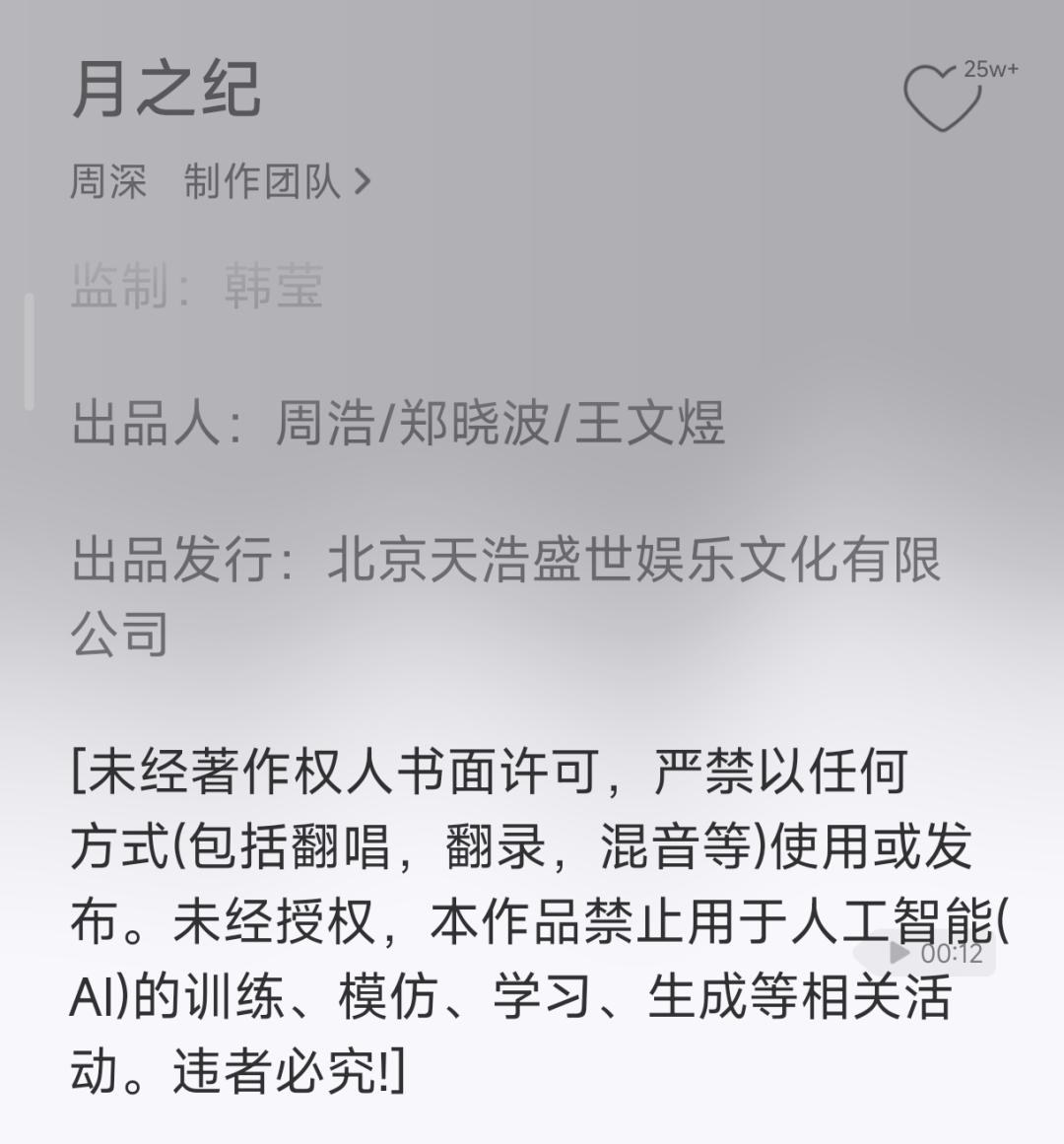
Where the music comes from is the dispute in that layer. The report says an original musician in Shandong got a call from an AI sampling company that wanted his tracks for training. Others posted new songs in a group chat and saw them clipped and regenerated, then went to court. Major labels have the resources to fight. Most working musicians do not. When Zhou Shen released Moon Chronicle, he stated that the work may not be used for AI training, imitation, learning, or generation without permission.
People are still teaching, and machines already hear part of it
DeepMusic’s UMP Board could automatically label 400,000 songs by 2023. Early automation mostly replaced standardized fields. On 1 May 2026, MOSI.AI, OpenMOSS, and the Shanghai Academy of AI for Science open-sourced MOSS-Music: two 8-billion-parameter models and a pipeline that starts from raw audio, extracts features, splits songs, reads lyrics, cleans metadata, and writes descriptions and training samples. Scoring those descriptions is also being tried with another large model.
There are two routes. One breaks music into structure a system can name, as UMP and MOSS-Music do, and still wants finer data. The other is end-to-end generation, as in Suno: a paragraph of text comes back as a full track, which can mean less song-by-song hand labeling. Both still need quality control and a judgment of the result. The report’s conclusion is that annotators move toward setting the standard, handling hard cases, and correcting the model, while basic recognition goes to the machine.
Supply is already far ahead of listening. Deezer said that in June 2026 it received about 90,000 AI-generated songs a day, and that at the peak these were more than half of new uploads. In October it said that from January 2025 through August 2026 it had kept more than 42 million AI songs out of algorithmic and editorial recommendations. Those songs account for 1 to 3 percent of plays on the platform.
FAQ
Q: What does a music annotator mark? A: Key, tempo, harmony, beat, and sections, plus instruments such as violin, brass, woodwind, and strings, and also wrong lyrics, wrong instruments, and rhythms that do not match. On generated tracks they also judge melody, lyrics, and arrangement.
Q: How does the business charge? A: Labor is project outsourcing. Judgment is blind listening and error analysis. MusicEval is that kind of test. Data sales bundle the audio, the labels, and the right to use them. GCX’s set is more than 4.4 million hours of audio.
Q: If machines can label automatically, are people still needed? A: UMP had auto-labeled 400,000 songs by 2023, and MOSS-Music can build training samples from raw audio. The structured route still wants fine data. End-to-end generation can reduce song-by-song hand labels. Quality control and scoring the result are still done by people.
相关文章