


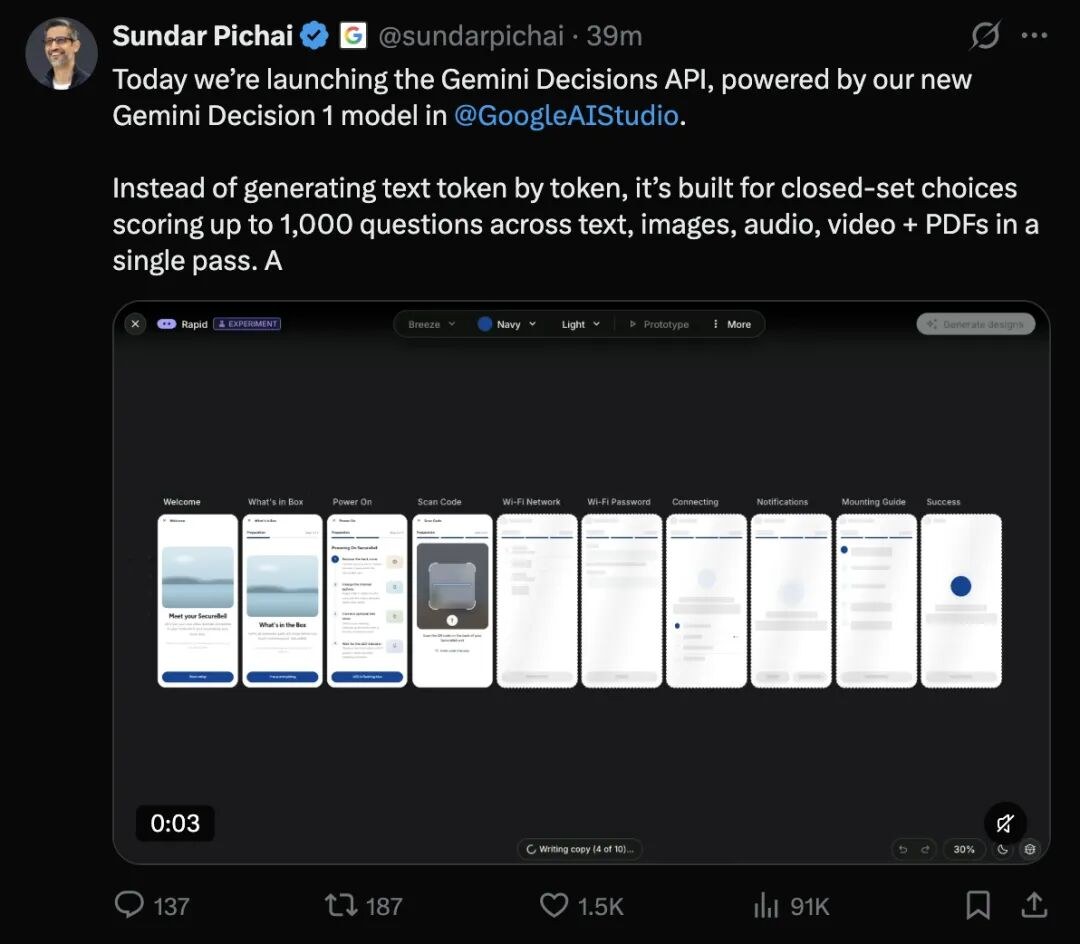
Google launched Gemini Decision 1 and the Gemini Decisions API in Google AI Studio: a model built for closed-option decisions that scores candidates in one forward pass instead of decoding long token streams. Per Google, a single request can score up to 1,000 questions across text, image, audio, video, and PDF; input is about $0.10 per million tokens with free output, end-to-end latency about 150–250 ms, and it took 7 of 9 published head-to-heads (peak 92.2% on JevBench).
Why it matters: peel judgment off the generative path
Spam checks, agent tool picks, policy triggers—teams often call a generative model and parse prose. Decision 1 returns the choice, probabilities, and confidence directly. CEO Sundar Pichai highlighted three modes: yes/no, multiple choice (up to 255 options), and rubric scoring, mixable with multimodal inputs in one call.
That fits the same stack story as our note on Gemini 4 Carbon’s global open and /swarm: flagship generators do heavy lifting; a cheap decision layer owns routing and gates so cost and latency stay in check.
Limits: 256K context, confidence for human review
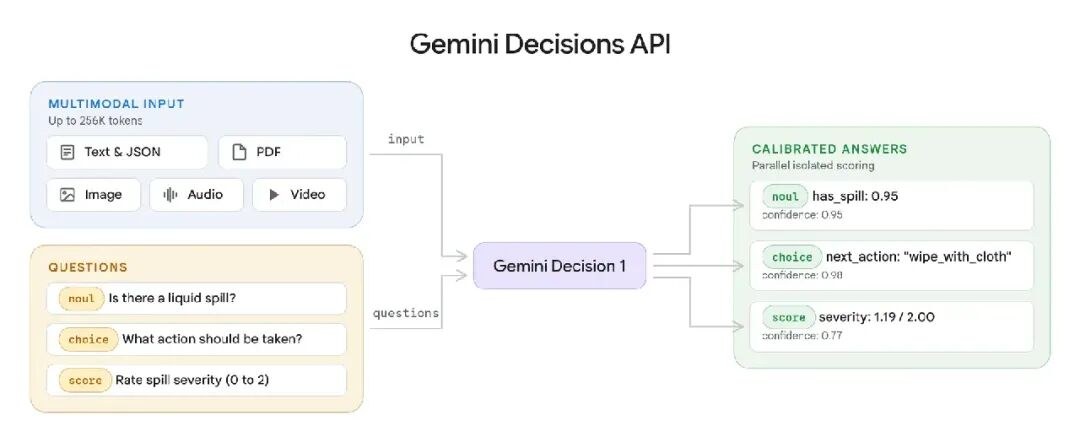
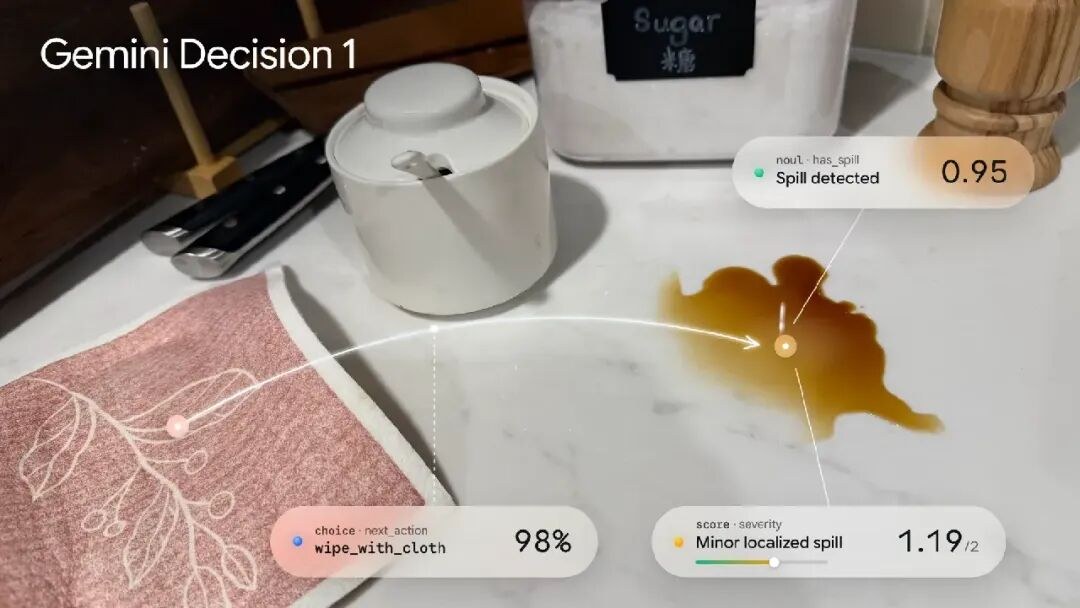
Tasks can mix in one request (e.g., spill yes/no, cleanup choice, severity score on a kitchen photo). Context tops about 256K tokens for enterprise bundles like call audio + CRM notes. Each decision carries a 0–1 confidence so uncertain cases escalate—aligned with our write-up on managing Coding Agents: delegate work, keep acceptance gates.
Speed: median compute ~50–100 ms under 16K tokens; end-to-end ~150–250 ms, largely flat from 1 to 100 questions. On Google’s shared suite, Decisions API cost is nearly 5× lower than Gemini 3.5 Flash-Lite via the Interactions API.
Scorecard: seven wins, tool-calling still contested
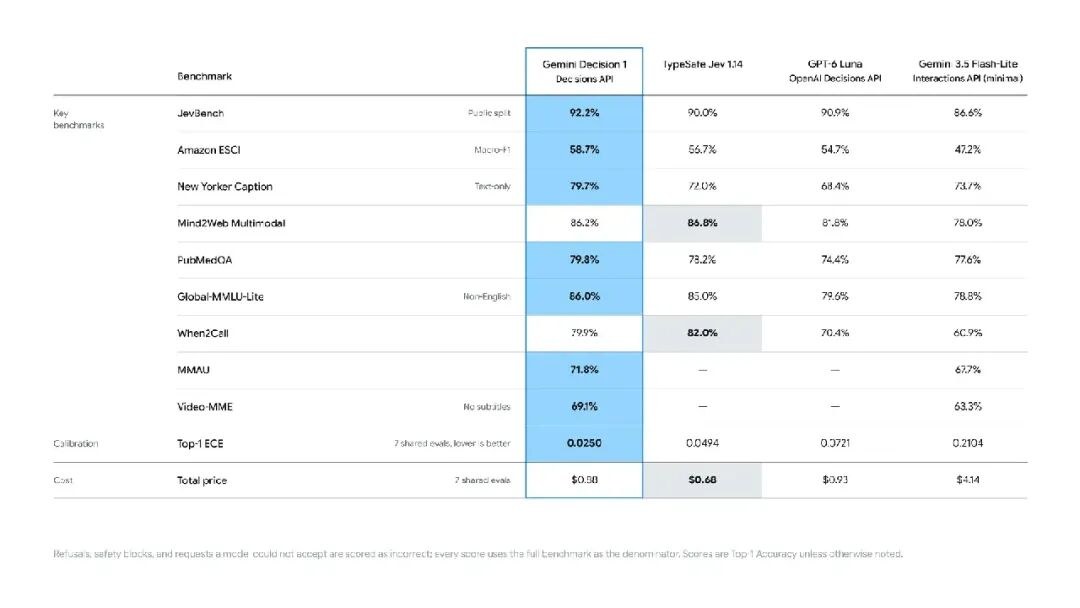
Comparators include OpenAI GPT-6 Luna, specialist TypeSafe Jev 1.14, and Flash-Lite. Google’s numbers:
– JevBench 92.2% (vs Luna 90.9%, Jev 90.0%, Flash-Lite 86.6%) – Amazon ESCI Macro-F1 58.7%; New Yorker Caption 79.7%; PubMedQA 79.8%; Global-MMLU-Lite 86.0% – Mind2Web Multimodal and When2Call still favor Jev 1.14 (86.8% / 82.0% vs 86.2% / 79.9%)—notable because tool timing is a core agent job – Top-1 ECE about 0.0250, well below Luna (0.0721) and Flash-Lite (0.2104)
Already inside Google products
Gemini Notebook uses Decisions API as a live model router—cheap/fast models for simple queries, stronger ones for hard reasoning—claiming up to ~40% lower latency on routine asks. Stitch’s Rapid Canvas drafts interactive wireframes in seconds; Labs’ CC picks among 200+ emoji; Search builds an MCP tool safety layer. The bet: a standing decision component in the agent stack, not another essay-then-parse loop.
FAQ
Q: How is Decision 1 different from chat Gemini? A: It scores closed options in one forward pass and returns probabilities/confidence instead of generating long answers token by token.
Q: What jobs fit? A: Yes/no, multi-choice up to 255 options, rubric scores, plus agent routing, tool selection, and content-safety gates with clear options.
Q: Did it sweep every bench? A: No. Google reports 7 of 9 firsts; TypeSafe Jev still leads on Mind2Web Multimodal and When2Call.
相关文章